
Legionnaires’ Disease Risk Assessment
A Legionnaires’ disease risk assessment examines how an organisation’s water systems could expose people to Legionella bacteria, identifies vulnerable individuals and specifies control measures. It supports informed prevention, documented responsibilities and compliance with relevant UK health and safety requirements.

Technical and Regulatory Considerations in Legionnaires’ Disease Risk Assessment
A Legionnaires’ disease risk assessment is a structured review of water-system design, use and management. It considers features such as storage vessels, distribution pipework, temperature control, outlets, dead legs, showers and thermostatic mixing valves, alongside maintenance records and the way the premises are occupied.
A technically sound assessment should distinguish between hazards that are present and controls that are actually effective. The assessor may identify sampling requirements, remedial work, monitoring arrangements or weaknesses in management procedures, while recording the reasoning behind each recommendation. This provides a practical basis for reducing Legionella risk rather than treating the document as a one-off inspection.
Under UK health and safety responsibilities, the dutyholder must appoint a competent person, implement suitable control measures and retain appropriate records. Blue Fish Water Management applies the principles set out in HSE guidance, including ACOP L8 and HSG274, to produce clear assessment findings that can support ongoing management, review and audit.
The Legionnaires’ Disease Risk Assessment Process
A practical Legionnaires’ disease risk assessment engagement should move from clarifying site use and client requirements to reviewing available information, carrying out agreed work, documenting findings and identifying proportionate follow-up actions where needed.
- 1
Confirm Scope and Responsibilities
The engagement starts by confirming the premises covered, how the water systems are used, who may be exposed and the dutyholder’s requirements. This establishes the assessment boundaries and identifies relevant responsible persons.
- 2
Review Existing Information
Available schematics, asset registers, previous assessments, monitoring records, maintenance reports and incident information are reviewed before the site work. Gaps or inconsistencies can then be identified for checking during the assessment.
- 3
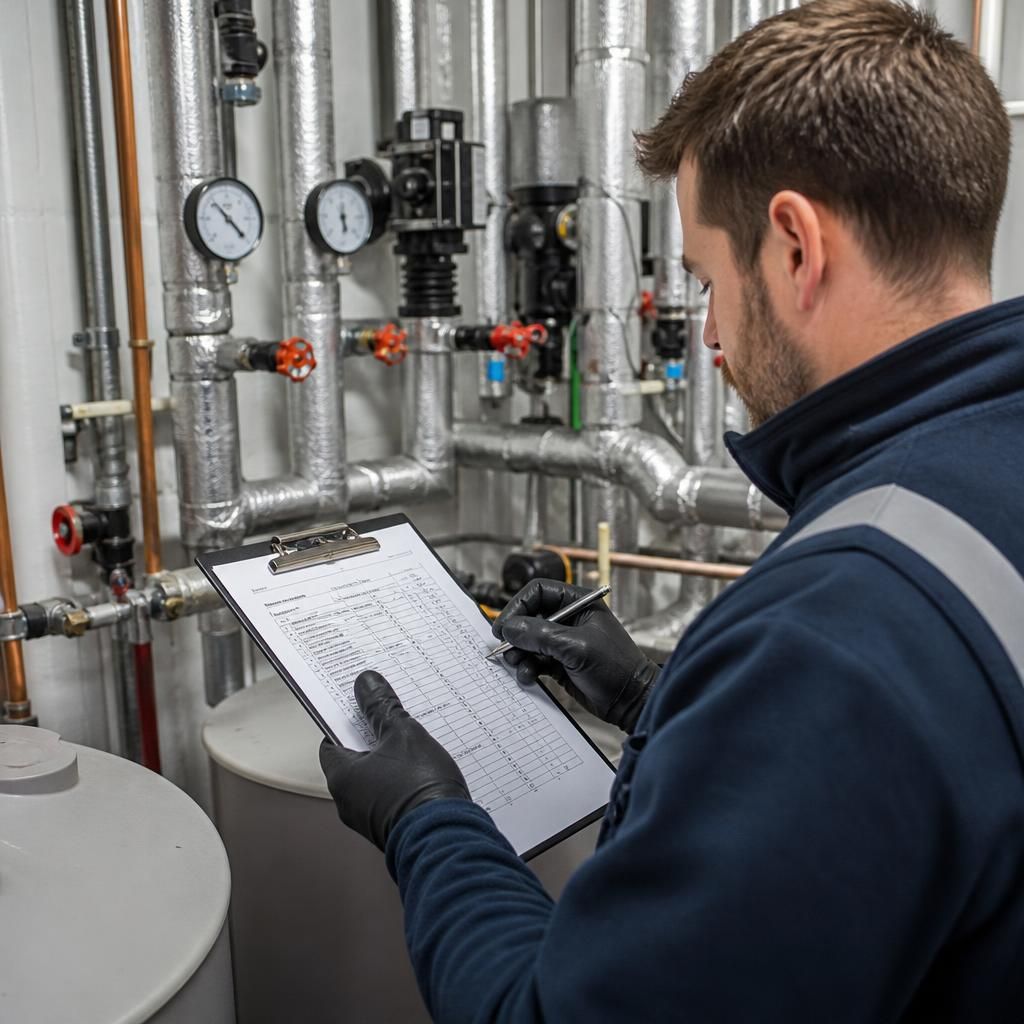
Inspect the Water Systems
The assessor examines relevant plant, storage, distribution pipework and outlets in their operational context. The inspection considers system condition, accessibility, temperature management, infrequently used outlets and other features that may affect Legionella risk.
- 4
Assess Exposure and Controls
Findings are considered alongside the people using the premises, including anyone who may be particularly vulnerable. Existing control measures are assessed for suitability, implementation and consistency, rather than being accepted solely because they are documented.
- 5
Record Findings and Recommendations
The completed assessment records identified hazards, existing safeguards, areas of uncertainty and the reasoning behind any recommendations. Actions are prioritised according to the nature of the risk and the evidence available.
- 6
Identify Follow-Up Requirements
Where necessary, the assessment sets out next steps such as further investigation, water sampling, remedial work, revised monitoring or management actions. Responsibilities and review requirements should be clear so the findings remain useful after the assessment is issued.
What the Completed Risk Assessment Report Includes
A completed Legionnaires’ disease risk assessment report is the formal record of the work undertaken and the evidence used to reach its conclusions. It should identify the premises, relevant water systems, assessment date and scope, and name the competent assessor responsible for the technical review.
Good reporting links each significant observation to supporting evidence, such as site notes, photographs, asset information, schematic drawings, temperature records or maintenance documentation where available. Technical findings should explain why a condition matters, rather than simply list defects.
Recommendations should be prioritised according to the nature of the finding, with a clear action and responsible role recorded where appropriate. The report should also state assumptions and limitations, enabling the dutyholder to demonstrate what was examined and use the assessment within ongoing management.
Questions About Legionnaires’ Disease Risk Assessments
What happens if a Legionnaires’ disease risk assessment identifies significant risks?
A Legionnaires’ disease risk assessment cannot cure infection; it identifies environmental prevention measures. Suspected cases require prompt medical diagnosis and treatment, guided by healthcare professionals instead of site controls alone.
Read moreWho needs a Legionnaires’ disease risk assessment?
Any organisation responsible for non-domestic water systems where people may be exposed to aerosols needs one, including employers, landlords, healthcare providers, housing operators, facilities managers and other dutyholders.
Read moreHow often should a Legionnaires’ disease risk assessment be reviewed?
Review frequency depends on site circumstances: reassess after significant water-system changes, incidents, control failures or changes in use, and periodically where conditions remain stable, following competent-person advice and current guidance.
Read moreHow much disruption does a Legionnaires’ disease risk assessment cause?
A competent assessment is usually planned around site operations, with access arranged to relevant plantrooms, outlets and records. Temporary restrictions may apply during inspections, temperature checks or sampling where necessary.
Read moreWhich standards apply to a Legionnaires’ disease risk assessment?
Relevant standards include HSE’s ACOP L8 and HSG274 guidance, alongside applicable health and safety duties. The assessment should interpret these requirements according to premises, systems and risks identified.
Read morePractical Expertise
Blue Fish Water Management provides consistent, pragmatic advice and dependable legionella assessment delivery, tailored to varied property types and requirements.
Discuss Your Legionnaires’ Disease Risk Assessment Requirements
Discuss your site’s circumstances with Blue Fish Water Management to clarify whether a Legionnaires’ disease risk assessment is appropriate, define the required scope, and agree practical next steps based on your premises, systems and management arrangements.