
What should a Legionella test kit result include?
A Legionella test kit result should state the bacteria level detected, the sample location and date, the testing method used, and any relevant interpretation. It should also explain recommended next steps, particularly where Legionella is detected or the result is inconclusive.
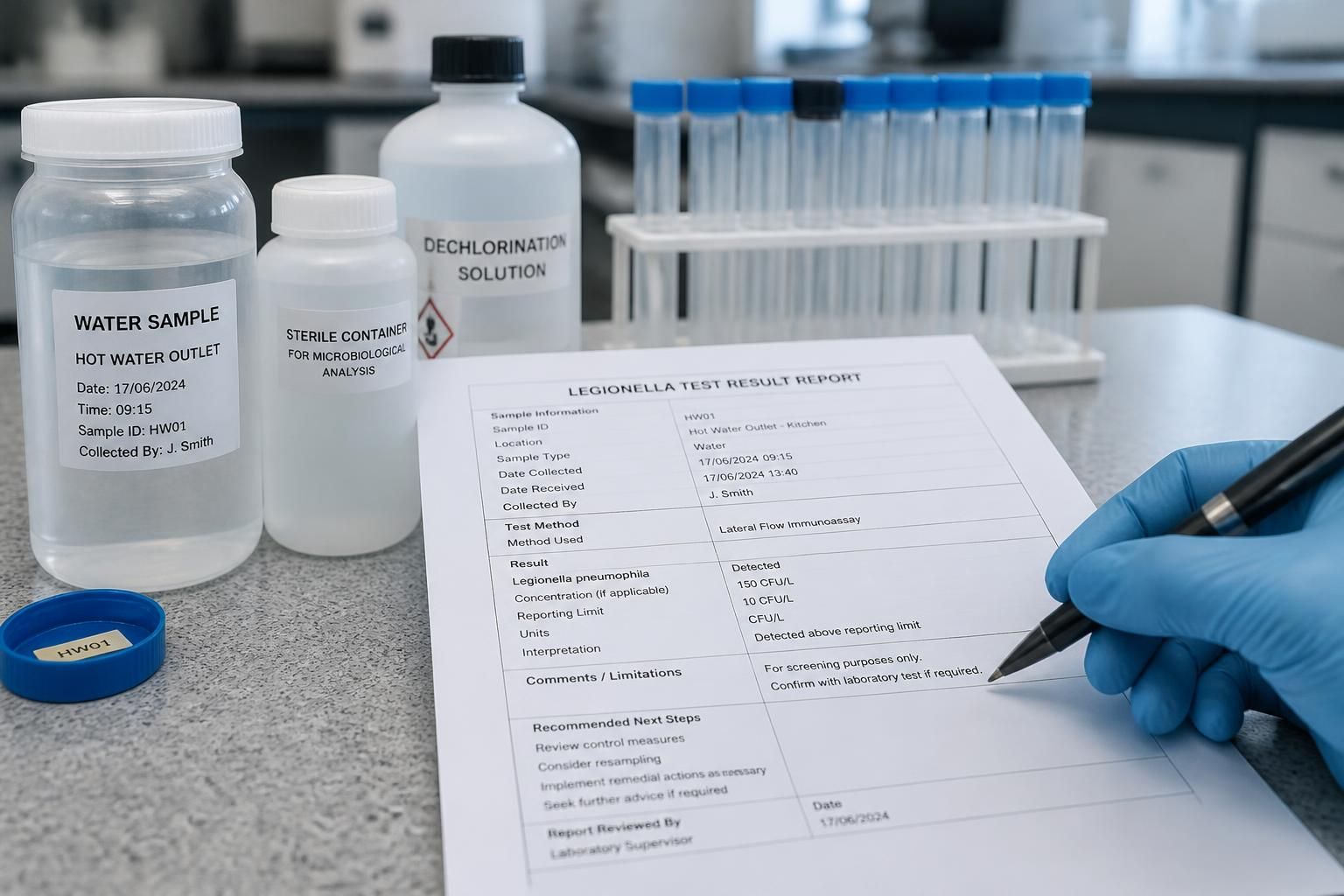
A useful Legionella test kit result is a traceable record, not simply a positive or negative statement. It should identify the sample, explain how the test was performed, present the finding in a meaningful format and state the limitations of the result. This allows a responsible person to judge whether the result can support a water safety decision or whether further laboratory investigation is required.
Identification and traceability
- A unique report, sample or test reference.
- The name or identifier of the site, building, system and sampling point.
- The date and, where relevant, time of collection and analysis.
- The identity of the person who collected the sample and the organisation that performed the test.
- Details of how the sample was labelled, stored, transported and handled before analysis.
These details matter because a result cannot be reliably applied to a wider water system unless its origin is clear. A single sample represents the condition at one location and time; it does not automatically establish the condition of every outlet, storage vessel, pipe run or water system on the premises.
Method and reporting format
The result should identify the test method used. A kit may use a culture-based, molecular or other screening approach, and these methods do not necessarily measure the same thing. The report should make clear whether it is reporting viable Legionella organisms, genetic material, an indicator of possible contamination or a screening response. It should also state whether the output is qualitative, such as detected or not detected, or quantitative or semi-quantitative.
Where a numerical result is provided, the units must be stated clearly. The report should also explain the reporting range, detection limit and the meaning of terms such as below detection, detected below the reporting limit or too numerous to quantify. Without this information, two results using different kits may appear comparable when they are not.
Sample information and condition
Good documentation records the type of sample taken and the circumstances at the sampling point. Relevant information can include whether the sample was taken from a hot or cold water outlet, storage tank, return pipe or other system component; whether the outlet was flushed; the water temperature; and whether disinfectant residual or other field observations were recorded.
The report should note anything that could affect interpretation, including insufficient sample volume, delays in receipt, unsuitable temperature during transport, damaged packaging, contamination concerns or deviations from the kit instructions. If the sample was not collected in accordance with the stated procedure, that limitation should be visible rather than hidden in a general comment.
Quality controls and confidence in the finding
A credible result should show that the test was conducted with appropriate controls. Depending on the method, this may include positive and negative controls, equipment checks, an internal control or confirmation of reagent validity. The kit's expiry date, batch or lot reference and any calibration or verification information may also be relevant, particularly where a result is disputed or forms part of a compliance record.
Some kits are intended for preliminary screening rather than definitive regulatory or operational decisions. Their instructions should state the intended use, performance limitations and circumstances requiring confirmation. A result from a screening kit should therefore be distinguished from a result issued by a competent laboratory using a validated method. Laboratory reports may provide additional information about method performance, quality assurance and reporting limitations.
Interpretation in context
The interpretation should explain what the finding means for that sample and what it does not prove. Legionella control decisions depend on the type and condition of the water system, the people who may be exposed, the history of monitoring, control measures and any changes in system operation. A result should be considered alongside the site's written risk assessment and monitoring records, rather than treated as an isolated pass-or-fail certificate.
Where a result is positive, elevated, unexpected or inconsistent with previous findings, the report should identify the need for a documented review. That review may involve checking sampling practice, examining system temperatures and control measures, taking additional representative samples, or using a suitable laboratory method for confirmation. The appropriate response depends on the risk assessment and the circumstances of the site; a kit result alone does not determine the full remedial programme.
Where the result is negative, the wording should not imply that the entire system is free from Legionella. A negative finding means the organism or marker was not detected by that method in that particular sample under the stated conditions. It does not exclude contamination at another outlet, at another time or below the method's detection capability.
Actions and review record
A well-prepared result should record who reviewed it, when it was reviewed and what action was assigned. The record may refer to repeat sampling, investigation of the relevant control measures, escalation to the responsible person or specialist advice. It should identify an owner for each action and provide a clear way to link the outcome to later monitoring, rather than leaving the report as a standalone file.
If a kit report lacks the method, units, sampling details, limitations or traceability information, its value for managing a commercial water system is restricted. In that situation, a water hygiene specialist or competent testing laboratory can assess whether the result is usable, whether further samples are needed and what evidence is appropriate for the site's compliance records.
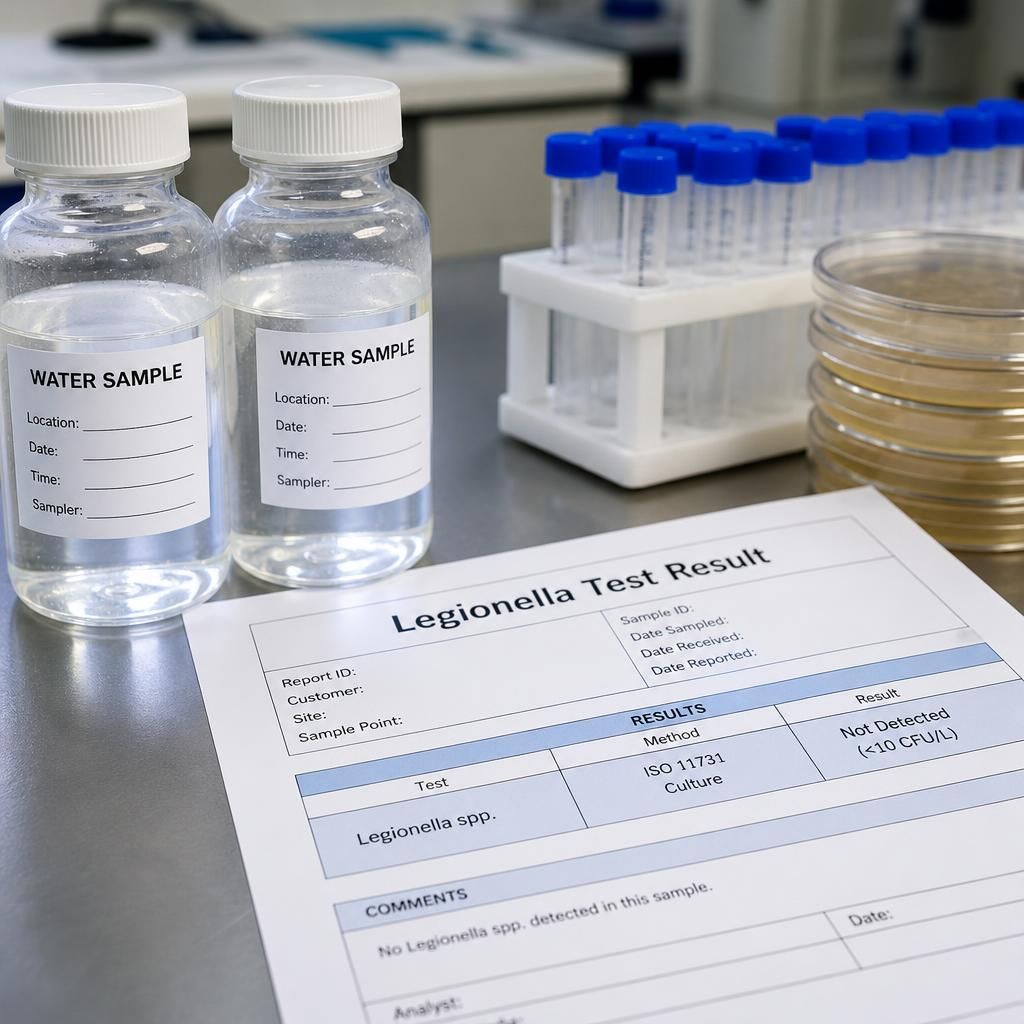
A Legionella test kit result should state exactly which organism or marker the test targets. Some methods are designed to detect Legionella broadly, while others focus on Legionella pneumophila or a specific serogroup. This distinction affects how the finding should be interpreted.
A result showing that one target was not detected does not necessarily demonstrate that all Legionella species are absent. Check the report or kit instructions for the target range, including any species or serogroups that the method cannot identify. If the scope is unclear, the result should not be treated as a complete assessment of the water system without appropriate technical review.
Need help interpreting a Legionella test kit result?
Need help interpreting a Legionella test kit result? Blue Fish Water Management Ltd can review the available evidence and advise whether further sampling, laboratory testing or specialist assessment is appropriate for your water system.