
Which legionnaires test kit suits your water system?
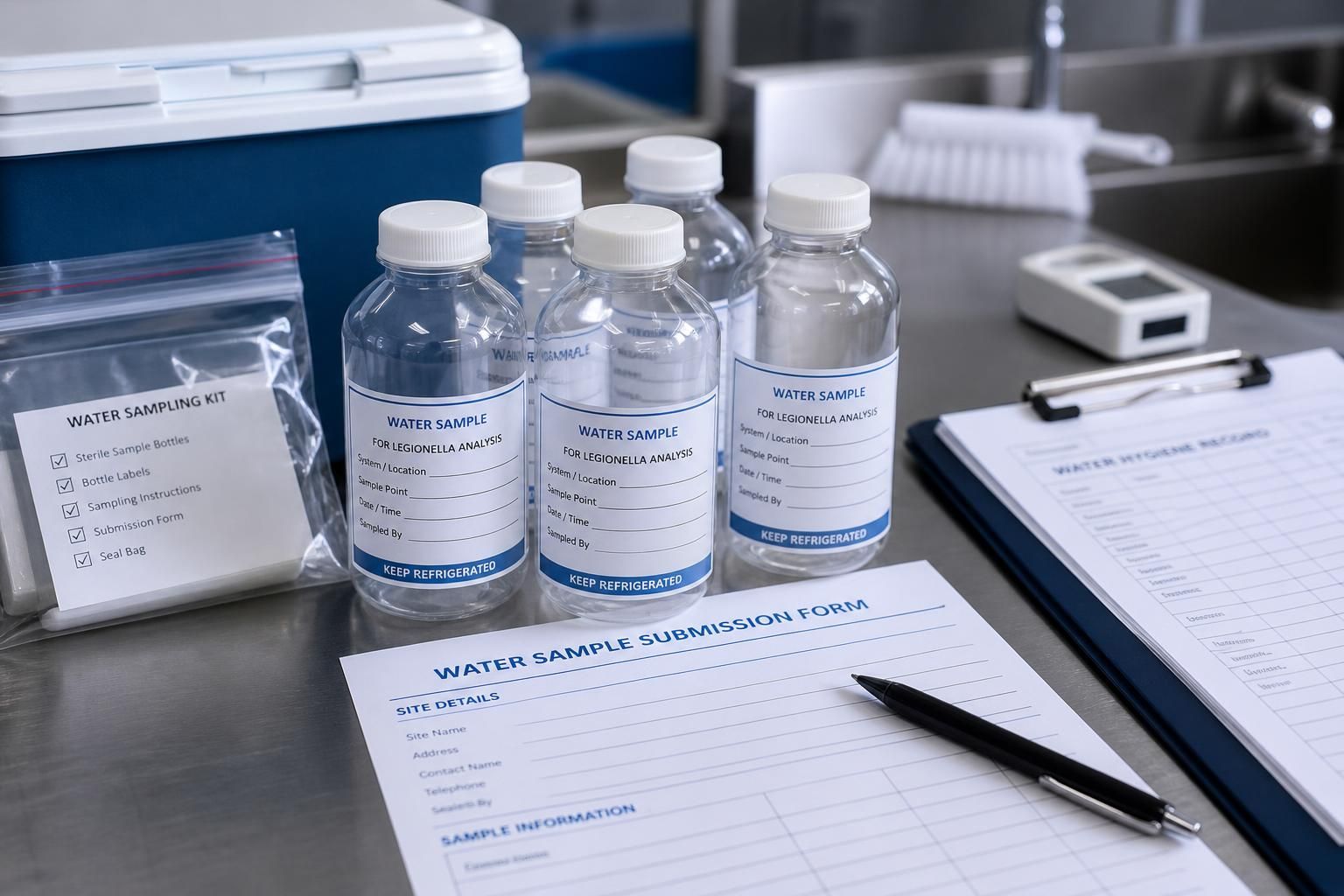
The most suitable Legionnaires’ test kit is determined by the type of water system, the reason for testing and the result required. A kit for routine operational checks is not the same as a laboratory sampling kit, and neither should be selected without considering the system’s risk assessment, sampling points and testing method.
Start with the testing objective
Before choosing a kit, establish what the test needs to show:
- Operational control: temperature, disinfectant residual, pH, turbidity and other indicators can help assess whether control measures are being maintained.
- Legionella screening: some methods provide an indication that Legionella DNA or organisms may be present, but their limitations must be understood.
- Investigating a suspected problem: the sampling equipment and laboratory method must be appropriate for confirming or characterising contamination.
- Verification after remedial work: samples should be taken from relevant locations and tested using a method capable of producing results suitable for comparison and record-keeping.
A basic onsite water-testing kit may be useful for monitoring system conditions, but it does not necessarily detect Legionella. A Legionella result normally requires a defined sampling process and a suitable laboratory technique.
Match the method to the evidence required
Culture testing estimates viable, cultivable Legionella in a water sample. It is commonly used where a quantitative result and an established laboratory process are required. The kit itself normally consists of suitable sample containers and associated paperwork; the analysis takes place under controlled laboratory conditions rather than at the tap.
Molecular methods such as polymerase chain reaction testing detect Legionella DNA. They can provide useful information, but detection of DNA does not by itself establish whether the organisms are alive. The sample container, preservation requirements, transport conditions and laboratory capability must therefore match the chosen method.
Rapid or field-based products should be assessed carefully. Their instructions should state what they detect, the water types for which they have been validated, their detection limits, possible interference from the sample and how results should be interpreted. A simple colour change or positive screening indication should not be treated as equivalent to a fully characterised laboratory result.
Consider the design of the water system
The system influences both the sampling equipment and the locations that need to be represented. A domestic hot and cold water system may require consideration of hot-water storage, secondary return circulation, sentinel outlets, low-use outlets and cold-water storage. Larger or more complex systems may also include calorifiers, blending valves, tanks, showers, process equipment or areas where water stagnates.
Cooling systems, spa pools and other non-domestic water environments have different operating conditions and may require different sampling arrangements. A kit intended for a straightforward potable-water sample may not be suitable for a process-water or aerosol-generating system. Check that the sampling container, neutralising agent and test method are suitable for the water chemistry and the system being investigated.
Check the sampling requirements
A suitable kit should support representative sampling. This includes using the correct container, avoiding contamination, recording the outlet and system conditions, and preserving the sample as required. Where disinfectant is present, the container may need an appropriate neutralising agent so that residual disinfectant does not continue to affect the sample after collection.
Sampling plans should identify why each outlet has been chosen. A single convenient tap may not reflect conditions elsewhere in the system, particularly where there are dead legs, infrequently used outlets, temperature deficiencies or poor circulation. Samples may need to be taken before and after flushing, depending on the investigation and the sampling protocol.
Transport is also part of kit suitability. The instructions should specify storage conditions, protection from contamination, maximum holding times and the information that must accompany the sample. If these requirements are not followed, a technically sound test method may still produce evidence of limited value.
Choose equipment that supports reliable records
For business premises, the kit should allow the sample to be linked to the relevant outlet and system. Labels and accompanying records should capture the sampling date, location, sample type, collector, relevant temperatures or disinfectant readings and any unusual conditions observed. This information helps explain the result and supports comparison with previous or subsequent samples.
Do not choose a kit solely because it is quick or easy to use. Consider whether the instructions are clear, whether staff are competent to collect the sample, whether the method has appropriate validation and whether the resulting report will be meaningful for the decision being made. A kit that cannot produce traceable, interpretable evidence may create uncertainty rather than reduce it.
A practical selection process
- Describe the water system and identify the parts that may present a Legionella risk.
- Define whether the purpose is routine control monitoring, investigation, verification or formal assessment.
- Select a testing method that answers that purpose, distinguishing operational checks from Legionella analysis.
- Confirm that the sample containers, preservatives, transport arrangements and laboratory requirements are compatible with the method.
- Identify representative sampling points and record the conditions under which each sample is taken.
- Ensure that the person collecting the sample understands the procedure and the limitations of the result.
- Interpret the findings alongside the risk assessment, system controls, maintenance history and other monitoring records.
For many commercial and industrial systems, the right choice is not a single off-the-shelf Legionnaires’ test kit but a defined sampling and testing arrangement. Blue Fish Water Management can help organisations assess the system, select an appropriate testing approach and interpret results within the wider water hygiene controls.
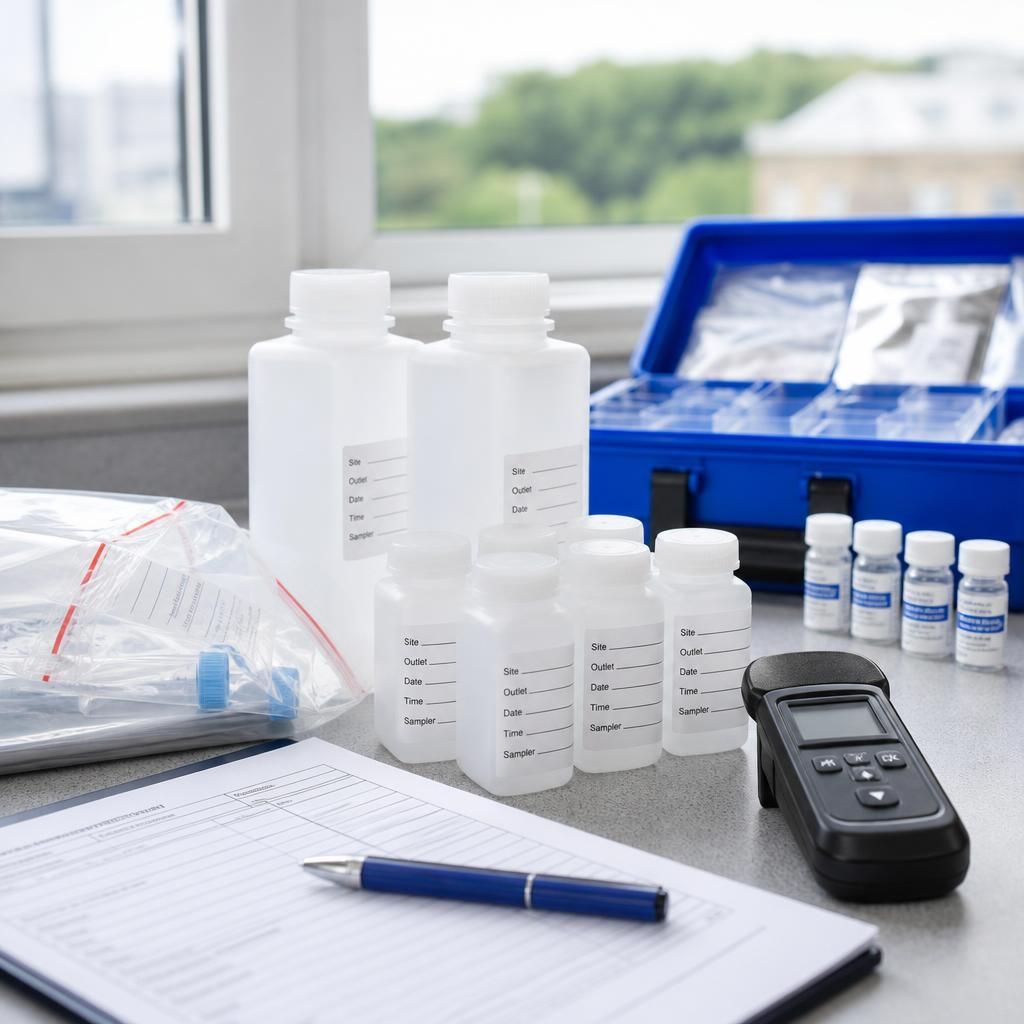
A Legionnaires’ test kit should also be assessed for quality control and traceability, not simply for the result it claims to provide. Check that its measurement range suits the expected water conditions, that reagents or sensors have clear expiry dates, and that storage requirements can be maintained on the premises.
- Confirm whether meters require calibration or routine verification.
- Check that reagents, sample bottles and preservatives are supplied for the intended test.
- Use lot numbers, expiry dates and control checks to identify any issue with the test materials.
- Ensure replacement consumables remain available for continued monitoring.
These details matter when results need to be compared over time or reviewed as part of a business’s water hygiene records. A kit that cannot demonstrate consistent performance may be unsuitable even if it appears convenient for day-to-day use.
Discuss your Legionnaires’ test kit requirements
Discuss your Legionnaires’ test kit requirements with Blue Fish Water Management to identify an appropriate approach for your water system and testing objectives.