
How should legionnaires test kit results be documented?
Document legionnaires’ test kit results in a dated record that identifies the sampling location, test method or kit used, sample details, observed reading and the person completing the test. Record any interpretation, corrective action, escalation or follow-up testing alongside the result, keeping the record with the water safety documentation for audit and compliance purposes.
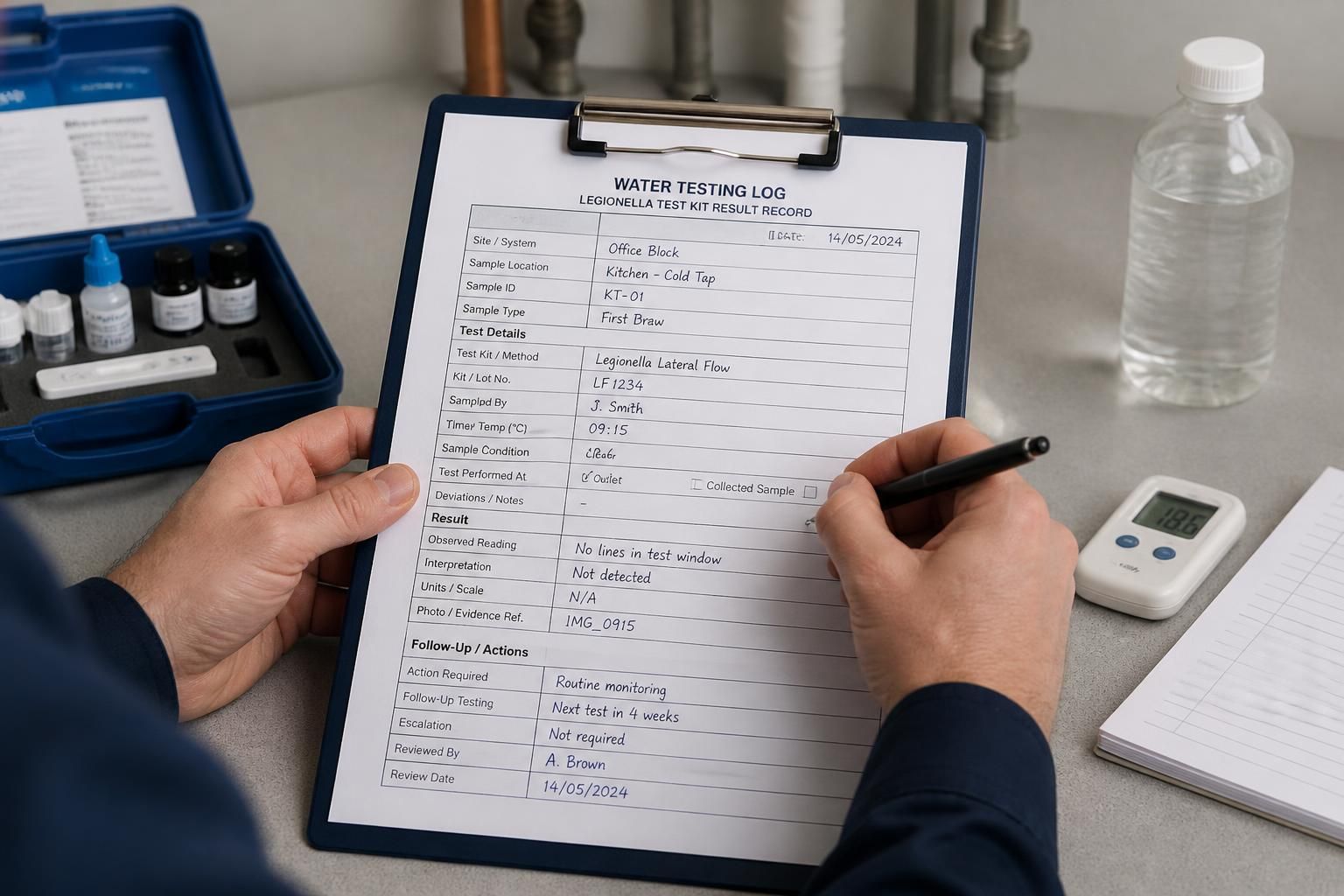
Legionnaires’ test kit results should be documented as traceable evidence of what was tested, how the result was obtained and how it was assessed. A useful record does more than preserve a result: it allows another competent person to understand the test conditions, check whether the method was followed and determine whether further action was justified.
Keep the record in a controlled format, such as a water hygiene log, electronic compliance system or approved testing form. Use a consistent entry structure for every test so that results can be compared over time. If the format changes, retain the earlier records and note when the new version came into use. Records should be legible, protected from unauthorised alteration and accessible to the people responsible for managing the water system.
Record the information that affects the reliability of the test, including:
- the kit identification, batch or lot reference and expiry status;
- the manufacturer’s stated test range, detection limit or interpretation bands, where relevant;
- the date and time of sampling and analysis, particularly where the kit requires testing within a specified period;
- the condition of the sample, such as unusual colour, turbidity, sediment or evidence of contamination;
- the water temperature and other relevant system conditions if the method requires or recommends them;
- whether the test was performed directly at the outlet or on a collected sample; and
- any deviation from the kit instructions, including damaged packaging, insufficient sample volume, timing difficulties or an invalid control result.
Do not replace an observed result with a conclusion. Preserve the original reading, colour change, scale position or other visible outcome, then record the interpretation separately. If a colour-based test falls between two reference bands, state that it was borderline or indeterminate rather than selecting the more convenient value. Where the kit produces a numerical reading, include the unit exactly as shown in the instructions. A number without its unit or test scale can be misleading and may be impossible to compare with later results.
Make clear whether the result is a screening indication, an operational check or a laboratory-confirmed finding. A field kit may provide useful information for identifying a potential issue, but its result should not automatically be presented as equivalent to a validated laboratory analysis. If the reading is unexpected, outside the kit’s range, internally inconsistent or significant enough to affect control decisions, record the reason for arranging professional or laboratory follow-up. Keep the original kit result alongside any subsequent test report rather than replacing it.
Supporting evidence can strengthen the record. Depending on the procedure, this may include a photograph of the result window, a copy of the completed test strip or colour chart, the kit instructions used, calibration or verification information for an electronic reader, and relevant laboratory paperwork. Electronic photographs should include a reliable date and be stored with the corresponding record. Do not rely on a photograph alone: the written entry should explain what it shows and how it was interpreted.
Use a clear process for amendments. If a paper record contains an error, draw a single line through the incorrect entry so that it remains readable, add the correction, and initial and date it. For electronic records, use an audit trail or amendment function rather than deleting the original entry. Never alter a result to make it fit a target range. If the error affects the validity of the test, identify the entry as invalid and explain whether a replacement test was carried out.
Results should be reviewed in relation to the water system, not considered in isolation. A competent reviewer can look for repeated changes, differences between outlets, recurring invalid tests or readings that coincide with maintenance, stagnation, temperature changes or other system events. The review should record the reasoning behind any decision, such as repeating the test, increasing monitoring, inspecting the system or obtaining laboratory advice. This creates a clear link between the evidence and the control decision without overstating what a single kit can establish.
Retain the completed records according to the organisation’s water safety management arrangements and any applicable contractual, regulatory or policy requirements. They should be available with related monitoring logs, maintenance information, risk assessments and test reports so that an auditor or responsible person can follow the history of the system. A record that is complete, consistent and supported by relevant evidence is more useful than an isolated result, particularly when investigating a change or demonstrating that a concern was dealt with appropriately.

Document a non-detect or apparently negative result with the same care as a positive or elevated reading. Where the method has a detection limit, record the result using the wording supplied by the kit or test method, such as “not detected” or “below the detection limit”, rather than changing it to “zero”. This distinction matters because a result below the detection limit does not necessarily prove that the water contains no Legionella.
Routine results should also remain in the record when no immediate action is required. They provide context for later findings and help show whether a subsequent change is isolated or part of a developing pattern. If a result is used to support a control decision, record that decision clearly without overstating what the test can establish.
Need help interpreting your test results?
If a result is unclear or requires further assessment, contact Blue Fish Water Management Ltd to discuss the appropriate interpretation and next steps for your water system.