
What determines the scope of a legionella testing service?
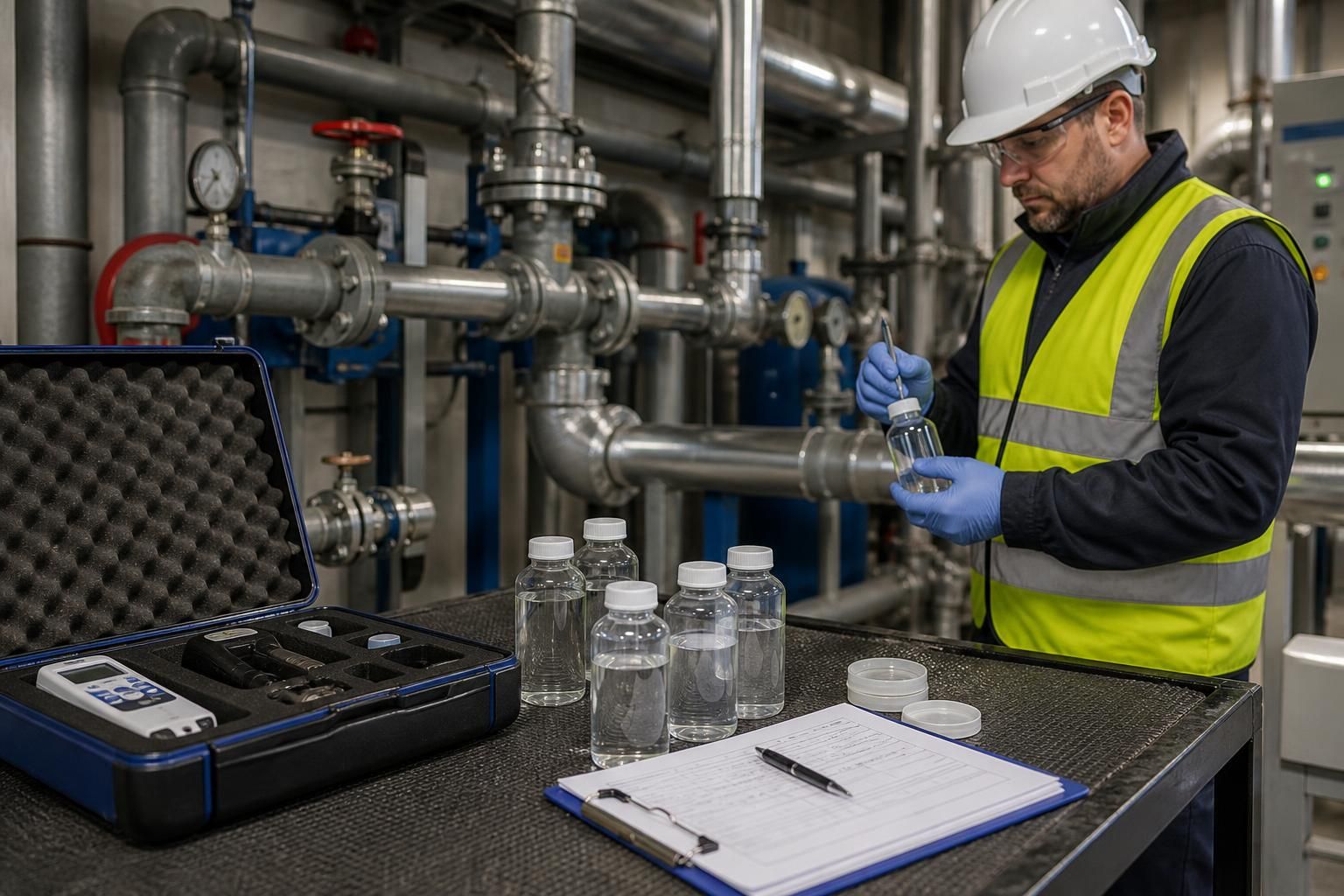
The scope of a legionella testing service is the documented definition of what will be examined, where samples will be taken, how results will be assessed and what action the findings are intended to support. It should be based on the water system’s risk profile and management arrangements, rather than a standard package applied to every site.
The current risk assessment is the main starting point. Testing should complement the risk assessment and written control scheme, not replace them. The assessor or water hygiene specialist will consider the system’s design, operating conditions, control measures and history of use. This helps determine whether testing is needed as routine verification, following a control failure, after remedial work, during commissioning, or because conditions on site have changed.
Relevant changes may include alterations to pipework, the installation or removal of outlets, periods of low occupancy, changes in building use, refurbishment, changes to water temperatures or modifications to plant. A service may therefore need to examine records and recent operational changes before a sampling programme is finalised.
The purpose of the testing also affects its scope. Different objectives require different evidence. For example, routine monitoring may be designed to verify that established controls remain effective, whereas an investigation may seek to identify the extent of contamination or help explain an unexpected result. Testing after cleaning, disinfection or remedial work may focus on confirming that the relevant part of the system has been brought back under control. A commissioning programme may also require checks that the system is operating as intended before normal use.
This distinction matters because a single negative result does not prove that every part of a water system is free from risk. Conversely, a positive result does not by itself identify the cause or determine the correct remedial response. The sampling plan, system information and interpretation of results must be considered together.
System design determines where testing can provide useful evidence. The scope may take account of:
- hot and cold water services, storage vessels, calorifiers and associated distribution pipework;
- sentinel outlets, remote outlets, low-use outlets and areas where water may stagnate;
- showers, taps, thermostatic mixing arrangements and other outlets that can create aerosols;
- dead legs, redundant branches, tanks, return loops and other features that may affect circulation or temperature control;
- plant rooms, occupied areas and separate buildings supplied by the same or linked systems; and
- points where access, isolation or safe sampling requires specific planning.
Sampling locations should be selected to represent the system and the question being investigated. Taking samples only from convenient or frequently used outlets may provide an incomplete picture. A competent plan will consider representative points, system boundaries and any locations identified as higher risk by the assessment.
The people using the premises are another determinant. The consequences of exposure may be greater where water systems serve individuals who are more susceptible to legionnaires’ disease. The nature of occupancy, the presence of healthcare or care-related activities, the number and type of users, and the frequency with which facilities are occupied can all influence the level of investigation and monitoring required. This is a risk-management consideration, not simply a decision based on building size.
Previous results and control performance can change the programme. A history of satisfactory results may support a proportionate routine approach, provided the system and controls remain materially unchanged. Repeated positive findings, unexplained variation, poor temperature records, inadequate flushing records or evidence of ineffective control may justify wider investigation, additional sample points or more frequent review. Results should be interpreted alongside temperature monitoring, maintenance records, inspection findings and details of any corrective work.
The service specification should also state whether it includes only sample collection and laboratory reporting or whether it covers the wider process. Depending on the requirement, this may include:
- review of available risk assessments, schematics, monitoring records and previous reports;
- development of a sampling schedule and identification of sample points;
- site attendance, sample collection and chain-of-custody documentation;
- laboratory analysis through an appropriate accredited testing arrangement;
- interpretation of findings in relation to the system and its controls;
- an explanation of any limitations, unusual results or areas requiring further investigation; and
- recommendations for follow-up testing, remedial work or changes to monitoring where the evidence indicates that these are necessary.
Practical site conditions can affect what is achievable. The responsible person should provide access to relevant plant and outlets, current system information and records of recent work. Restricted access, missing schematics, inaccessible outlets or uncertainty about which parts of the system are connected may limit the conclusions that can be drawn. These constraints should be recorded rather than overlooked.
Before commissioning the service, a business should ask for the proposed scope in writing. It should identify the systems and buildings included, the sampling points, the reason for testing, the analysis to be performed, the reporting arrangements and the process for dealing with significant findings. It should also make clear whether repeat sampling, additional investigation and remedial verification are included or would require separate instruction.
In practice, the appropriate scope is the smallest programme that can answer the relevant risk-control question with defensible evidence, while being broad enough to account for the system’s configuration, use and history. A tailored specification is therefore more informative than selecting a fixed number of samples without first understanding how the water system operates.

The sampling method is part of the service scope because it affects what each result represents. A sample taken before an outlet is flushed may provide information about conditions at that outlet, while a sample taken after the water has been run may give different evidence about the wider distribution system. The specification should therefore state the sampling method, the points at which it will be used and the reason it is appropriate to the investigation.
The scope should also define the practical requirements for each sample, including the sample type, volume, labelling, preservation and transport arrangements. These details help maintain sample integrity and allow results to be linked accurately to the relevant outlet or system section. Where results will be compared over time, using a consistent method and recording the sampling conditions makes changes more meaningful.
Discuss your legionella testing requirements
Discuss your legionella testing requirements with Blue Fish Water Management Ltd to identify an appropriate service scope for your premises and water management objectives.