
How do sampling scopes affect legionella testing prices?
Sampling scope directly affects legionella testing prices because each additional outlet, water system, sample type and sampling location increases the work required for collection, laboratory analysis and reporting. A targeted scope may cost less, while comprehensive sampling can provide broader evidence of system condition and compliance where the risk assessment justifies it.

Sampling scope affects legionella testing prices by determining how many samples must be collected, how widely they are distributed across the water system, which types of water are tested and how much planning, access and reporting the work requires. The appropriate scope should be based on the system’s risk assessment and intended purpose, rather than selecting the largest available package by default.
The number and type of outlets are only part of the calculation. A sampling plan may include representative hot and cold water outlets, sentinel points, distal outlets, showers, taps, storage tanks, calorifiers or other parts of a building water system. Each location can provide different information about control and potential exposure. For example, samples from outlets close to a hot water source may help assess conditions at the beginning of a distribution network, while distal outlets can indicate whether temperatures and control measures are being maintained further along the system.
A larger or more complex building may therefore require a broader scope than a small premises, even where the number of systems appears similar. Multiple buildings, separate hot water services, low-use areas, healthcare-related risks, accommodation areas and seldom-used outlets can all influence the sampling plan. The price reflects the work involved in identifying suitable points and ensuring that the results represent the systems being assessed.
Risk-based sampling can make the scope more focused. A risk assessment may identify a limited group of representative points that provides useful evidence for routine monitoring. This can avoid collecting unnecessary samples while still covering the relevant systems and higher-risk areas. It does not mean that the cheapest possible scope is automatically suitable. Excluding locations without a documented reason may leave gaps in the evidence, particularly where there are vulnerable occupants, inconsistent usage, temperature concerns or known control problems.
In other situations, a wider scope may be appropriate. Comprehensive sampling can be considered where a water system is extensive, its configuration is unclear, previous results have been unsatisfactory, remedial work has been completed or there is a need to investigate possible contamination. An investigative scope may also involve additional sample types or locations selected to help identify where a problem is concentrated. This work is usually more involved than routine monitoring because the sampling plan may need to be reviewed as findings emerge.
Access and site conditions can also influence the price. Sampling points may be spread across several floors, buildings or restricted areas. Some may require coordination with the person responsible for the premises, access arrangements, isolation of equipment or safe access to plant rooms and storage areas. If the planned points cannot be reached or identified when the visit takes place, extra planning or a further visit may be needed. A clear quotation should state whether such circumstances are included or treated as additional work.
The timing and condition of a sample can affect the reliability of the result. Sampling may need to follow a defined procedure, with the outlet prepared in a particular way and the sample recorded against the correct location. Where the scope includes different sampling conditions, such as samples intended to assess particular parts of the distribution system, the collection and interpretation requirements may differ. These details can add professional time even when the number of laboratory containers is unchanged.
Laboratory and reporting requirements are linked to scope. Each sample generally requires identification, chain-of-custody records, laboratory processing and inclusion in the results report. A larger dataset takes longer to review and may require the results to be organised by building, system, floor or outlet type. If the client needs interpretation against the risk assessment, comparison with earlier results or recommendations for further investigation, the reporting element may be more substantial than a basic result sheet.
When comparing quotes, check whether the stated price covers:
- the number of samples and the specific sample types included;
- the buildings, systems and outlet categories within the scope;
- sample collection, laboratory analysis and result reporting;
- the identification of sampling points and any required site planning;
- interpretation of results and advice on next steps;
- additional samples, repeat visits or inaccessible points; and
- any separate charges for urgent investigative work or remedial follow-up.
A useful quotation should make the scope transparent enough for different providers to be compared on a like-for-like basis. A lower price may reflect fewer locations, a narrower range of sample types or limited interpretation rather than a more efficient equivalent service. Conversely, a higher price is not necessarily better if it includes sampling that is unrelated to the identified risk.
For a business arranging testing, the practical approach is to provide the current risk assessment, system schematics where available, previous results, details of occupancy and information about known control issues. The testing provider can then distinguish between routine compliance monitoring, verification after remedial work and investigative sampling. Blue Fish Water Management Ltd can advise on a proportionate sampling scope and provide UKAS-accredited water testing as part of a wider legionella control service, with the final scope tailored to the water system and the evidence required.
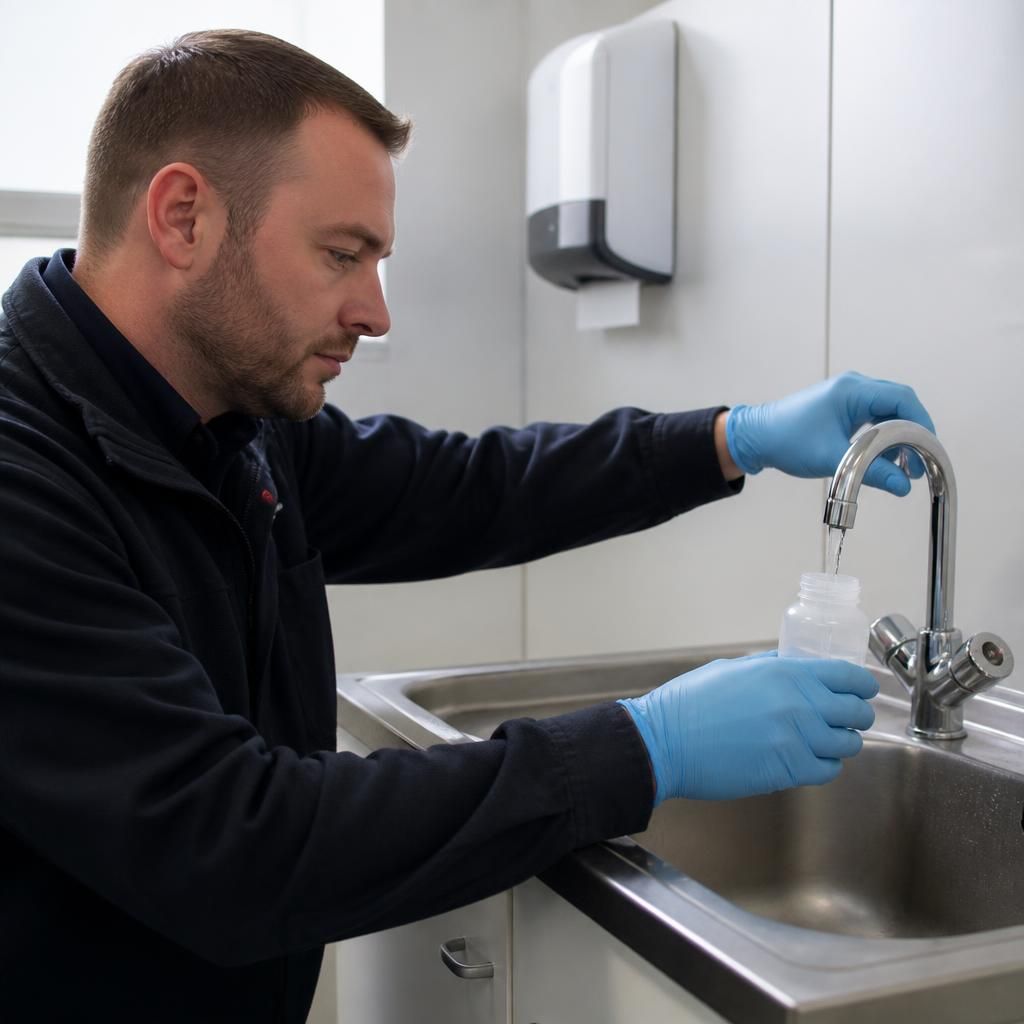
Legionella testing prices do not always increase in direct proportion to the number of samples. A quotation may combine fixed costs, such as reviewing the brief, planning the visit, travelling to site and preparing records, with variable costs for sample collection, laboratory analysis and reporting. This means a small sampling scope can have a higher apparent price per sample, while a larger scope may spread the fixed work across more locations.
When comparing prices, ask the provider to separate the fixed elements from the costs that change with each additional sample or sampling point. This makes it easier to understand whether adding locations will materially change the total and whether a reduced scope genuinely removes work or simply removes laboratory tests from an otherwise similar site visit.
Discuss your legionella testing sampling scope
Discuss your proposed sampling scope with Blue Fish Water Management Ltd to clarify the evidence required and request a tailored legionella testing quotation.