
What should businesses record when sending water samples to a laboratory?
Businesses should record a unique sample reference, the site and precise sampling point, the date and time of collection, the person who collected it, and the tests requested. They should also document sampling methods, sample condition and preservation, storage or transport details, and any chain-of-custody information needed to link the laboratory result to the correct water system and location.
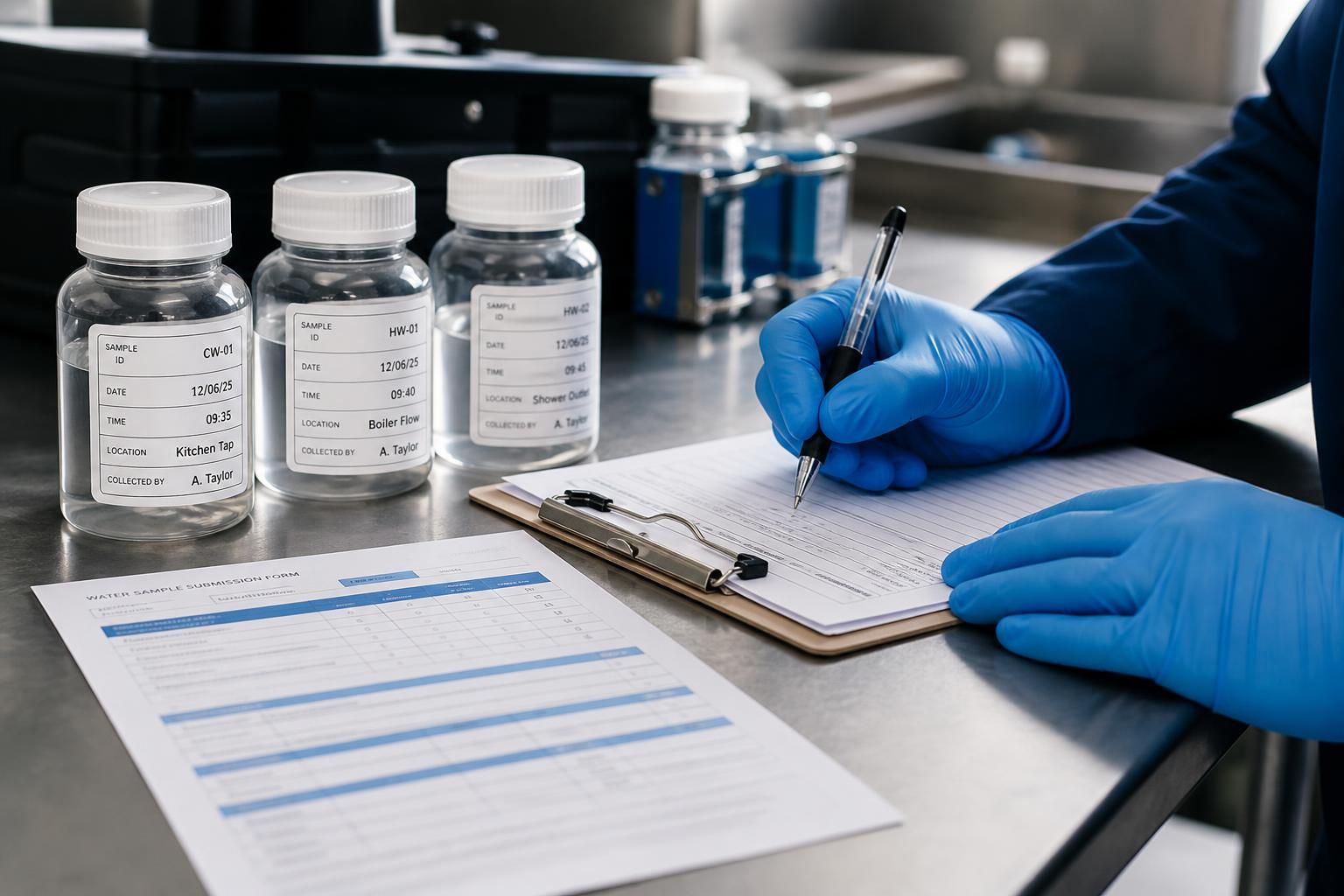
Businesses should keep a complete, traceable record that explains why each water sample was taken, where it came from, how it was handled, what analysis was requested and whether anything could have affected the result. The laboratory submission should contain the information needed to identify the sample and perform the requested work, while the business’s own records should preserve the wider operational context.
Record the reason for sampling. State whether the sample relates to routine monitoring, a Legionella control programme, a new or altered water system, an investigation, a complaint, an outbreak concern, or verification following remedial work. Recording the purpose helps the laboratory and later reviewers understand how the result is intended to be used. It also prevents routine monitoring results from being confused with samples collected during an investigation or after corrective action.
Describe the relevant water system context. The submission or associated monitoring record should identify the type of system involved and any features that may affect interpretation. Depending on the investigation, this may include:
- whether the system is hot, cold, process, spa, cooling or another type of water system;
- whether the supply is mains-fed, stored, blended or otherwise treated;
- the normal use of the area or outlet, particularly where vulnerable people may be exposed;
- recent commissioning, maintenance, alterations, cleaning, disinfection, flushing or shutdown;
- known control issues, abnormal temperatures, low-use areas or changes in occupancy; and
- any previous result or incident that explains why the sample has been requested.
This information should be factual and dated where possible. It is not a substitute for the laboratory result, but it gives the result a defensible operational context.
State the analysis required in precise terms. Avoid relying on a general instruction such as “test water”. The request should identify each parameter or examination required, together with any relevant method, reporting requirement or action level specified by the business’s monitoring procedure. If the sample is being submitted for Legionella analysis, record the particular examination requested and whether additional testing is required for the investigation. Where several containers relate to one sampling event, link them clearly so the laboratory does not treat them as unrelated samples.
Keep a record of any departure from the planned method. Sampling does not always take place under ideal conditions. The record should explain relevant deviations, such as an outlet that could not be prepared in the usual way, restricted access, an insufficient volume, a damaged container, unusual water appearance, a delay before collection, or a sample taken from an alternative outlet. Do not hide or correct these details retrospectively. A clear note allows the laboratory and the person reviewing the report to consider whether the deviation could influence the result.
Document instructions given to the laboratory. Retain the completed submission form, purchase or service request, laboratory reference and any written communication that changes the original request. If the laboratory asks for clarification, records a rejected sample, requests a replacement container or identifies a problem with the submission, retain that correspondence with the monitoring file. The final report should be matched to the original request rather than filed in isolation.
Keep the laboratory report together with supporting evidence. A useful record set may include:
- the sampling plan or schedule that authorised the work;
- the relevant water safety plan, risk assessment or monitoring procedure;
- the sample submission documentation and laboratory correspondence;
- records of system work or control measures that preceded sampling;
- the laboratory report, including any comments, qualifications or limitations; and
- the review, decision and follow-up action taken after the result was received.
Keeping these items together makes it possible to reconstruct the sampling event without relying on memory. It also helps distinguish a laboratory finding from the management decision made in response to it.
Record how the result was reviewed. The responsible person should note who assessed the report, when it was reviewed and what conclusion was reached. If the result prompted further sampling, inspection, temperature checks, cleaning, disinfection, engineering work or an update to the risk assessment, cross-reference the relevant action record. Where no action was required, record the reason by reference to the applicable monitoring procedure or control criteria. This creates an auditable link between the laboratory evidence and the business’s water safety decisions.
Records should be written in a consistent format, use unambiguous dates and times, and be retained in accordance with the organisation’s document-control arrangements. Corrections should leave the original entry identifiable and show who made the change and when. A laboratory result has greatest value when another competent person can establish what was tested, the circumstances surrounding the sample, the limits of the evidence and the decision that followed.
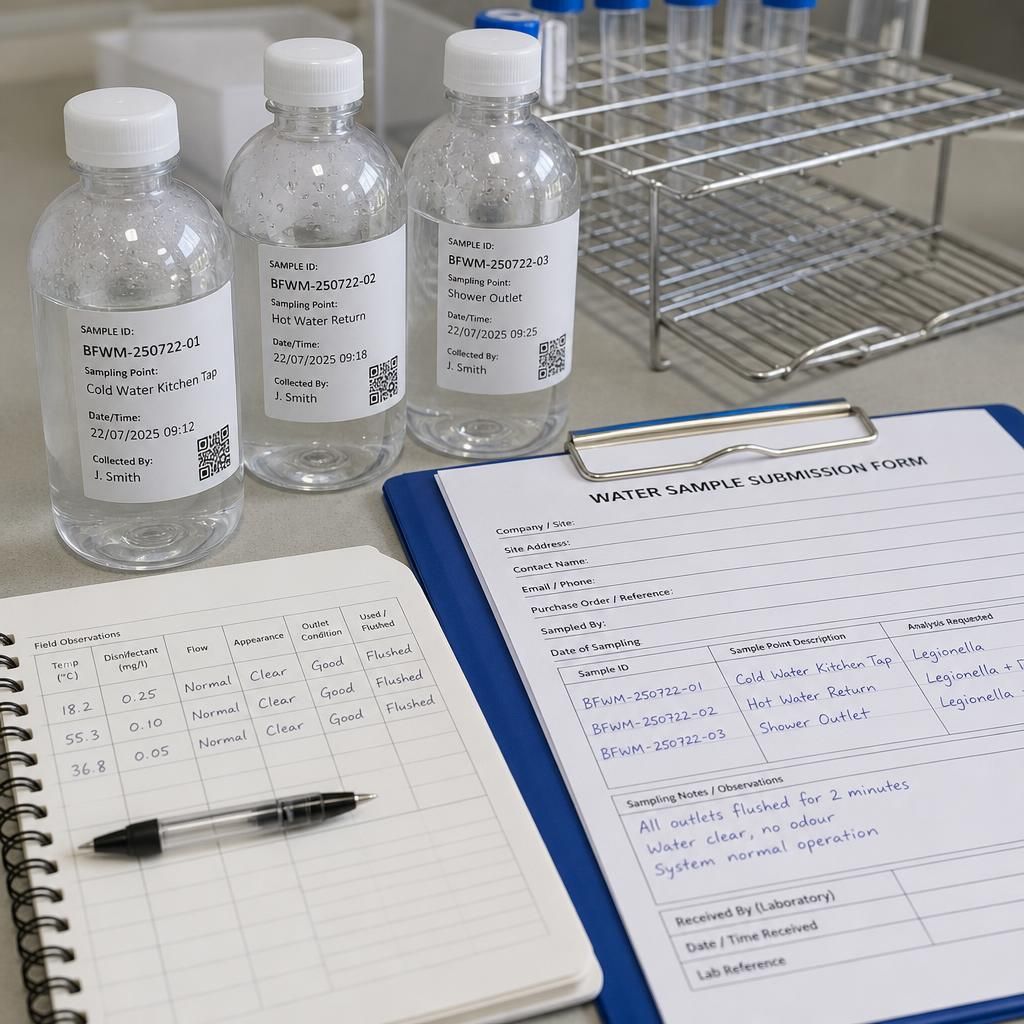
Record relevant observations made at the sampling point. Alongside the sample identification, note contemporaneous field information that may help interpret the laboratory result, such as the water temperature, disinfectant residual where applicable, appearance, flow, outlet condition and whether the outlet had been used or flushed before collection. These observations should be recorded at the time of sampling, with the units and method used where measurements are taken.
Field observations do not replace laboratory analysis, but they provide useful evidence about the conditions under which the sample was collected. Recording them consistently also helps distinguish an analytical finding from a change in the water system that occurred before or after sampling.
Need guidance on water sample records?
If you need to confirm that your water sampling process and laboratory submission arrangements are appropriate, speak to Blue Fish Water Management Ltd for practical guidance tailored to your water system.