
What does a water sample lab report include?
A water sample laboratory report typically includes the sample identification and collection details, the tests performed, the analytical method, and the results for each parameter, usually with units and any relevant reporting limits. It may also record quality-control information, laboratory authorisation details and comments explaining whether the findings require further investigation or action.

A water sample lab report is a formal record that shows what the laboratory found, how confidently the result can be interpreted and whether the findings may require further investigation. For a business, its value lies not only in the reported bacteria or chemical result, but in the context attached to that result and the decisions it supports.
Results and units
Results are normally presented in a table, with one row for each analyte or organism examined. The report should state the numerical result, the unit of measurement and, where relevant, whether the finding is qualitative or quantitative. Microbiological results may be expressed as colony-forming units, while chemical results may use units such as milligrams per litre or micrograms per litre. The unit is essential: the same number can have a very different meaning when expressed against a different volume or measurement scale.
A result may be shown as a number, as not detected, or using a less-than symbol followed by a reporting limit. A result reported as below that limit does not prove that the substance or organism is completely absent. It means that it was not detected at the level the analytical process could reliably report. This distinction matters when comparing reports from different laboratories or tracking low-level findings over time.
Legionella-specific detail
Where Legionella has been examined, the report may identify the organism detected, the level found and any species or serogroup information available from the examination. It may also distinguish between a negative result, a result below the reporting limit and a confirmed recovery. Those distinctions should be retained when the result is entered into a water safety record.
A Legionella result should not be read in isolation. Its significance depends on the type of water system, the location sampled, the system's condition, the temperature profile, vulnerable occupants and any previous results. A laboratory report can provide evidence about the sample, but it does not by itself replace a risk assessment or establish that the whole water system is safe.
Interpretive comments and flags
Reports may contain comments that draw attention to an unusual result, a limitation affecting interpretation or a need for additional review. Flags can indicate that a result is outside an agreed specification, has been reported near a measurement limit, or differs from an expected pattern. Some reports also use symbols, footnotes or abbreviations to qualify individual entries, so the accompanying legend should be read before the table is circulated.
Interpretation should be separated from the raw result. A comment may explain why a finding merits attention, but the decision about corrective action belongs within the responsible person's water safety management process. For example, a result may lead to a review of temperatures, outlets, storage arrangements, cleaning records, sampling locations or remedial work, depending on the wider evidence.
Dates and report status
A complete report commonly distinguishes between the date the sample was taken, the date it arrived at the laboratory, the date the examination began or ended, and the date the report was issued. These dates help establish whether the result is being considered within the relevant monitoring period. They are also useful when investigating a change between successive samples.
The document should make clear whether it is an original report, a revised report or a replacement for an earlier version. If a report is amended, the reason for the amendment and the affected result should be identifiable. Businesses should retain the current version with their water hygiene records and avoid leaving superseded versions in circulation without clear status markings.
How businesses should use the report
- Check that the result has been assigned to the correct site, system, outlet and sampling point.
- Compare the finding with previous results from the same or a genuinely comparable location.
- Read all notes, symbols and comments rather than relying only on the headline result.
- Record any decision arising from the report, including who reviewed it and what follow-up was required.
- Escalate significant or unexpected findings through the organisation's water safety management arrangements.
Trend review is often more informative than considering one result alone. Repeated results from comparable sampling points can indicate whether conditions are stable, deteriorating or improving. However, a change in sampling location, laboratory process, system operation or reporting limit can affect comparability, so those factors should be recorded alongside the results.
The report should therefore be read as one part of a wider control system. It provides documented evidence from a particular sample at a particular time; it does not describe every part of the water installation. Responsible persons and competent advisers use the findings alongside system records, inspection information, temperature monitoring, maintenance history and risk assessment findings when deciding whether further action is appropriate.
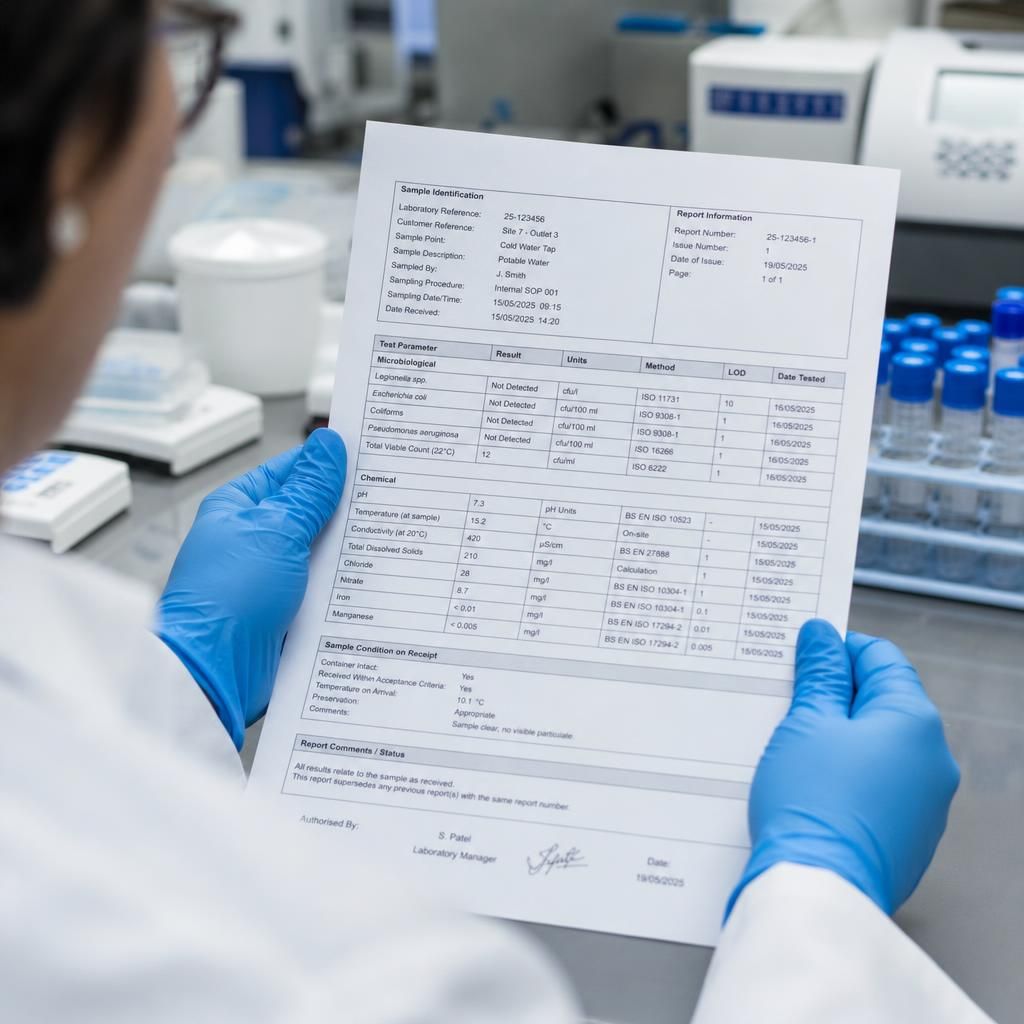
A water sample lab report may also record the condition of the sample when it arrived and any factors that could affect the result. This can include whether the container was intact, whether the sample was received within the laboratory’s acceptance criteria and whether the sample required a qualification or limitation.
If a sample was delayed, insufficient, poorly preserved or otherwise unsuitable for a particular examination, the report may identify this in a comment or status note. Such information is important because a technically reported result may not be fully representative if the sample’s condition has affected its integrity. Businesses should consider these qualifications before using the result to support water safety decisions or comparing it with earlier findings.
Need help interpreting your water sample lab report?
If you need help interpreting a water sample lab report or deciding whether its findings require further review, contact Blue Fish Water Management Ltd for practical guidance based on your wider water safety records.