
What should a business water quality report include?
A business water quality report should summarise the premises and water systems assessed, the samples and tests undertaken, the results obtained, and any relevant compliance findings. It should also explain significant risks and set out clear recommendations for monitoring, corrective action or remedial work where required.

A useful business water quality report is a structured record of what was examined, how the assessment was carried out, what the findings mean and what should happen next. It should provide enough evidence for the responsible person, facilities team or contractor to understand the condition of the water systems and make proportionate, documented decisions.
Scope and site information
The report should identify the premises, relevant buildings or areas, the date of the inspection and the purpose of the work. It should explain which water systems, outlets, storage arrangements and associated equipment were considered. Where the assessment covers only selected areas, that limitation should be stated clearly so that readers do not assume the report represents the whole site.
Useful background information may include occupancy, vulnerable users, periods of low use, changes to the building and any known alterations to the water services. These details help put the findings into context. The report should also record inaccessible areas, unavailable outlets or missing records that may have affected the assessment.
Details of the assessment and sampling process
Readers should be able to see how the information was obtained. A well-prepared report normally records:
- the inspection and sampling dates;
- the locations and outlet types examined;
- the sample identification or reference numbers;
- the type of sample collected and any relevant handling or transport information;
- the tests requested and the methods used; and
- the laboratory or organisation responsible for analysis.
This information establishes traceability between an observation, a sample and its result. It is particularly important where results may lead to remedial work, further investigation or communication with building users.
Test results in a readable format
Results should be presented in a table or equivalent format, with the sampling point, parameter, unit of measurement and result shown together. The report should distinguish between a result that is below a reporting limit, a result that was not detected and a test that was not undertaken. It should also explain any abbreviations or technical terms that a non-specialist reader may need to understand.
The selection of parameters should reflect the risks and uses of the premises rather than follow a generic list. Depending on the system and assessment objectives, testing may include microbiological indicators, Legionella, temperature, chemical characteristics or other relevant measures. The report should explain why the chosen tests were appropriate and identify any tests that were recommended but not completed.
Interpretation rather than data alone
Laboratory results do not provide a complete risk assessment on their own. The report should explain the significance of the findings in relation to the water system, the building’s use and applicable guidance or requirements. Where comparison values or action criteria are used, their source and relevance should be clear.
Interpretation should consider patterns as well as individual results. For example, a finding may need to be considered alongside water temperatures, stagnation, storage conditions, outlet usage, control measures or previous results. A single result should not be described as proof of a wider system condition unless the available evidence supports that conclusion. Equally, a satisfactory result from one outlet does not necessarily demonstrate that every part of a complex system is adequately controlled.
Water system observations and control measures
A report should record relevant physical and management controls, not just laboratory data. These may include storage tank condition, insulation, temperature control, dead legs, infrequently used outlets, blending valves, calorifiers, distribution pipework and evidence of maintenance. It should also note whether monitoring, flushing, cleaning, disinfection and servicing records were available and consistent with the system’s risk profile.
The report should identify the people or roles responsible for managing the water systems and indicate whether duties, procedures and records are sufficiently defined. If documentation is missing, outdated or inconsistent, that should be recorded as a management issue rather than left implicit.
Clear findings and an action plan
Each significant finding should be linked to a practical action. Recommendations are most useful when they state:
- the issue requiring attention;
- the reason it matters;
- the suggested corrective or preventive measure;
- the priority or timescale for completion;
- the person or role responsible; and
- any verification, follow-up sampling or evidence needed to confirm completion.
Actions should be prioritised according to the level and nature of the risk. The report should separate urgent controls from routine improvements and avoid presenting every recommendation as equally important. Where remedial work could affect the system, it should explain what further assessment or testing may be appropriate afterwards.
Limitations, conclusion and supporting evidence
The closing section should give a concise overall conclusion supported by the evidence in the report. It should state any important limitations, assumptions or areas requiring further investigation. Photographs, sampling records, laboratory certificates, diagrams and relevant monitoring logs can provide useful supporting evidence when they are clearly labelled and linked to the findings.
Finally, the report should be dated and attributable to the person or organisation that prepared it. A controlled version, review record and retained evidence make it easier to demonstrate how decisions were reached and to compare future checks with the current position.
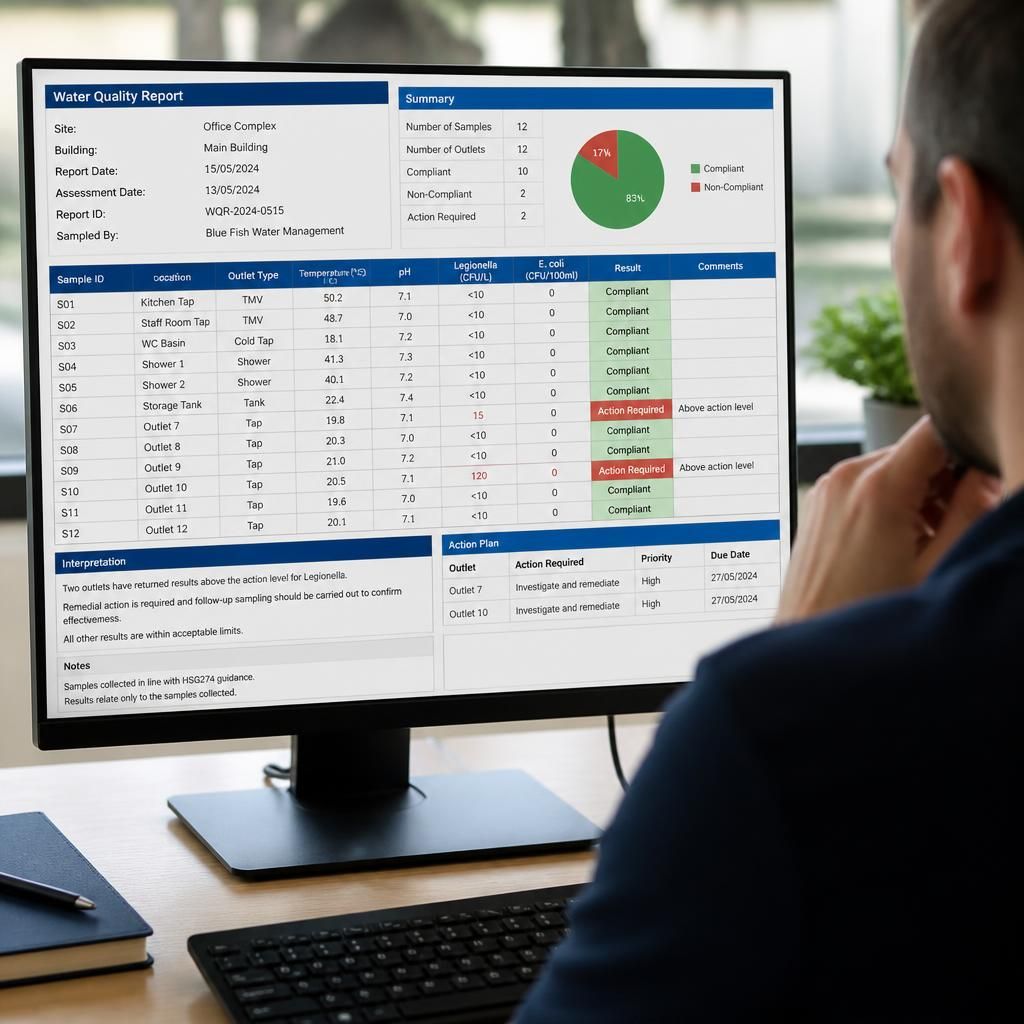
A business water quality report should show what has changed since the previous assessment and whether earlier recommendations were completed. For each outstanding action, it should record the current status, any evidence of completion, revised findings and the reason the matter remains open. This creates continuity between reports and helps the responsible person distinguish new issues from recurring or unresolved ones.
The report should also identify circumstances that may require an earlier review, such as alterations to the water system, changes in occupancy, prolonged periods of low use or a significant test result. This makes the document a practical record for ongoing water safety management rather than a standalone account of one inspection.
Discuss your business water quality report
Discuss your business water quality report with Blue Fish Water Management Ltd to clarify the findings, assess the significance of any concerns and determine the appropriate next steps.