
What should you assess before selecting a commercial drinking water filtration system?
Before selecting a commercial drinking water filtration system, assess the incoming water quality, contaminants requiring control, expected demand, flow rate, storage and available installation space. Confirm that the proposed filtration method supports applicable drinking water requirements and can be operated, monitored, maintained and replaced without compromising water safety.
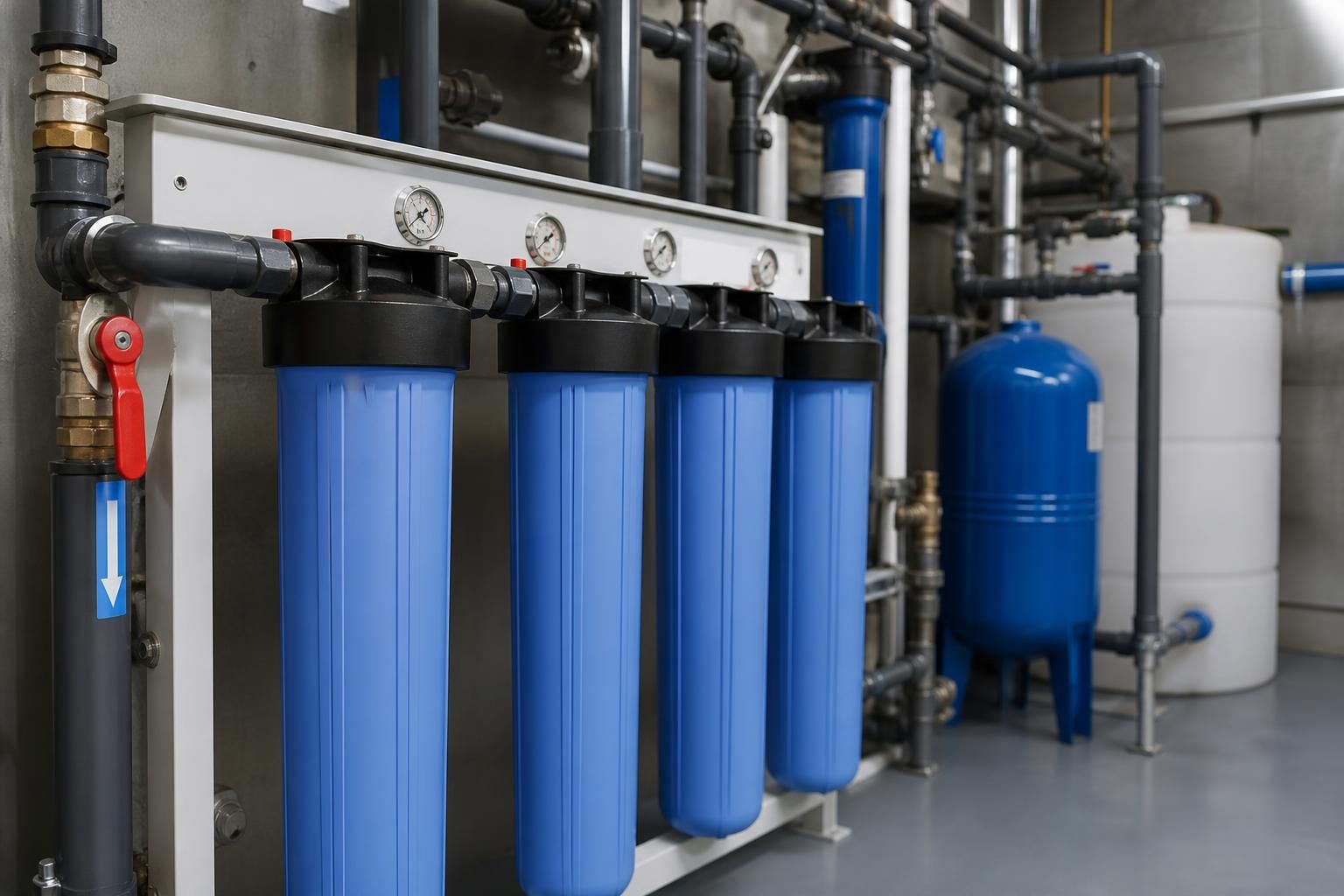
A commercial drinking water filtration system should be assessed against the water safety objective, the evidence for its performance, and the organisation’s ability to control it throughout its service life. The right selection must be technically suitable for the intended use, compatible with the building’s water installation, supported by appropriate compliance documentation and practical to inspect, clean, service and replace.
Define what the system is expected to achieve. Filtration may be intended to reduce particles, improve appearance and taste, protect downstream equipment or control a specified substance. These are different objectives and may require different filter media, pre-treatment or a treatment stage rather than filtration alone. A filter should not be selected simply because it is described as suitable for drinking water.
Establish whether the system is for general potable supply, drinking water dispensers, catering areas, healthcare-related use, food production or another controlled application. The consequence of inadequate treatment varies between settings, so the selection should reflect the users, the point of use and the potential impact of a failure.
Review the evidence behind the performance claims. Ask for test data showing which substances the system has been assessed against, under what conditions and for how long. Useful evidence should identify the test method, influent conditions, rated capacity, expected reduction and any limitations. Claims such as “purifies” or “removes impurities” are too broad to support a technical decision without this detail.
Check whether the stated performance applies to the complete installed system or only to a new cartridge tested in controlled conditions. Installation configuration, water chemistry, temperature, pressure, contact time and cartridge age can all affect results. Where a specific contaminant is a concern, the supplier should be able to explain how the proposed system addresses it and what verification is required after installation.
Confirm suitability for potable water use. Materials that contact drinking water should be supported by appropriate conformity information for the jurisdiction and application. Check documentation for potable-water approval or other recognised evidence, together with details of seals, housings, media and connection materials. Also confirm that any installation requirements under applicable water fittings and building controls have been considered.
Compliance documentation should relate to the actual model, configuration and intended use. A certificate for a similar product, a component or a different operating condition may not demonstrate that the complete arrangement is suitable. Retain the technical file, installation instructions, certificates and maintenance requirements as part of the site’s water safety records.
Consider the effect on microbiological control. A filter can collect organic material and suspended solids, creating conditions in which microorganisms may multiply if the unit is poorly selected, operated or maintained. Assess whether the design creates stagnant sections, low-use branches, inaccessible housings or other areas that could compromise water hygiene.
Determine how the system will be included in the site’s water safety arrangements. This may require defined inspection points, flushing procedures, cartridge-change controls, cleaning instructions and records. Filtration should not be treated as a substitute for a suitable water hygiene management plan or for investigation of an underlying contamination issue.
Assess the installation and hydraulic arrangement. The system should be checked against the pipework material, connection type, available pressure and the operating conditions specified by the manufacturer. Consider whether a pressure-reducing device, isolation valves, non-return protection, sampling points, a bypass or a drain connection is needed. Any bypass must be controlled so that untreated water cannot be supplied unintentionally.
Consider what happens during cartridge replacement, fault conditions and planned servicing. A design that requires the whole building or a critical outlet to be taken out of service may be unsuitable unless an adequately controlled alternative supply is available. Conversely, a permanently live bypass can undermine the treatment objective if it is not locked, labelled and managed.
Examine maintenance and replacement requirements before purchase. Find out the replacement interval, the indicators of exhaustion or blockage, the safe isolation procedure and the method for disposing of used cartridges. Replacement should be based on documented operating conditions and monitoring, not solely on an unverified calendar assumption. Where a filter has a finite capacity, confirm how capacity will be tracked.
Access is an important part of the design. Operators need sufficient room to inspect housings, read gauges or indicators, remove cartridges and clean surrounding surfaces without contaminating the equipment. Components should be identifiable, and replacement parts should remain available for the expected operating life of the installation. Include service tasks, responsibilities and record keeping in the operating procedure.
Check monitoring and verification arrangements. Decide what will demonstrate that the system continues to perform as intended. Depending on the treatment objective, this may include pressure readings, visual checks, flow or usage records, cartridge condition checks, operational inspections and repeat water quality testing. Results should have defined action levels and escalation arrangements rather than being collected without a response plan.
Sampling points should represent the treated water that users actually receive. Sampling only before the filter, or only at a convenient nearby outlet, may fail to identify problems caused by the filter housing, downstream pipework or an infrequently used outlet. The monitoring approach should be proportionate to the risk and aligned with the relevant water safety assessment.
Compare whole-life implications, not just the purchase price. The assessment should include installation, commissioning, routine servicing, replacement cartridges, testing, disposal, water wastage and any effect on other equipment. A lower initial cost may not represent better value if the system needs frequent intervention, has difficult-to-source consumables or cannot provide the records required for compliance.
Ask who will own the system operationally. A clear arrangement is needed for ordering replacement parts, carrying out inspections, responding to failed results and updating documentation when the building use or water system changes. Staff involved in operation should understand the controls that matter and the consequences of bypassing or delaying maintenance.
Use a documented selection process. Before approving a system, retain:
- the defined treatment objective and intended points of use;
- relevant water quality results and the assumptions used in the design;
- manufacturer performance data and limitations;
- potable-water conformity and materials documentation;
- the proposed schematic, isolation and bypass arrangements;
- commissioning, sampling and maintenance procedures; and
- roles, records and actions for faults or unsatisfactory results.
A competent water hygiene review can help determine whether filtration is appropriate, whether additional treatment is needed and how the system should be monitored. Blue Fish Water Management Ltd can support businesses with drinking water testing, water safety advice and related compliance assessments, helping the proposed filtration arrangement to be considered as part of the wider water management system rather than as an isolated piece of equipment.
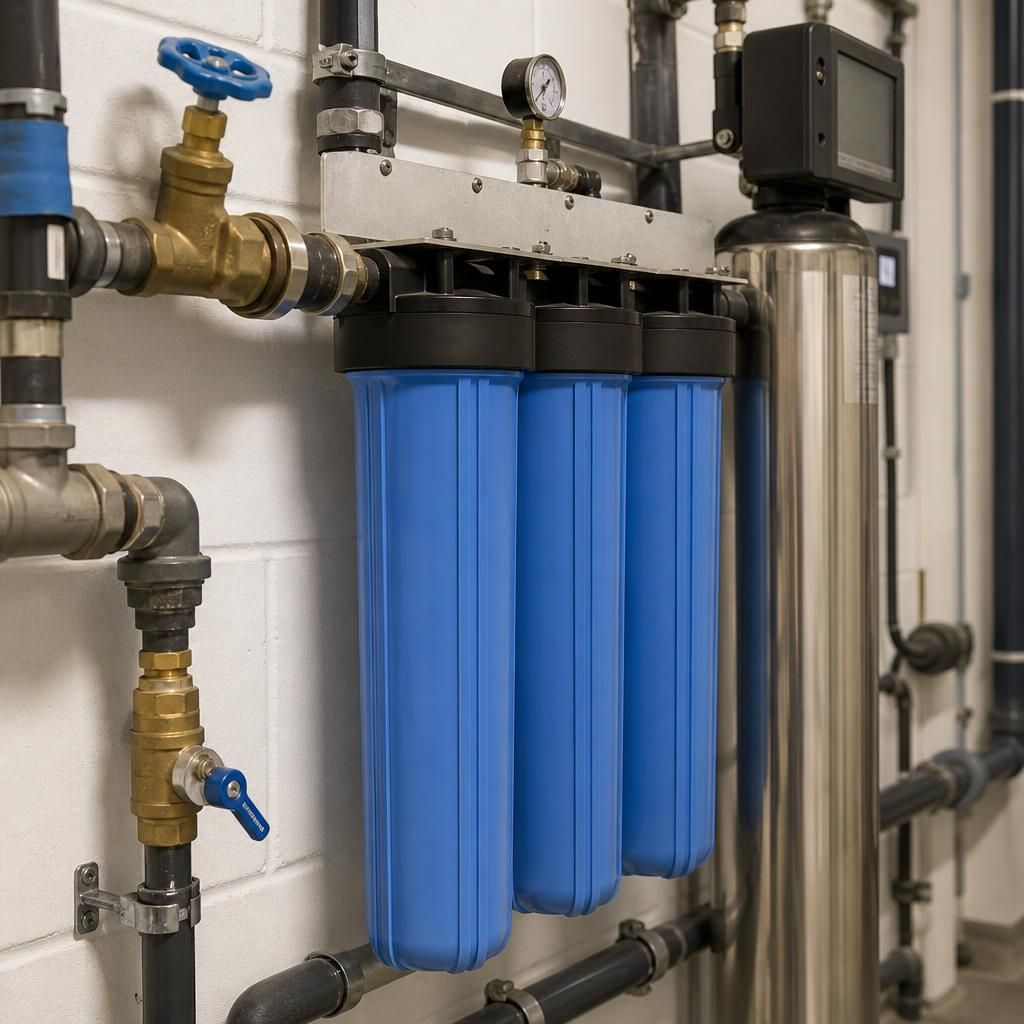
Assess how the proposed commercial drinking water filtration system will interact with equipment and treatment stages downstream. Filtration can alter particle loading, pressure, flow characteristics and, depending on the technology, the water chemistry presented to dispensers, boilers, ice machines, process equipment or a later treatment stage. The sequence of components should therefore be reviewed as part of the selection rather than assessed in isolation.
- Identify every downstream outlet or appliance that depends on the treated supply.
- Check the operating requirements of connected equipment, including acceptable pressure, flow and water characteristics.
- Confirm that one treatment stage will not reduce the effectiveness or service life of another.
- Define which system is responsible for controlling each identified water-quality concern.
This interface review helps prevent a filter being selected for one purpose while creating an unsuitable supply for another. It also gives the site a clearer basis for deciding whether a single system is appropriate or whether separate point-of-use arrangements are needed.
Discuss your commercial drinking water filtration requirements
Discuss your proposed commercial drinking water filtration system with Blue Fish Water Management Ltd to review its suitability for your site, intended use and water safety arrangements. Their team can advise on drinking water testing, filtration requirements and related compliance considerations.