
What Should a Commercial Water Conditioning Review Assess?
A commercial water conditioning review should assess the system’s performance, physical condition and effect on water quality, while identifying operational risks, maintenance needs and relevant compliance requirements. It should also consider whether the current setup remains suitable for the building and recommend practical improvements where needed.

A commercial water conditioning review should establish whether the treatment arrangement is correctly specified, operating as intended and being managed with suitable evidence. It should examine the water entering the building, the equipment and controls, the demands placed on the system, the quality of treated water, and the way operation and maintenance are recorded.
The review should begin with the treatment objective. The assessor should identify why conditioning is installed and which outlets or processes depend on it. A softener may be intended to reduce hardness and protect boilers, dishwashers, laundry equipment or process plant, whereas filtration or dosing equipment may address a different water-quality concern. The review should check that the selected treatment method matches the actual requirement rather than assuming that every water problem can be addressed by softening.
Water demand and system capacity should then be compared with the equipment specification. This includes:
- the incoming water hardness and any meaningful variation in supply conditions;
- peak and average demand, including changes in occupancy, production or operating patterns;
- flow rates and pressure available at relevant outlets;
- the required treated-water volume between regeneration or servicing cycles;
- the size and condition of vessels, valves, brine tanks, filters, dosing equipment and associated pipework; and
- whether the system can continue supplying essential outlets safely during regeneration, maintenance or a component failure.
An undersized system may fail to provide adequate treatment during periods of high demand. An oversized or poorly configured system may also create unnecessary operating complexity, excessive water use during regeneration or ineffective control of the intended water-quality parameter.
Controls and operating settings require close examination. A review should confirm that hardness settings, regeneration intervals, brine concentration, dosing rates, alarms and automatic controls are appropriate for the site conditions. It should also check whether controls are functioning reliably and whether staff can recognise and respond to fault indications. Manual overrides, isolation valves and bypass arrangements should be clearly identified, accessible and protected against inappropriate use.
The physical inspection should cover signs of leakage, corrosion, scale, damaged insulation, insecure connections, obstructed access and deterioration around tanks or equipment bases. Pipework should be traced so that treated and untreated supplies are not confused. Any bypass should be assessed for its purpose and configuration, particularly where bypassing the conditioner could expose downstream equipment to untreated water without the relevant people being aware.
Water-quality verification should use an appropriate sampling plan rather than relying solely on the appearance of the equipment. Samples may need to be taken before and after treatment, and at representative outlets, depending on the purpose of the system. Testing should confirm the relevant parameter, such as hardness, conductivity, chlorine, turbidity or another characteristic associated with the treatment objective. Results should be interpreted alongside operating settings and recent maintenance records, since a single result may not explain an intermittent or load-related problem.
Where conditioning equipment forms part of a hot- or cold-water system, the review should consider how its operation interacts with the wider water installation. This includes stagnation risks, low-use branches, storage arrangements, temperature management, dead legs and any connection that could allow untreated or poorly controlled water to enter another part of the system. The review is not a substitute for a separate legionella risk assessment, but its findings should be made available to the people responsible for overall water safety where the systems are connected.
Maintenance arrangements and records should be tested against the equipment’s actual needs. The assessor should look for evidence of servicing, cleaning, replenishment of consumables, calibration or functional checks, fault rectification and follow-up testing. Records should identify the equipment addressed, the work completed, the person or contractor responsible, findings, test results and any outstanding actions. A schedule that records visits but not what was checked provides limited assurance.
The review should also assess whether the people managing the system understand their responsibilities. This includes knowing who checks alarms and salt or chemical levels, who authorises bypass operation, who reviews test results, who arranges remedial work and who escalates a failed result. Written procedures should cover normal operation, loss of treatment, water-quality failure, leaks, contamination concerns and return to service after maintenance.
Compliance and documentation should be considered in relation to the building, the water use and the equipment installed. Relevant information may include asset registers, commissioning details, operating instructions, water-quality results, maintenance records, risk assessments, service reports and records of remedial actions. The assessor should identify missing documents, inconsistent records and any gap between the documented procedure and what takes place on site.
A useful review concludes with a prioritised action plan. Each action should state the observed issue, the potential consequence, the recommended correction, the person responsible and any further inspection or testing needed. Immediate safety concerns should be separated from routine improvements, and recommendations should distinguish between adjustment, repair, replacement, monitoring and further investigation. This gives the responsible business a practical basis for deciding whether the existing conditioning arrangement remains appropriate and how it should be managed.
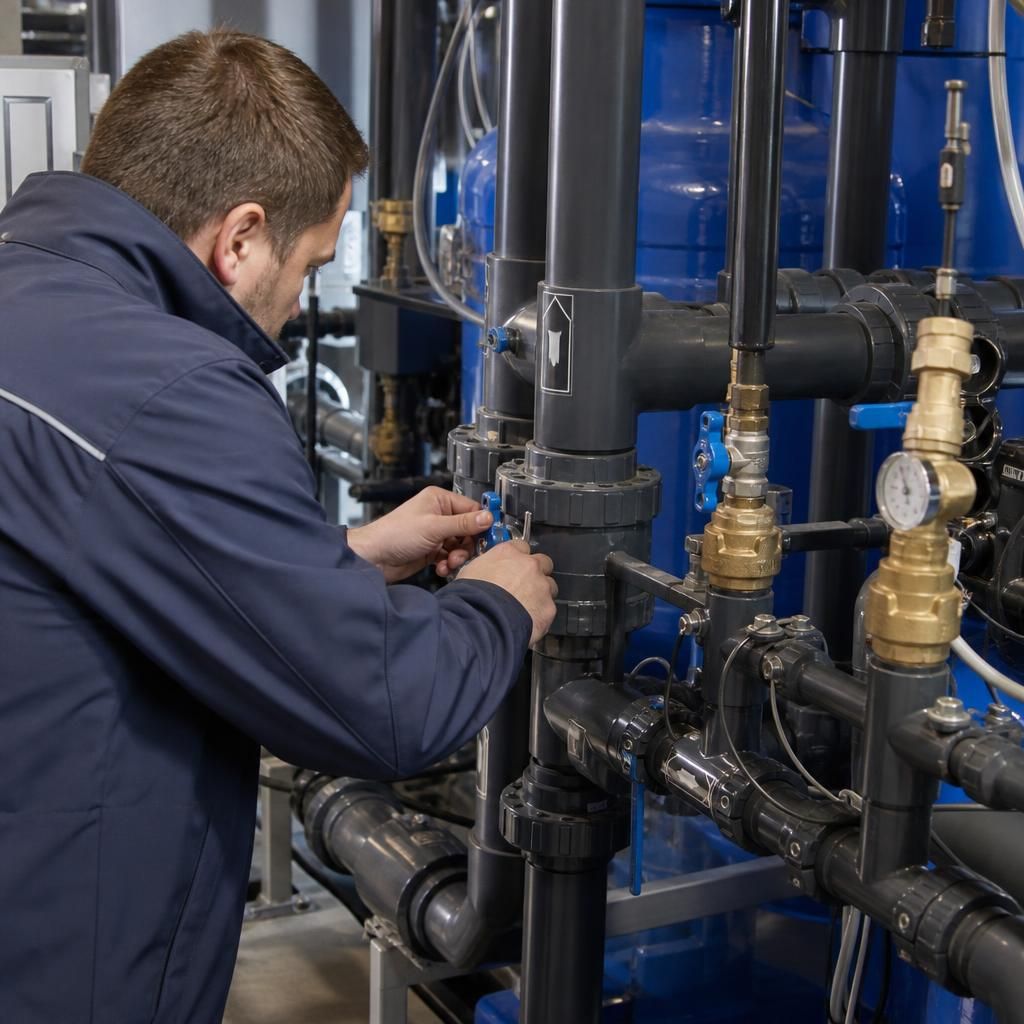
A commercial water conditioning review should assess the consequences of losing or reducing treatment, not just whether the equipment is currently operating. The assessor should identify which building services, processes or items of plant depend on conditioned water and determine how a treatment failure would affect them.
This consequence-based view helps distinguish critical findings from minor defects. The review should consider:
- which uses would be affected by untreated or inadequately treated water;
- whether a temporary operating arrangement is available while a fault is investigated;
- how quickly scale, corrosion or process disruption could become significant; and
- whether the business has enough information to make a safe decision about continued operation.
These findings give the final review report a clearer priority structure. A fault affecting a non-critical outlet may require planned correction, while a failure that could damage essential plant or compromise a controlled process may require immediate escalation and a documented interim measure.
Discuss Your Commercial Water Conditioning Review
If you need to establish whether your commercial water conditioning arrangement remains suitable, discuss the scope of a review with Blue Fish Water Management Ltd. The initial discussion can help clarify the system information, site access and testing requirements involved.