
When should a business arrange drinking water quality testing?

Businesses should arrange drinking water quality testing when the risks associated with the supply, building, activities or occupants cannot be adequately verified through existing records and controls. Testing is not simply a routine administrative exercise: it should provide evidence that water is suitable for its intended use and identify whether further investigation or corrective action is needed.
Testing is particularly appropriate when:
- the business is taking responsibility for an existing premises and cannot establish a reliable history of water hygiene checks;
- the building has a complex or extensive water distribution system, multiple occupants, storage tanks or outlets that are not used evenly;
- the water supply is private, shared, blended with another source or otherwise requires additional assurance;
- the use of the premises changes in a way that affects water consumption, occupancy or the consequences of poor water quality;
- the building accommodates people who may be more susceptible to the effects of contaminated water, making documented assurance especially important;
- there are unresolved differences between supplier information, previous test records and the business's own observations; or
- a regulator, landlord, client, insurer or internal compliance process requires objective evidence of water quality.
A business should also consider testing as part of due diligence when acquiring, leasing or taking operational control of a site. The aim is to identify any unknowns before they become a compliance issue. Existing reports should be checked for the sampling locations, parameters tested, laboratory competence, dates, results and actions taken. A report that contains only a limited selection of samples may not demonstrate conditions throughout the wider system.
There is no single testing schedule suitable for every commercial building. The appropriate timing and scope depend on the source of the water, system design, storage and distribution arrangements, occupancy, activities carried out on site, previous findings and the quality of other control measures. A risk assessment should therefore explain why particular tests are required, where samples should be taken and how results will be reviewed. Testing should be repeated when the underlying risk changes, rather than continuing an unsuitable programme simply because it has been used previously.
A practical decision process is:
- Review available water hygiene records, system information and any previous laboratory reports.
- Identify the people, outlets and activities that could be affected by poor water quality.
- Determine whether the existing evidence is representative of the system and sufficiently recent for the current use of the premises.
- Define the required parameters and sampling points with reference to the identified risks.
- Use a suitably competent sampling and testing provider, with laboratory work carried out by a UKAS-accredited facility where appropriate.
- Record the findings, assign responsibility for any action and establish when the programme should next be reviewed.
Testing should not be treated as a substitute for good water system management. Results are evidence from particular samples at particular times; they do not, by themselves, prove that every outlet is consistently safe. Sampling therefore works best alongside system inspections, temperature or other relevant monitoring, cleaning arrangements, maintenance records and clear management responsibilities.
Where a result is unsatisfactory, the business should avoid relying on the laboratory report alone. The finding should be assessed against the sample location, the parameter involved, the building's risk profile and any possible source of contamination. Appropriate corrective action may include investigating the system, reviewing controls, taking further samples or obtaining specialist advice. The testing plan should then be updated if the result reveals a weakness in the original assessment.
For a commercial organisation, the best time to arrange testing is when it will answer a defined risk or compliance question. A documented, risk-based programme provides more useful assurance than ad hoc sampling or testing selected parameters without considering how the building's water system is operated.
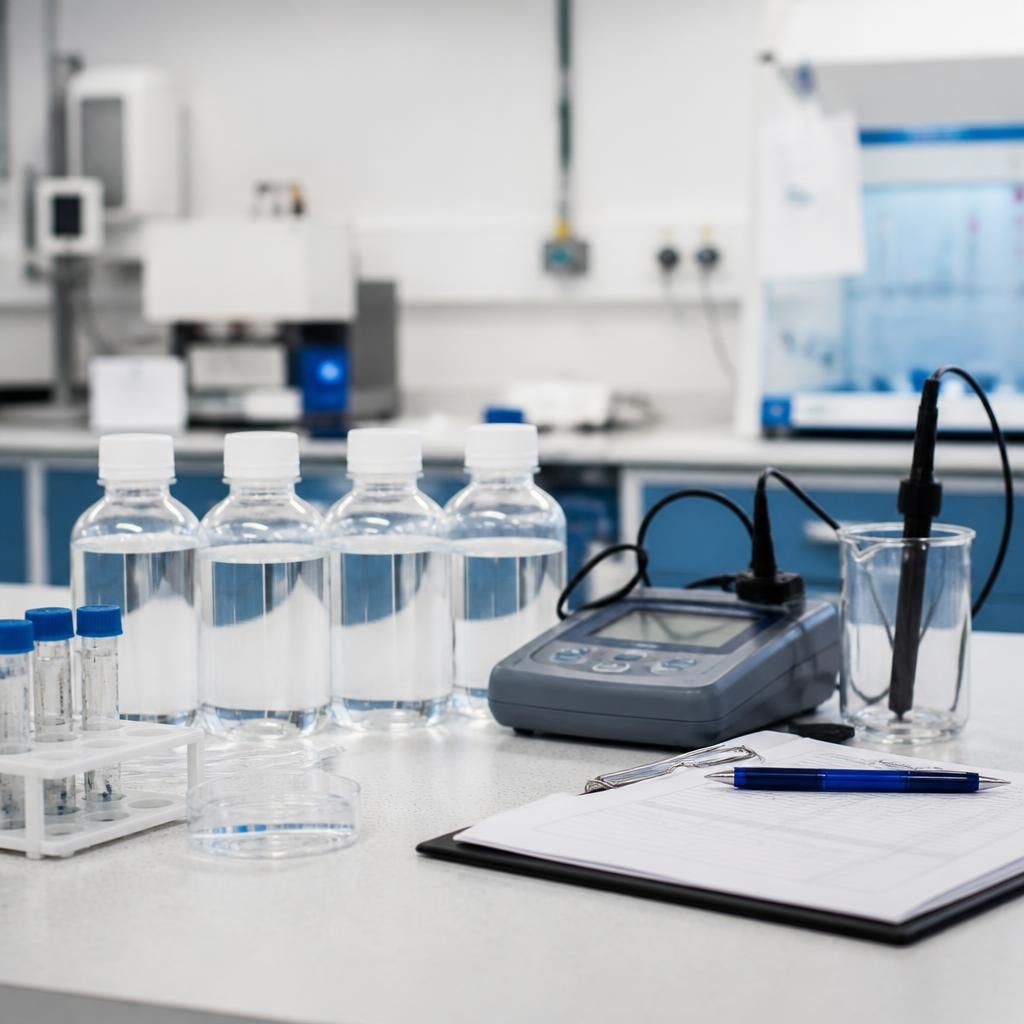
The timing of a drinking water sample affects how useful the result is. Sampling should normally reflect the building’s usual operating conditions, with the relevant outlets and storage arrangements in service. A sample taken immediately after flushing, cleaning or remedial work may show the effect of that intervention rather than the condition the building normally presents.
Where testing is intended to verify maintenance or corrective work, that purpose should be recorded clearly and the sampling conditions documented. The report should note the date, outlet, system status and any activity that could have influenced the result. This distinction helps the business decide whether the result demonstrates normal water quality or confirms a specific intervention.
Discuss your drinking water testing requirements
Discuss your drinking water testing requirements with Blue Fish Water Management Ltd to determine a suitable scope for your premises and its operational risks. The team can advise on the information needed to plan an appropriate testing programme.