
How are drinking water test results interpreted against compliance requirements?
Drinking water test results are interpreted by comparing each measured parameter with the applicable UK regulatory limit or specification, while considering the sample location, collection method and relevant monitoring requirements. Any result outside the required value is assessed to determine its significance, reported appropriately and followed by investigation or corrective action where necessary.

Drinking water test results are interpreted by establishing whether the reported concentration or count meets the requirement that applies to the supply, sample point and intended use. The assessment also considers the validity of the sample, the analytical method, the significance of the parameter and whether the result forms part of a wider pattern. A result should therefore be read alongside the laboratory report and sampling records, rather than treated as an isolated pass-or-fail statement.
Which compliance requirement applies?
Drinking water requirements are set through the relevant regulations and guidance for the UK nation in which the premises is located. Requirements can also differ according to whether water comes from a public supply or a private water supply, and whether the assessment concerns a water supplier, a landlord, an employer or an organisation with responsibility for premises and occupants.
The applicable requirement may be expressed as a maximum or minimum value, an absence requirement, or an operational specification. Some parameters have direct public health importance, while others indicate a possible problem with the source, treatment process or building plumbing. The report should identify the relevant standard or specification for each parameter instead of applying one generic limit to every result.
How individual parameters are assessed
- Microbiological parameters: Results for organisms used to indicate faecal contamination or general microbiological quality are assessed against the relevant requirement and sample validity criteria. An adverse microbiological result may require prompt investigation because it can indicate contamination, inadequate control or a problem introduced within the premises.
- Chemical parameters: Results for substances such as metals, nitrate, pesticides or other chemicals are compared with the applicable concentration value. Interpretation includes consideration of whether the substance is associated with the incoming supply, storage, pipework, fittings or a particular activity on site.
- Indicator and aesthetic parameters: Colour, taste, odour, turbidity, pH and related measurements may not all have the same direct health significance. Nevertheless, an unusual result can identify deterioration, corrosion, treatment problems, stagnation or a change in source quality that warrants investigation.
- Operational parameters: Some measurements help demonstrate that treatment, storage or distribution controls are functioning properly. They may be used with other results to identify developing problems before a formal regulatory limit is exceeded.
Legionella testing is a separate part of water system risk management. It should not be assumed that a satisfactory general drinking water result demonstrates control of Legionella in a building's hot and cold water systems, or that a Legionella result replaces testing for drinking water compliance.
Why the sample details matter
The same parameter can have different significance depending on where and how the sample was taken. A sample from the incoming supply helps assess water entering the building, whereas a sample from a drinking water outlet can reflect the effects of internal pipework, tanks, treatment equipment, fittings and stagnation. Comparing these locations can help distinguish a supply issue from a premises-related issue.
The laboratory report should be checked for the sample point, date and time, sampling method, preservation requirements, sample condition, analytical method and reporting units. A result may be qualified if the sample was delayed, insufficient, contaminated during collection or outside the method's normal conditions. Where the method has a reporting limit or measurement uncertainty, these details should be considered before deciding whether a marginal result represents a confirmed breach.
Interpreting results close to a limit
A value close to a regulatory limit should not automatically be treated as equivalent to a clear exceedance. The laboratory's reporting convention, measurement uncertainty and any applicable rounding rules need to be understood. Equally, a result just below a limit should not be dismissed if it is rising, repeated at several outlets or accompanied by other abnormal findings.
Trend analysis is particularly useful for commercial premises. Results can be compared with previous samples from the same locations and with results from the incoming supply. A single abnormal result may lead to confirmation sampling, while a repeated or worsening pattern may point to corrosion, contamination, poor turnover, ineffective treatment, defective equipment or an inadequately controlled storage arrangement.
What happens when a result is unsatisfactory?
- Validate the finding: Check the report, sample identification, chain of custody, method, units and any laboratory qualification. If necessary, arrange a repeat sample using a suitable method and sampling point.
- Assess the risk: Consider the parameter, level of non-compliance, likely source, duration, exposed population and whether the water is used for drinking, food preparation, washing or another purpose.
- Escalate appropriately: Notify the people and organisations responsible for the supply or premises. Depending on the circumstances, this may include the water supplier, local authority, regulator, responsible person or public health adviser.
- Apply proportionate controls: Temporary restrictions, point-of-use controls, flushing, isolation or an alternative supply may be considered where the risk assessment indicates that they are necessary. The correct measure depends on the parameter and its likely cause.
- Investigate and remedy: Examine the source, storage tanks, treatment equipment, pipework, fittings, dead legs and maintenance records. Corrective work should address the cause rather than only removing the immediate symptom.
- Verify the outcome: Follow-up samples should be taken from appropriate points to confirm that the corrective action has worked and that water quality is stable.
Records should show the original result, the interpretation reached, the risk assessment, communications, actions taken, responsible persons and follow-up findings. This evidence helps demonstrate that the organisation has responded systematically rather than simply filing a laboratory certificate.
For complex premises, results are best interpreted within a documented drinking water testing plan and wider water hygiene arrangements. Blue Fish Water Management Ltd can support this process through UKAS-accredited water testing, compliance audits and practical advice on investigation and remedial action. The appropriate interpretation remains dependent on the applicable UK requirements, the premises' water system and the evidence contained in the sampling record.
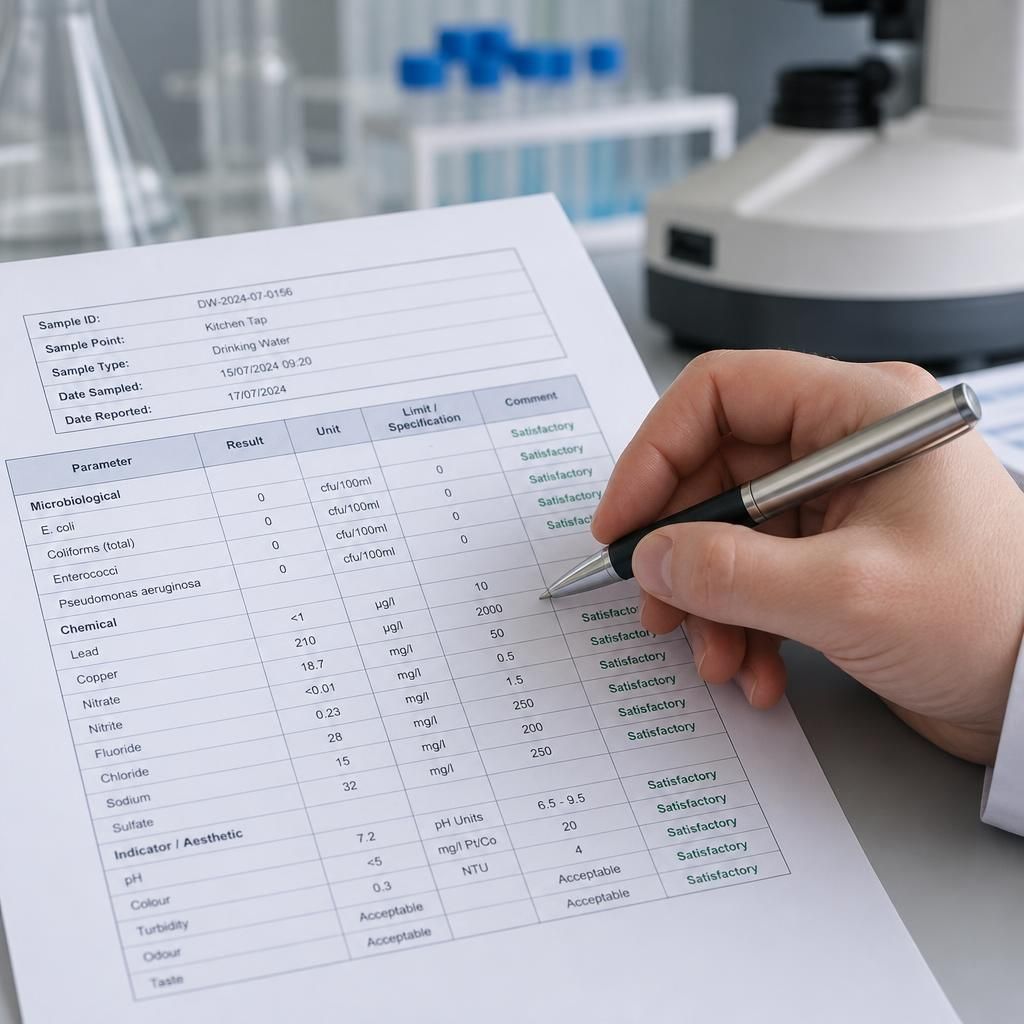
A laboratory report’s reference range or comment such as “satisfactory” is not necessarily the legal compliance decision. The result must be matched to the requirement applying to the premises, supply type and parameter, because laboratories may present findings using technical reporting conventions that do not capture the organisation’s wider regulatory duties.
For example, a result can fall within a stated reference range while still warranting action if it conflicts with site-specific control criteria, shows a significant change from previous findings or affects a sensitive use. Conversely, an operational alert does not automatically mean that a statutory limit has been breached. The compliance assessment should therefore record both the laboratory finding and the reasoned decision made by the responsible organisation.
Get Expert Help Interpreting Drinking Water Test Results
If you need help assessing what a drinking water test report means for your premises, speak to Blue Fish Water Management Ltd about reviewing the findings against the relevant compliance requirements and identifying appropriate next steps.