
How often should commercial water filters be replaced?
Commercial water filters should be replaced according to the manufacturer’s specified capacity or service interval, adjusted for water quality, usage and the results of routine checks. Replace the cartridge sooner if flow falls, taste or odour changes, the filter becomes damaged or monitoring shows that water quality is no longer being maintained.
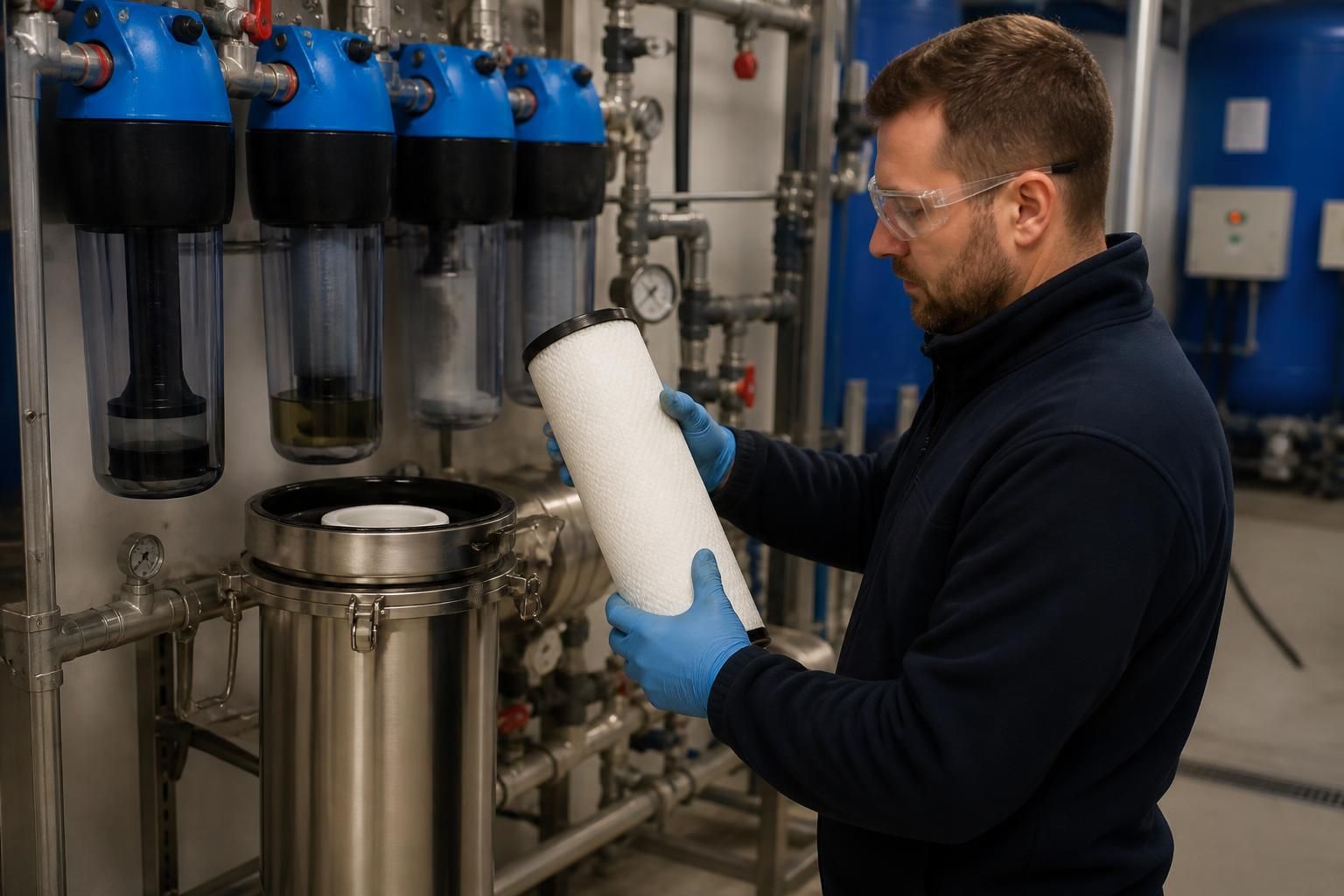
Commercial water filters do not have one universal replacement interval. The correct timing is determined by the filter manufacturer’s instructions, the filter’s treatment function and the way the system is used. A documented schedule should set the planned replacement point, while inspection and monitoring determine whether earlier action is necessary.
Replacement intervals should be established during system commissioning. Record the filter type, model, rated capacity, installation date, intended use and the manufacturer’s service instructions. The capacity is usually affected by the volume treated and the concentration of substances being removed. A filter treating heavily sedimented or chemically variable water may reach its useful limit sooner than an identical unit in a cleaner supply, even where the calendar interval is the same.
For this reason, a date-only approach is inadequate. A cartridge that has been installed for a relatively short period may still need changing if it has processed a high volume or become blocked. Conversely, extending a replacement date simply because the filter looks clean is not a reliable control. Some exhausted media show little visible change, and appearance does not demonstrate that the filter is still removing the substances for which it was selected.
The type of filter affects the replacement method. Sediment cartridges commonly become restricted as particles accumulate. Carbon-based cartridges can lose adsorption capacity without an obvious external sign. Specialist media may have a defined treatment capacity or require regeneration, while membrane systems have separate requirements for pre-filters, membrane condition and associated components. Ultraviolet systems are not filters, but any upstream filtration and the UV lamp itself must be maintained in accordance with the equipment instructions. Each component should therefore have its own maintenance requirement rather than being treated as part of a single generic interval.
Commercial operators should define what happens at the planned service point. This may include isolating the supply, removing the used cartridge hygienically, inspecting the housing and seals, cleaning or sanitising reusable parts where appropriate, fitting the specified replacement and flushing the system. The system should not be returned to service until any required checks have been completed and the outlet is suitable for use. Procedures must prevent contamination from hands, tools, packaging or an incorrectly fitted seal.
Replacement may be required before the planned date when:
- the pressure differential or flow restriction reaches the system’s defined action point;
- the cartridge housing, head, connections or seals are cracked, leaking or otherwise damaged;
- the filter has been exposed to conditions outside its specification;
- the system has remained unused for a period that requires additional assessment under the site procedure;
- testing, trend analysis or other monitoring indicates that the treated water is no longer meeting the required specification; or
- there has been a change in the source water, process, occupancy, equipment or demand that alters the filter’s duty.
A change in taste, odour or appearance should be investigated rather than treated as proof that replacing the cartridge alone will solve the problem. The cause could be the incoming supply, stagnant water, pipework, a dirty housing, a failed seal or another part of the treatment system. Where the filter forms part of a drinking-water or water-hygiene control, investigate the wider system and take proportionate corrective action.
Keep replacement evidence with the water-system records. Useful entries include the date and location of the change, the person carrying out the work, the cartridge or media specification, meter or usage information where available, inspection findings, pressure or flow readings, flushing details, test results and any follow-up action. A missed or overdue change should be recorded and assessed, not silently moved to a later date.
The responsible person should review the schedule when monitoring identifies repeated early blockages, when demand changes or when a risk assessment or compliance audit identifies a weakness. Trend information can help distinguish a one-off fault from a consistently unsuitable capacity or filter selection. If the filter cannot reliably perform its intended function, replacement with the same component may not be sufficient; the treatment design, installation and operating controls may also need review.
In a commercial setting, filter replacement should form part of the wider water-management plan. It does not replace cleaning, temperature control, sampling, risk assessment or other measures that may apply to the building and its water systems. Where the consequences of treatment failure are significant, an appropriately competent water-hygiene professional can help verify the schedule, assess monitoring results and identify remedial work.
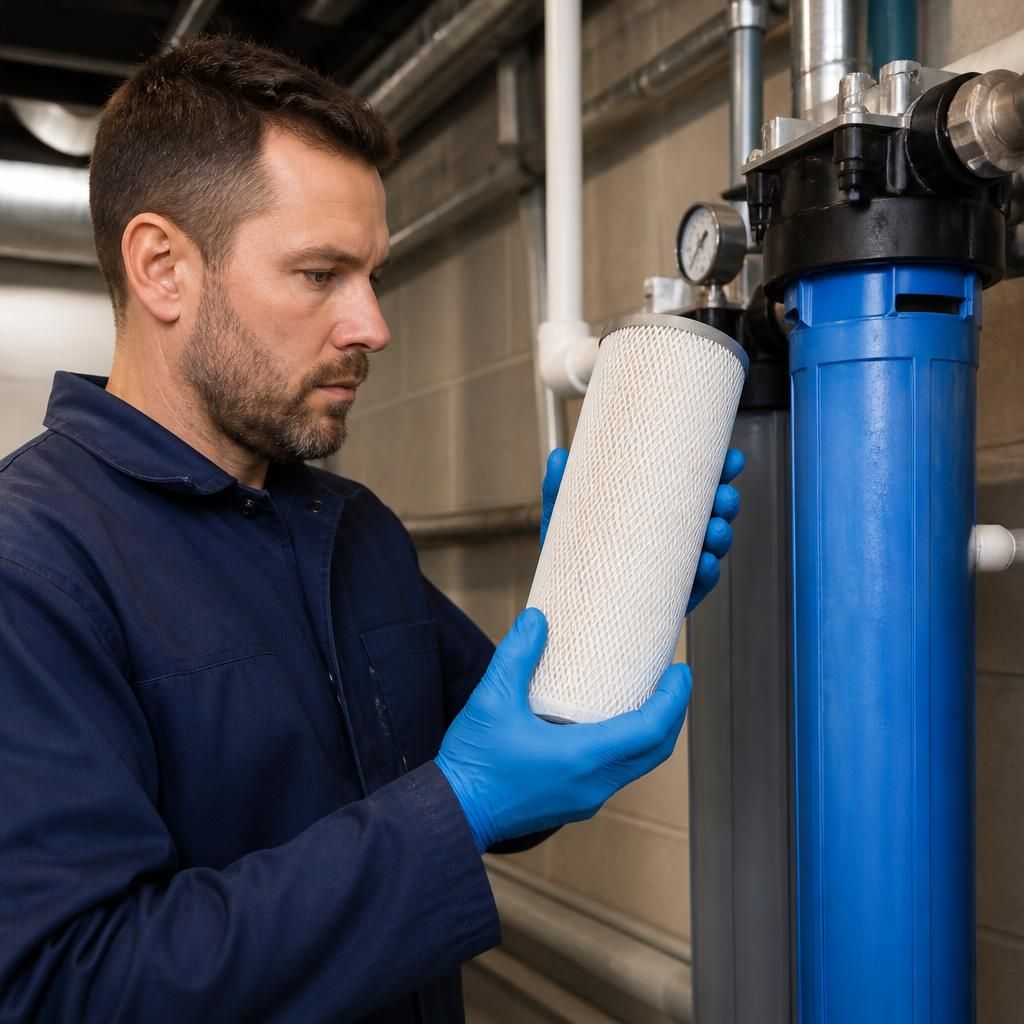
A replacement cartridge must be suitable for the filter housing and the water-treatment duty, not merely the same size as the item removed. Before fitting it, confirm the specified media, treatment capability, flow requirement, pressure and temperature limits, connections and intended water use. An apparently compatible cartridge may provide inadequate treatment or restrict the system if its performance characteristics differ.
Where the water source, process or demand has changed, the original replacement specification should be reviewed rather than automatically ordering the same part. The change record should identify the replacement used and why it remains appropriate for the system. If suitability cannot be demonstrated from the available information, obtain competent technical advice before returning the installation to service.
Need advice on replacing your commercial water filter?
If you need help reviewing a commercial water filter replacement schedule or assessing whether the existing specification remains suitable, contact Blue Fish Water Management Ltd for practical water-management advice.