
What should a water hygiene risk assessment include?
A water hygiene risk assessment should describe the water systems and uses, identify legionella hazards and people at risk, and evaluate how effectively those risks are controlled. It should also set out monitoring requirements, responsible persons, recommended corrective actions, review arrangements and evidence needed to demonstrate compliance.

A water hygiene risk assessment should provide a documented, site-specific examination of how water is stored, heated, distributed and used, with enough technical detail to justify the control measures selected. It should allow the dutyholder, responsible person and maintenance teams to understand the installation, the factors that could support legionella growth or spread, and the actions needed to manage those factors.
The document should identify its scope and basis. It should state the premises assessed, the systems included, the areas visited, the date of the inspection and any limitations, such as inaccessible plant rooms, unavailable records or equipment that could not be inspected safely. It should identify the assessor and record relevant competence and experience. Where parts of the installation are excluded, the assessment should explain why and whether a separate assessment or specialist inspection is required.
A clear description of the water installation is essential. This normally includes the incoming supply, storage cisterns, cold-water distribution, hot-water generation and return arrangements, outlets and specialist systems. The assessor should trace the system rather than relying solely on drawings, because alterations, redundant pipework and undocumented connections can change the actual risk. A simple schematic, supported by photographs or marked-up plans where useful, can show how water moves through the building and where control points are located.
- Cold-water storage tanks, lids, insect screens, overflows and warning arrangements
- Calorifiers, hot-water cylinders, boilers, secondary return pipework and associated controls
- Showers, spray taps, hoses, thermostatic mixing valves and other aerosol-generating outlets
- Low-use outlets, capped branches, redundant pipework, dead legs and sections subject to stagnation
- Plant or processes that alter water temperature, flow, pressure or quality
- Areas with restricted access, difficult maintenance conditions or unusual patterns of water use
An asset schedule should link these components to identifiable locations. It should record useful details such as equipment type, capacity where relevant, service function, access arrangements and maintenance requirements. This gives future inspections a consistent reference point and helps prevent overlooked assets from being omitted from planned control work.
The assessment should examine conditions that influence risk. It should consider whether water can remain within a temperature range that supports microbial growth, whether storage or circulation is inadequate, and whether deposits, scale, corrosion or biofilm may be present. It should also consider poor tank condition, damaged insulation, contamination pathways, insufficient turnover and irregular use. The significance of each finding depends on the design and operation of the system; an isolated observation should not be treated as a complete conclusion without considering how the installation functions as a whole.
People and activities should be considered in context. The assessment should record how outlets are used, whether showers or other spray-producing equipment are present, and whether the building accommodates people who may be particularly susceptible to infection. Relevant factors can include age, underlying health conditions, treatment-related vulnerability and the nature of the premises. This information helps determine the level of control and management needed without assuming that every outlet or occupant presents the same level of risk.
Existing arrangements should be tested against the system observed. The assessor should review available records, such as schematic drawings, asset registers, temperature logs, cleaning and disinfection certificates, maintenance reports, sampling results, incident records and previous assessments. The document should distinguish between controls that are documented and controls that have been verified during the site visit. It should also note inconsistencies, for example where a log refers to equipment that has been removed or where an outlet is absent from the current asset list.
Temperature management is usually examined in detail, including the performance of hot-water generation, circulation and point-of-use controls, as well as the condition and insulation of pipework. Cold-water systems should be considered separately, since their risks may relate to heat gain, storage conditions, slow turnover or proximity to hot services. Measurements should be interpreted alongside system design and operating conditions rather than presented as isolated figures.
Sampling and laboratory testing should be addressed proportionately. A risk assessment is not the same as a water sample or a certificate showing a single test result. Where sampling is appropriate, the assessment should explain what question the samples are intended to answer, which outlets or system sections are selected, how samples are taken, and how results will affect the management response. Sampling cannot replace inspection of the installation, review of controls or investigation of the causes of an unsatisfactory result.
Findings should be prioritised rather than presented as an undifferentiated list. Each recommendation should identify the deficiency, the associated risk, the corrective measure, the person or role responsible, and the evidence needed to confirm completion. Suitable actions may include removing redundant pipework, improving access, repairing or replacing damaged components, correcting temperature control, cleaning and disinfecting equipment, revising procedures or obtaining further technical information. The assessment should make clear where specialist design, engineering advice or additional investigation is needed.
Management arrangements should be practical and specific. The report should show how duties are allocated between the dutyholder, responsible person, facilities team, contractors and other relevant parties. It should identify required competence, escalation arrangements and the records that need to be retained. If contractors undertake monitoring, servicing, cleaning or remedial work, the arrangements should define what they are expected to provide and how their work will be checked.
The review section should explain what would trigger an earlier reassessment. Relevant changes can include alterations to the water system, changes in building use or occupancy, prolonged closure, acquisition of new equipment, a significant change in water use, an incident, or evidence that existing controls are not effective. A scheduled review should not be treated as a substitute for reassessing the system when circumstances change.
For compliance purposes, the completed assessment should be dated, version-controlled and retained with supporting records. It should be sufficiently clear for someone who was not present during the inspection to understand the conclusions and follow the recommended actions. Guidance such as the Health and Safety Executive’s ACOP L8 and HSG274 can help inform the approach, but the final document should reflect the actual premises rather than reproduce generic guidance.
In practice, a useful assessment is one that connects the physical installation with its operation and management. It should give the organisation a defensible basis for deciding what to monitor, what to repair, what to test and when the arrangements need to be reviewed.
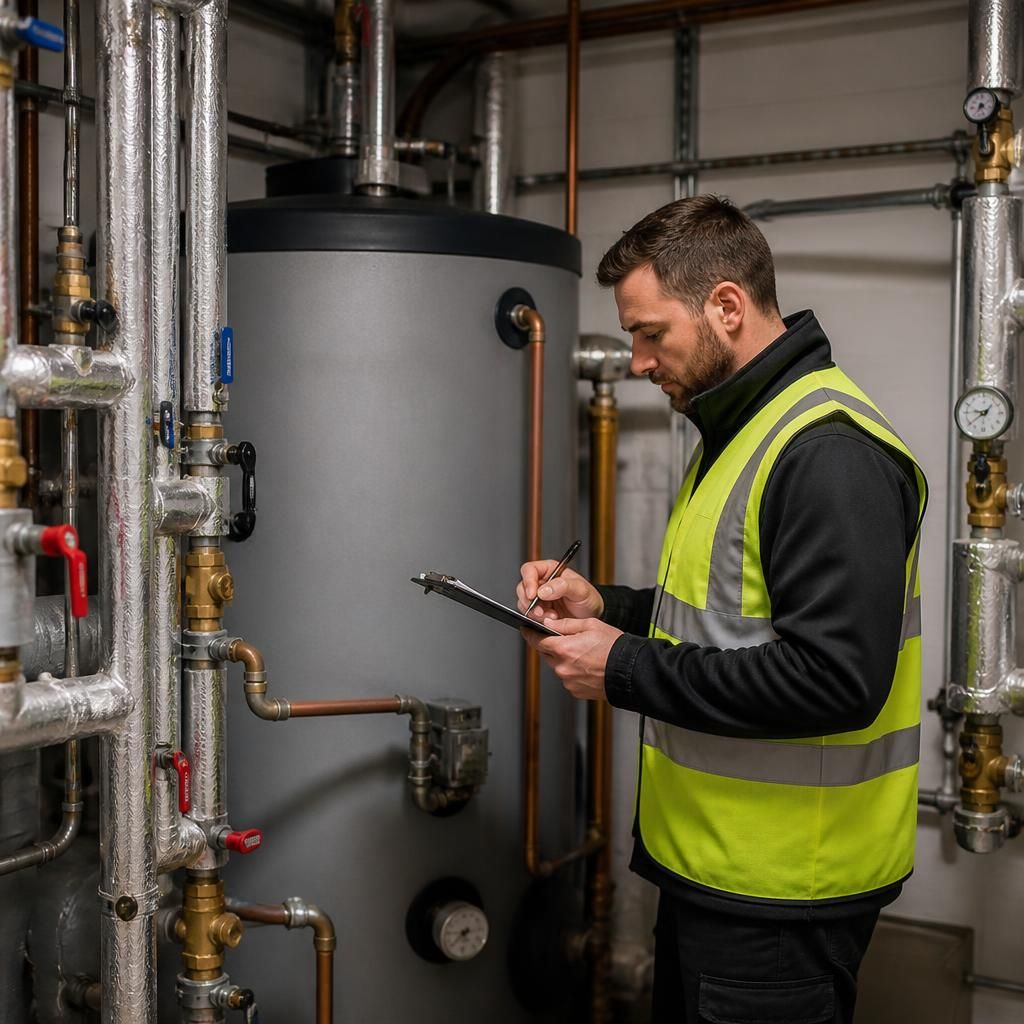
A water hygiene risk assessment should distinguish between the risk presented by the system before controls and the residual risk that remains after existing measures are considered. This prevents a well-managed installation from being treated in the same way as one with similar hazards but ineffective controls.
The report should explain how each significant control affects the assessment, including whether it is present, suitable and operating as intended. Where the remaining risk cannot be reduced immediately, the assessment should record the interim management measures and the basis for accepting the risk until permanent corrective work is completed.
Discuss your water hygiene risk assessment
Discuss your water hygiene risk assessment with Blue Fish Water Management to clarify its scope, findings and recommended next steps for your organisation.