
Which water quality indicators should a laboratory test alongside legionella?
Alongside legionella, a laboratory may test indicators such as water temperature, pH, turbidity, conductivity, residual disinfectant and background bacteria, depending on the system and risk assessment. These results help identify conditions that support microbial growth, assess treatment performance and interpret legionella findings within the wider water hygiene picture.

The additional water quality tests should be selected according to the type of water system, its use, the control measures in place and the risks identified in the assessment. There is no universal panel that is appropriate for every legionella investigation. A suitable laboratory schedule combines microbiological, chemical and physical indicators that can explain system conditions, reveal changes over time and help determine whether remedial action has been effective.
General bacterial indicators can provide context for a legionella result. A heterotrophic colony count, sometimes called a total viable count, gives an indication of the broader population of organisms able to grow under the test conditions. It is not a direct measure of legionella risk and cannot confirm that a system is safe, but an unexpected change between comparable samples may indicate altered system conditions, stagnation, ingress or a loss of treatment control.
For water intended for drinking, laboratories may also examine coliform bacteria and Escherichia coli where the sampling purpose and applicable requirements call for them. These organisms are used as indicators of contamination associated with the supply or distribution system. They answer a different question from legionella testing: they are principally relevant to the sanitary quality of potable water and should not be treated as substitutes for a legionella analysis.
In healthcare, care settings and other higher-risk environments, the testing plan may include organisms of particular concern to vulnerable users. Pseudomonas aeruginosa, for example, can be relevant in certain healthcare water systems, clinical areas and outlets. Its inclusion depends on the site risk assessment, the users exposed and the type of outlet or system being investigated. Other targeted microbiology may be appropriate where there is a known contamination concern rather than as part of every routine sample.
Water chemistry tests can help identify conditions that affect corrosion, scale formation, disinfectant performance and the persistence of deposits or biofilm. Depending on the installation, useful parameters may include:
- Hardness and alkalinity: these help assess the water's tendency to form scale and its buffering capacity, both of which can affect treatment and system condition.
- Chloride and sulphate: elevated or changing concentrations may contribute to corrosion risk, particularly where materials and operating conditions make the system vulnerable.
- Iron and copper: these can indicate corrosion, dissolution from pipework or fittings, and the presence of deposits that may affect water quality.
- Ammonia, nitrate and nitrite: these may help investigate contamination, nitrification or changes associated with treatment processes, where relevant to the supply and system.
- Phosphate or other treatment-related chemicals: these may be measured where a dosing regime is used and the laboratory needs to assess whether the treatment is being applied consistently.
Where a building uses a private water supply, a storage tank, a softener, a treatment plant or reclaimed water, the testing scope may need to be broader than for a straightforward mains-fed installation. The source, treatment stages and materials in contact with the water should be recorded so that the laboratory can recommend relevant analytes rather than applying a standard list without regard to the system.
Testing for nutrients and organic loading can sometimes support an investigation into microbial growth. Organic carbon, biochemical oxygen demand or related measures may be considered for complex systems or unusual contamination events, although these are not routine legionella tests. Their value depends on whether the result can be linked to a specific source, treatment process or operational change.
Some indicators are most useful when measured alongside the sample rather than retrospectively. Temperature and disinfectant measurements, for example, can change during transport, so a laboratory report should distinguish between field observations and results produced under controlled laboratory conditions. The sampling record should also identify the outlet, system section, whether the sample was taken before or after flushing where applicable, and any recent cleaning, disinfection or maintenance.
Results should be interpreted as a set rather than as isolated pass-or-fail findings. A raised general bacterial count alongside evidence of deposits, poor circulation or inconsistent treatment may point towards a system-management issue. A chemical result suggesting corrosion may explain discolouration or metal release without proving microbial contamination. Conversely, an acceptable result for one indicator does not rule out legionella elsewhere in the system, because organisms may be unevenly distributed and conditions can differ between outlets.
For this reason, the laboratory report should state the method used, the units, any reporting limits and whether the result is quantitative or qualitative. Results should then be compared with the relevant specification, site history and risk assessment. Where findings are unexpected, repeat or targeted sampling may be more informative than commissioning a large number of unrelated tests. A competent water hygiene professional can help determine which indicators will answer the investigation's specific question and whether the sampling locations provide a representative picture of the system.
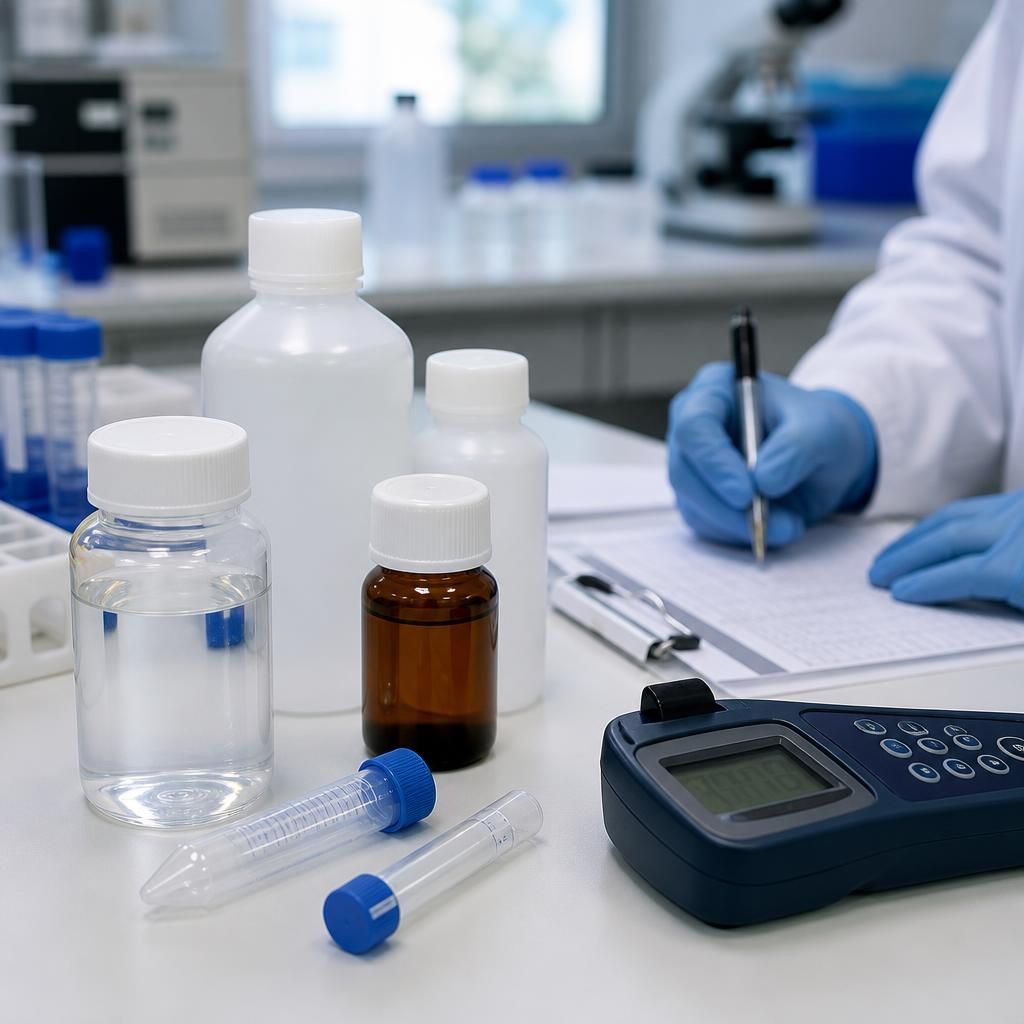
Water quality indicators should be agreed with the laboratory before sampling because different analyses may require different containers, sample volumes, preservatives and holding conditions. A bottle collected for legionella may not be suitable for every chemical or microbiological examination, and some parameters are best measured at the site rather than after transport.
The sampling request should therefore list legionella and each additional indicator required, together with the sampling location and system details. This helps the laboratory prepare the correct materials and prevents an unsuitable sample from limiting the investigation. If the purpose of testing changes after collection, the laboratory should confirm whether the remaining sample is suitable before adding further analysis.
Discuss the right water quality tests for your system
Contact Blue Fish Water Management to discuss the most appropriate laboratory testing scope for your water system. The team can help identify the information and sampling requirements to agree with the laboratory before testing begins.