
How should businesses interpret legionella laboratory results?
Businesses should interpret legionella laboratory results alongside the sample location, collection date, test method and detection limit, rather than treating a result as meaningful in isolation. A positive finding should be assessed against the water system’s risk assessment and management controls, with proportionate corrective action and follow-up testing where required.
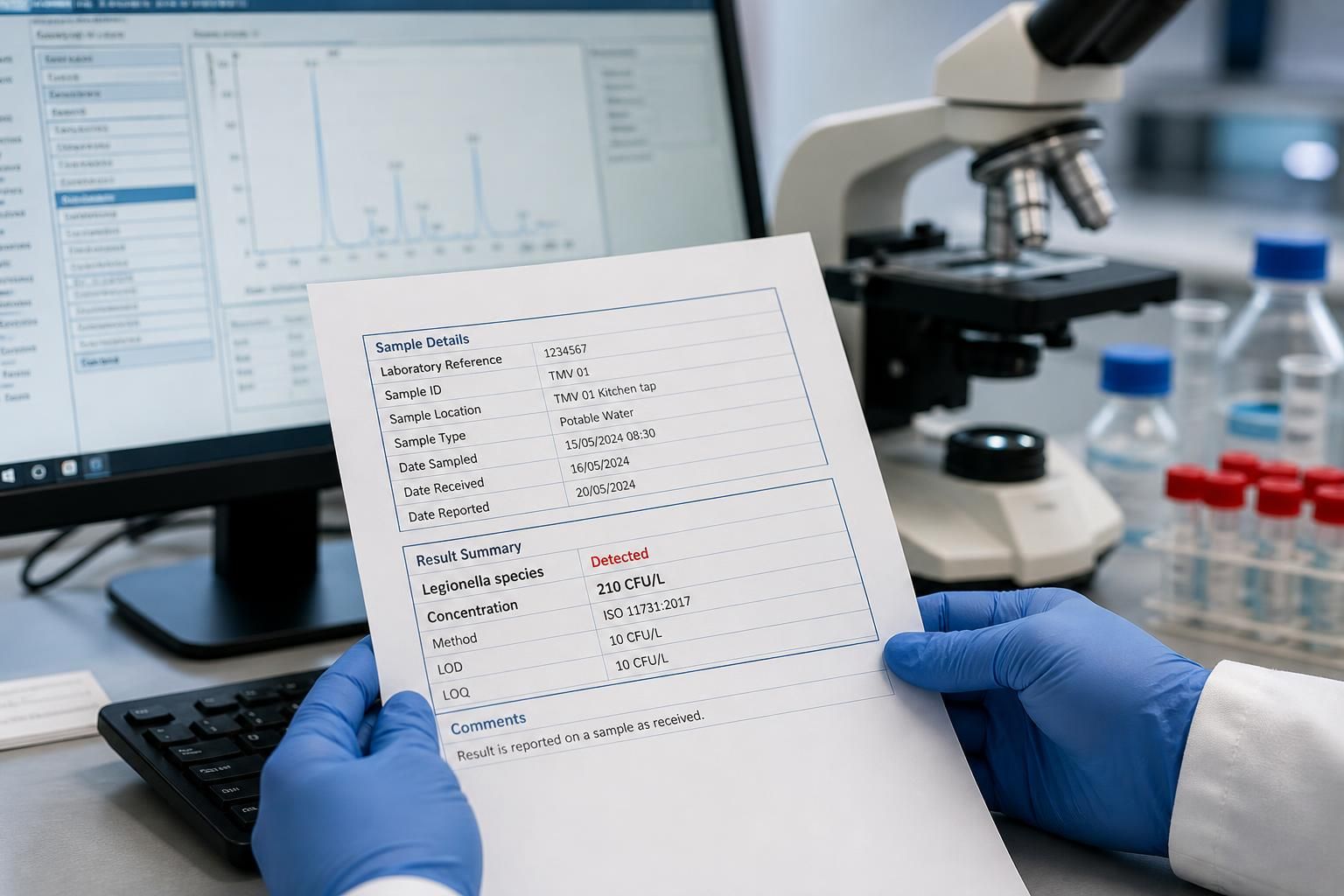
Legionella laboratory results should be interpreted as evidence about a particular water sample, not as a complete pass-or-fail judgement on the whole water system. The meaning of a finding depends on the organism identified, the concentration reported, the analytical method, the sample point and the controls already in place. A competent person should combine the report with the site’s risk assessment, monitoring records and knowledge of system use before deciding what action is proportionate.
Start with the exact result. Check whether the report states that legionella was not detected, detected and quantified, or detected but below the laboratory’s reporting or quantification limit. These terms are not interchangeable. “Not detected” means the organism was not found in that sample using the stated method; it does not prove that legionella is absent from every part of the system. A result below a reporting limit may still indicate that the organism was detected, even if the laboratory cannot reliably provide a concentration.
Where legionella has been quantified, review the reported unit, normally colony-forming units per litre for culture-based testing, and any relevant uncertainty or qualification attached to the result. The detection limit and quantification limit help explain how much confidence can be placed in a low-level result. A value close to a reporting limit should not be treated as directly comparable with a result obtained using a different method or laboratory limit.
Confirm what the laboratory has tested for. A report may identify Legionella generally, Legionella pneumophila, a particular serogroup, or another species. Culture and molecular methods do not provide identical information. Culture can indicate viable organisms capable of growing under the conditions used, while molecular testing may detect genetic material without demonstrating that the organisms are viable. The method therefore affects how the result should be used in the risk assessment and whether confirmatory culture or additional investigation is appropriate.
Interpret the concentration against current guidance. UK guidance uses action bands to help dutyholders judge the significance of legionella counts. A low result does not remove the need for effective control, and a higher result does not by itself explain the cause. Results that enter an action band should prompt a review of the system, control measures and sampling strategy. A substantially elevated result generally requires urgent investigation and corrective action in accordance with the site’s risk assessment and the relevant guidance.
Do not apply an action level mechanically. The same result can have different implications depending on whether the sample came from a rarely used outlet, a hot-water return, a storage vessel, a cooling system or a point used by people who may be particularly vulnerable. The potential for aerosol generation, the frequency of use, water temperatures, stagnation, scale, biofilm and the condition of the system should all be considered.
Compare the result with the sample history. A single result is less informative than a properly designed trend. Compare like with like, including the same or comparable outlet, sampling technique, laboratory method and relevant operating conditions. An isolated increase may require investigation, while repeated detection or a rising pattern can indicate deteriorating control even where individual results do not appear extreme. Conversely, a lower follow-up result does not necessarily confirm that the underlying cause has been removed.
Review the sample date and time, whether the outlet was representative, and whether the sample was taken before or after flushing. A routine outlet sample and a total-volume or upstream sample answer different questions. If the sample point was seldom used, recently cleaned, disinfected or affected by unusual operation, that context should be recorded when the result is assessed.
Use the result to investigate control performance. Where legionella is detected, examine records for temperature monitoring, outlet use and flushing, cleaning and disinfection, tank condition, scale or sediment, dead legs, changes in occupancy and any recent maintenance. Check whether monitoring was completed as specified and whether readings were taken at representative points. The purpose is to identify why the result occurred, rather than simply arranging another sample without addressing the system conditions that may have allowed growth.
Corrective action may include improving temperature control, removing stagnation, cleaning or disinfecting affected components, repairing defects, revising flushing arrangements or increasing monitoring temporarily. The selected measure should follow the risk assessment and be suitable for the type of system. Any intervention should be documented, including the reason for it, the parts of the system affected, the date completed and the person responsible.
Interpret follow-up results carefully. Repeat sampling is used to check whether control has been restored and whether the initial finding was isolated or persistent. It should be planned around the corrective action and the system’s operating characteristics, not used as a substitute for action. If results remain positive, fluctuate significantly or conflict with other evidence, review the sampling plan, laboratory method and system investigation. A specialist assessment may be needed where the cause is unclear or the system presents a significant exposure risk.
The final interpretation should be traceable. Keep the laboratory report with the sample location, sampling date, collector, method, detection limit, operating conditions, related control records, risk assessment and decisions taken. This provides an auditable explanation of how the business responded and helps the responsible person distinguish a genuine change in system condition from a change in sampling or testing approach.
For businesses without the technical expertise to interpret a result, the report should be reviewed by a competent water hygiene professional who can relate the finding to the whole system. Laboratory data is an important part of legionella management, but it cannot replace competent risk assessment, effective control measures and documented review.
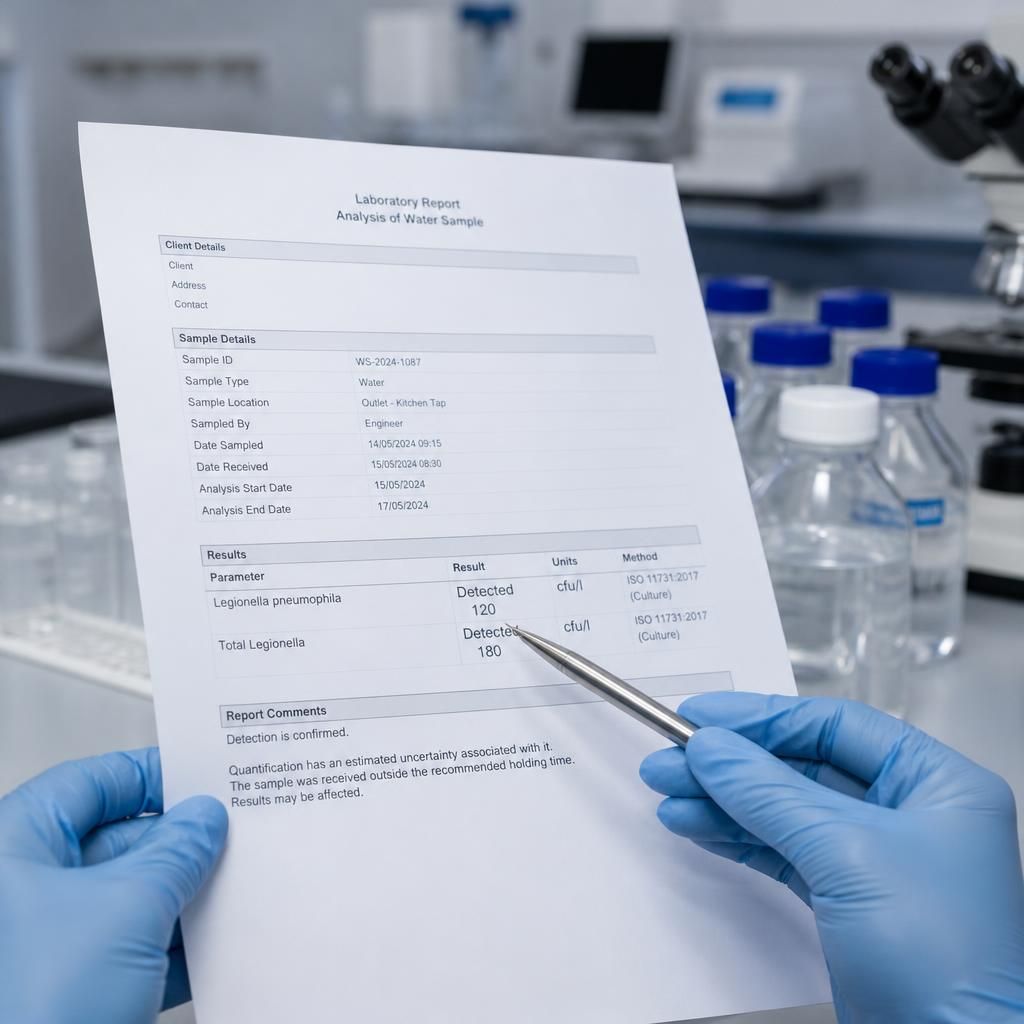
Laboratory comments and result qualifiers are important when interpreting a legionella report. A result may be marked as estimated, qualified or affected by a deviation such as delayed receipt, an unsuitable sample condition or interference during analysis. These flags do not automatically invalidate the finding, but they can limit how confidently it should be compared with previous or future results.
Where a report includes a qualification, businesses should establish what it means before making a compliance decision. The laboratory can clarify whether the reported result remains suitable for risk assessment, or whether a further sample collected under appropriate conditions is needed. Record that explanation with the report so the basis for any subsequent action remains clear.
Discuss your legionella laboratory results
If you need an expert review of legionella laboratory results, Blue Fish Water Management Ltd can help relate the findings to your water system and management controls. Contact the team to discuss the report and determine whether further investigation or action is appropriate.