
What records should a water supply check produce?
A water supply check should produce a dated, traceable record covering the areas and systems examined, observations made, readings or samples taken, and any defects or non-compliances identified. It should also record the recommended corrective actions, assigned responsibilities, completion dates and supporting evidence, such as test results or photographs.

A water supply check should produce an auditable record set, not just a brief pass-or-fail note. The records should show what was reviewed, the evidence used, how the findings were interpreted, and how the organisation controls any continuing risk. They should be clear enough for a responsible person, auditor, contractor or enforcing authority to understand the condition of the water system without relying on informal explanations.
Alongside the findings, the record should identify the premises and the relevant water systems or assets. Useful details include the site address, building or area, system description, asset reference, inspection route and the person or organisation carrying out the check. Where a site has several buildings, tanks, outlets or secondary systems, precise identification prevents a result from being wrongly applied to the wrong part of the installation.
Good records also explain the basis of the check. This may include:
- the inspection or monitoring schedule;
- the relevant risk assessment, water safety plan or control procedure;
- the guidance, specification or internal standard used to assess the system;
- the reason for any additional check, such as a change in use, an unusual result or remedial work; and
- any limitations, access restrictions or areas that could not be examined.
Recording limitations is particularly important. An incomplete inspection should not appear to be a full confirmation of control. The record should state what was unavailable, inaccessible or outside the agreed scope, together with the consequence for risk management and whether a further check is required.
Where water samples are taken, the supporting paperwork should allow the result to be followed from collection to reporting. It should link each sample to the precise outlet or system location and record the collection date, sample identifier, sampler and relevant handling information. Laboratory reports should be retained with the corresponding check record, including any interpretation provided by the laboratory or competent water hygiene professional. A result should be considered in context rather than filed as an isolated number: previous results, system conditions and the control measures in place may all affect its significance.
The record should also show how findings were assessed. This means distinguishing between observations, maintenance issues, control failures and matters requiring urgent escalation. The reasoning behind a priority or recommendation is valuable because it helps later reviewers understand why a particular action was selected. If the check confirms that a control is operating as intended, that confirmation should be recorded with the evidence supporting it; records should not focus only on faults.
Corrective action records should be connected to the original finding and should remain live until closure has been verified. A useful action trail includes:
- a unique reference for the finding;
- the required control or remedial measure;
- the person, role or contractor responsible for arranging it;
- the target date and any interim control used while the issue remains open;
- the completion date and description of work undertaken; and
- verification that the action addressed the identified risk.
Completion evidence might include an updated maintenance entry, commissioning information, photographs, a revised procedure, staff instruction records or follow-up monitoring. The appropriate evidence depends on the action. A completed work order alone may show that someone attended, but not necessarily that the water safety control was restored or is functioning correctly.
Records should support communication as well as inspection. Where a finding is significant, they should show who was informed, what advice or escalation was given, and whether the responsible person accepted or amended the proposed action. Changes to the system, occupancy, use of outlets, contractors or control arrangements should be reflected in the relevant water safety documentation so that records do not become disconnected from the current installation.
Document control is another essential element. Each record should have a clear title or identifier, date, author or approver, and revision status where it is amended. Superseded versions should be managed so that staff do not rely on obsolete instructions, while completed records remain accessible for review. Electronic records should have suitable access controls and backups; paper records should be legible, securely stored and protected from loss or deterioration.
The organisation should define how long different records are retained, taking account of applicable legal, regulatory, contractual and insurance requirements. Retention arrangements should cover the original check, supporting evidence, action history and closure verification rather than keeping only a final summary. Periodic management review can then use the record set to identify recurring defects, missed checks, deteriorating controls or changes that require the risk assessment and monitoring programme to be updated.
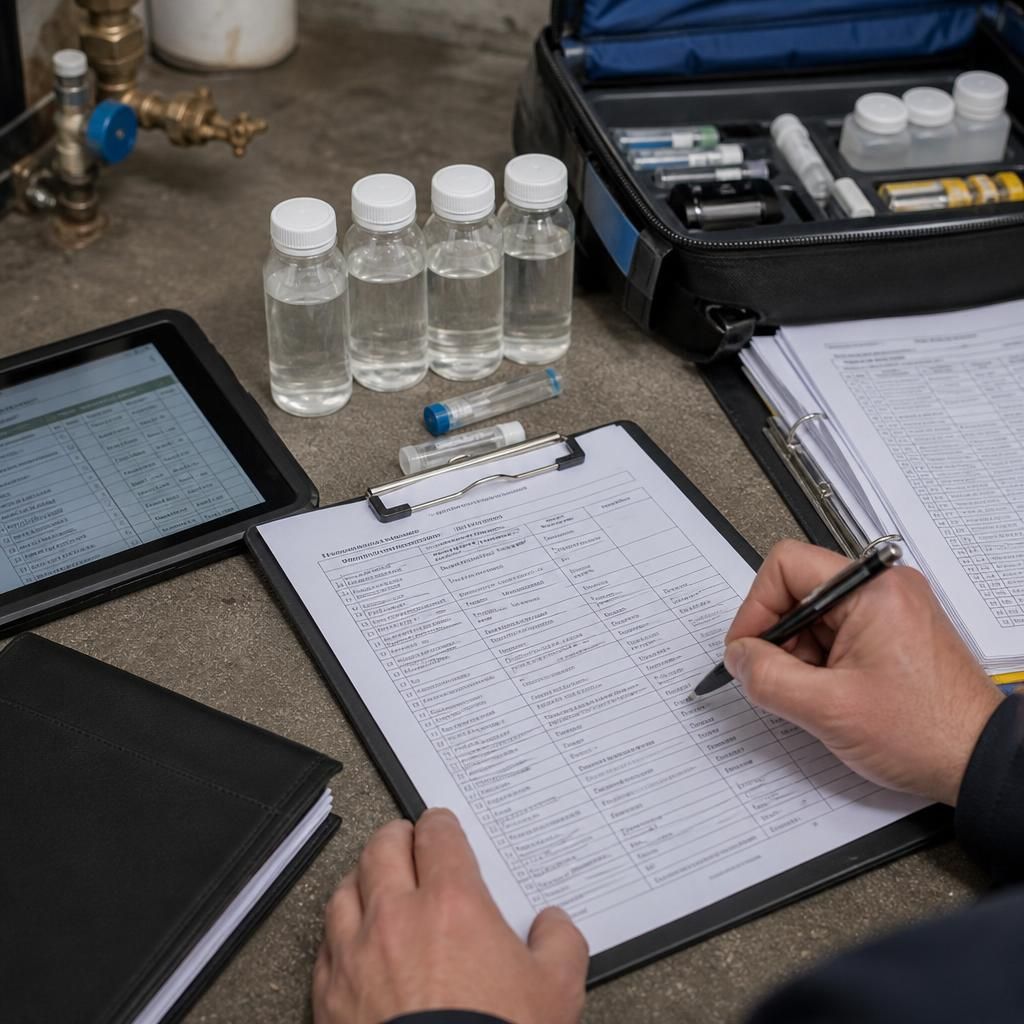
The most useful water supply check record separates factual evidence from professional interpretation. For each item examined, record what was observed or measured first, followed by the relevant control expectation and the conclusion reached. For example, a temperature reading, outlet condition or flushing observation should not be replaced by a general comment such as “satisfactory”.
Use consistent terms and units throughout the record, and distinguish clearly between compliant, not compliant, not checked and not applicable. This prevents an incomplete check from being mistaken for a clean result and makes separate records easier to compare. If an assessment depends on professional judgement, briefly state the reason for that judgement so another competent reviewer can understand how the conclusion was reached.
Discuss your water supply check record requirements
If you need to review your water supply check requirements, discuss your organisation’s arrangements with Blue Fish Water Management Ltd. Their team can advise on appropriate water hygiene checks and supporting documentation.