
Which water chemistry test best fits your system’s compliance needs?
The best water chemistry test depends on the control parameter your system requires: hardness and TDS testing assesses mineral content and dissolved solids, while BOD, COD and TOC testing measures organic loading and water quality. Select the test by considering the system’s risk assessment, the parameter being investigated and whether a documented laboratory result is required for compliance.
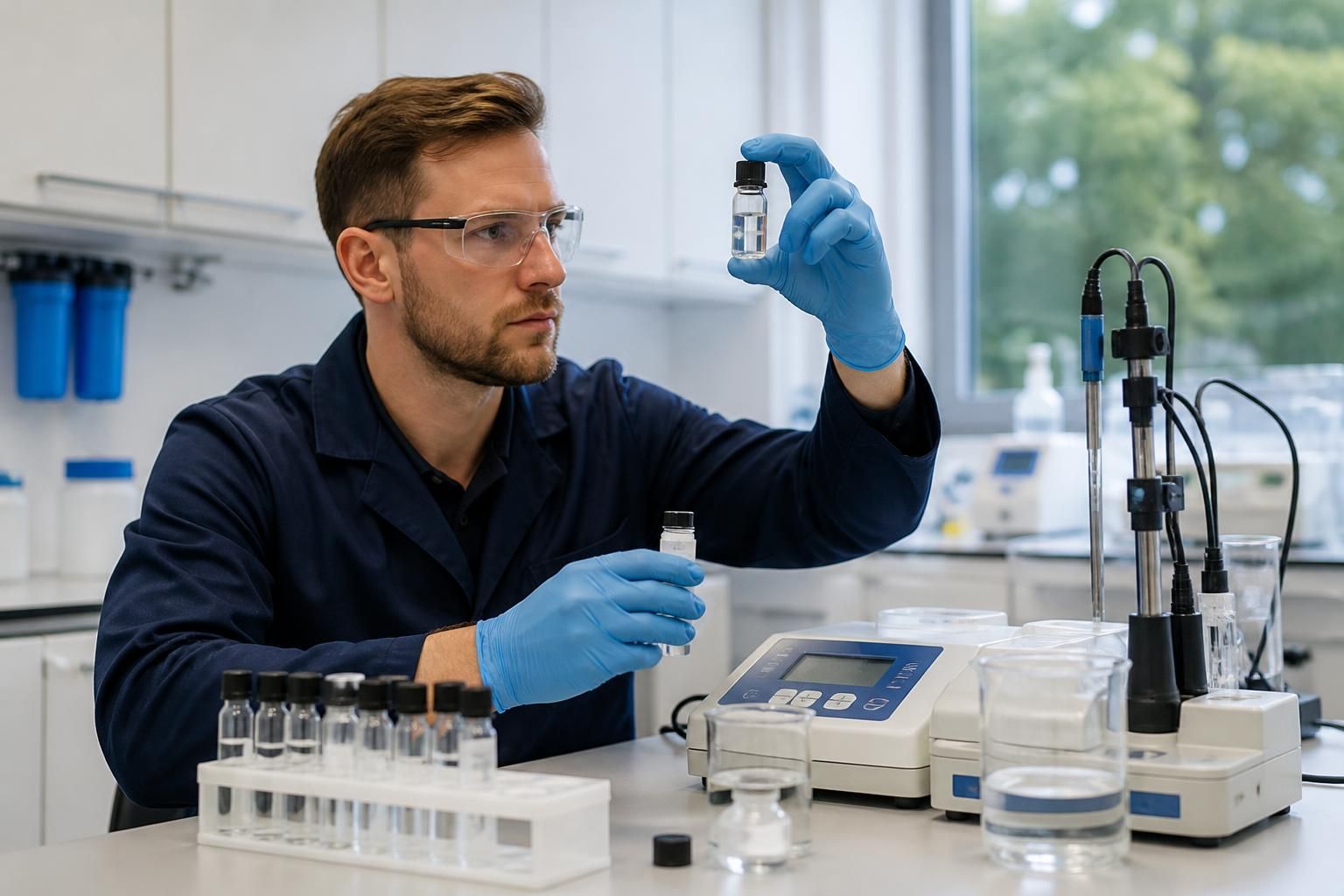
The most suitable water chemistry test is the one that measures the parameter linked to the system’s control objective and produces evidence at the level required by the risk assessment. A single test is rarely appropriate for every water system: hardness and total dissolved solids (TDS) are mainly used to assess mineral loading, whereas biochemical oxygen demand (BOD), chemical oxygen demand (COD) and total organic carbon (TOC) investigate organic contamination and degradable material.
Start by identifying the operational question rather than choosing a test by name. For example, a water treatment programme may need to establish whether scale-forming minerals are entering a system, whether dissolved material is concentrating through evaporation, or whether organic loading is increasing. The result should support a defined action, such as adjusting treatment, investigating a change in source water, reviewing system cleanliness or escalating a developing risk.
- Choose hardness testing when calcium and magnesium content may contribute to scale, affect heating efficiency or reduce the performance of water treatment equipment. It can also help verify whether a softening process is operating as intended.
- Choose TDS testing when the concern is the overall concentration of dissolved substances. TDS is useful for trending changes and identifying concentration in systems where evaporation or repeated recirculation occurs, but it does not identify which individual substances are present.
- Choose BOD testing when the question concerns the amount of dissolved oxygen likely to be consumed as biodegradable organic matter breaks down. This can be relevant when assessing organic pollution or wastewater characteristics.
- Choose COD testing when a broader estimate of chemically oxidisable material is required and a faster indication than BOD may be useful. COD can include substances that are not readily biodegradable, so it should not be treated as interchangeable with BOD.
- Choose TOC testing when the objective is to measure the amount of carbon contained in organic compounds. It is particularly useful for tracking low-level organic changes, comparing samples over time and assessing whether a treatment or cleaning process has altered organic loading.
The intended decision also determines whether one parameter is enough. Hardness and TDS answer different questions: a water sample can have a relatively stable TDS while its mineral balance changes, and a high TDS reading does not by itself prove that scale will form. Similarly, BOD, COD and TOC describe organic content in different ways. Where the cause of a change is uncertain, a planned combination of tests may provide more useful evidence than relying on one result in isolation.
Sampling location is part of test selection. A source-water sample establishes the incoming condition, while samples taken before and after treatment help assess the performance of that treatment. Samples from storage tanks, distribution points, return lines or process outlets may reveal local changes that would be missed by a single representative sample. The sampling plan should specify the point, date, conditions and reason for collection so that results can be compared meaningfully.
Consider the evidence required for the compliance record before sampling begins. An on-site test may be suitable for operational checks and immediate trend monitoring, particularly where the method is validated for the parameter and the equipment is maintained and used correctly. Laboratory analysis is more appropriate when the result must be independently documented, when the concentration is close to an action level, when the water quality problem is disputed or when a wider analytical range is needed. The method, detection capability, sample preservation and chain of custody can all affect whether a result is defensible.
Test results should be interpreted against the system’s documented control measures, relevant specifications and the conditions under which the sample was taken. A result outside an internal control range is not automatically proof of a statutory breach, but it should prompt investigation. Review recent changes to source water, dosing, temperature, flow, occupancy, cleaning, maintenance and equipment condition. Repeat sampling may be necessary to distinguish a one-off result from a persistent trend, but it should not be used to dismiss an adverse finding without a documented rationale.
Water chemistry testing supports legionella control, but chemistry results do not replace a legionella risk assessment, temperature management, system monitoring or microbiological investigation where those controls are required. The selected test should therefore sit within the wider water safety plan, with clear responsibility for reviewing results, recording actions and confirming whether corrective work has resolved the underlying issue.
A practical selection process is:
- Define the suspected change or compliance decision.
- Identify the parameter that directly measures that issue.
- Choose sampling points that distinguish source, treatment and downstream conditions.
- Decide whether an operational check or a documented laboratory result is needed.
- Set the interpretation criteria before reviewing the result.
- Record the finding, investigation, corrective action and any follow-up sample.
For a system with a clear scale or concentration concern, hardness or TDS may be the most proportionate starting point. For suspected organic loading, select BOD, COD or TOC according to whether biodegradability, chemically oxidisable material or total organic carbon is the relevant control question. Where the compliance decision is significant or the cause is unclear, a risk-based sampling plan and laboratory-supported interpretation provide stronger evidence than an isolated test reading.

The right water chemistry test can change as a system moves from routine control to investigation or remedial verification. During routine operation, a simple, repeatable parameter may be sufficient for trending. After a treatment change, cleaning exercise or unexplained result, the test should be selected to verify the specific change and its effect rather than automatically continuing the routine check.
- Routine monitoring: use a consistent method so meaningful changes can be distinguished from normal test variation.
- Investigation: broaden the assessment where the initial result does not explain the suspected change.
- Post-remedial verification: repeat the relevant parameter under comparable conditions and retain the result with the corrective-action record.
This staged approach prevents unnecessary testing while ensuring that the evidence matches the compliance decision being made.
Discuss which water chemistry test fits your compliance needs
If you are unsure which water chemistry test supports your compliance decision, discuss your system, sampling objectives and evidence requirements with Blue Fish Water Management Ltd. Their specialists can help identify a proportionate testing approach for your water safety programme.