
Which hard water test is suitable for a commercial water system?
For most commercial water systems, a total hardness test using an EDTA titration method is suitable for routine assessment of calcium and magnesium hardness. Where results inform compliance decisions, investigate an unexpected change or need formal evidence, use a laboratory water sample analysis from a UKAS-accredited testing service.

The suitable hard water test depends on what the result needs to establish. For routine operational checks, measure total hardness as calcium carbonate, which combines the calcium and magnesium responsible for most scale formation. For investigation, verification or documented compliance evidence, send a representative sample for laboratory analysis rather than relying solely on an on-site test kit.
Total hardness testing is generally the most useful starting point for a commercial water system. An EDTA titration test measures the combined concentration of calcium and magnesium ions. It is appropriate for checking whether incoming water, softened water or treated water is within the operating range set for the system. It can also help identify a change in the source water or a softener that is not performing as expected.
Commercial operators may use a manual titration kit, a digital titrator or a photometric test. These methods can be suitable for routine monitoring when the equipment is appropriate for the expected hardness range, correctly maintained and used by a trained person. The test method should have clear instructions, suitable reagents and a defined reporting unit, such as mg/l as calcium carbonate or degrees of hardness. Results should not be compared unless they are reported in the same units.
A laboratory water analysis is more suitable where the result may be challenged, needs to form part of an audit trail, or does not fit the system's previous pattern. Laboratory testing can provide a controlled method, documented sample handling and a report that identifies the analytical method and result. A UKAS-accredited testing service is appropriate where accredited evidence is required for the particular analysis.
Testing for total hardness should not be confused with a total dissolved solids, or TDS, test. TDS indicates the combined concentration of dissolved substances and does not identify how much of that reading is calcium or magnesium. A high TDS result therefore cannot be converted reliably into a hardness result. Conversely, water can have a relatively stable hardness value while other dissolved constituents change. Select the test according to the decision being made, and request both parameters only when both are relevant.
Other tests may be needed alongside hardness testing in particular situations:
- Calcium hardness can be useful when the contribution from calcium needs to be separated from total hardness.
- Alkalinity helps assess carbonate chemistry and can support an investigation into scaling or water treatment performance, but it is not a substitute for hardness.
- pH and conductivity can provide useful supporting information about water chemistry and changes in treatment conditions.
- Softener performance checks may include hardness before and after the unit, together with a review of regeneration, salt supply, bypass operation and sampling points.
The sampling point matters as much as the selected method. Take the sample from a clearly identified outlet or pipe section that represents the water being assessed. Avoid drawing conclusions from a stagnant sample when the purpose is to evaluate circulating or supplied water. Record the date, location, system condition, whether the outlet was flushed, the treatment state and the test method. If a sample is sent to a laboratory, follow its container, preservation and transport instructions.
For a commercial system, a practical selection process is:
- Define the purpose of the test, such as routine control, softener verification, troubleshooting or formal evidence.
- Choose total hardness for a direct assessment of calcium and magnesium hardness, adding supporting parameters only where they answer a specific question.
- Use a suitable field method for straightforward operational monitoring and apply the same method consistently when comparing results.
- Use laboratory analysis when the result is unexpected, technically significant or required as documented evidence.
- Compare the result with the system's documented operating criteria, treatment design and previous reliable results rather than with a generic value.
- Investigate a material change before adjusting treatment, particularly if sampling, reagent condition, equipment operation or the water source may have affected the result.
Hardness results describe water chemistry; they do not, by themselves, demonstrate that a water system is microbiologically safe or that legionella controls are effective. They should sit within the wider water management record, alongside treatment checks, system observations and any testing required for the system's risk assessment. Where the result has implications for plant operation or compliance, an appropriately specified laboratory report and a documented interpretation provide a stronger basis for action than an isolated screening result.
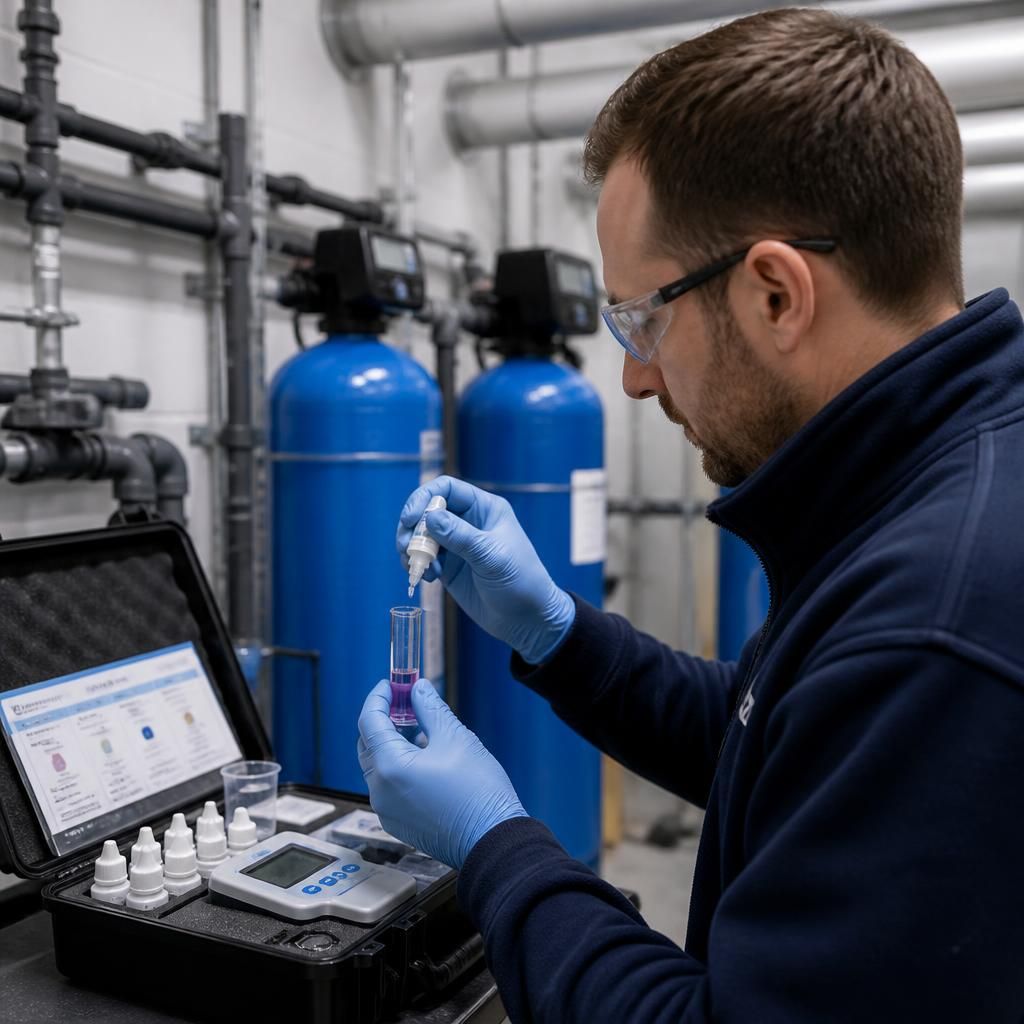
The test range is a key consideration when selecting a hardness test for a commercial water system. A kit designed for very hard incoming water may not distinguish small changes in softened or treated water, while a low-range kit may be unsuitable for untreated supplies.
Select a method that covers the expected result and provides enough resolution for the decision being made. If the reading falls outside the stated range, do not treat the result as an accurate measurement or extend the test beyond the manufacturer’s instructions. Use a more suitable range or an appropriately specified laboratory analysis, then interpret the result against the system’s operating requirements.
Need advice on choosing a hard water test?
If you are unsure which hardness test matches your commercial water system, speak to Blue Fish Water Management about defining the testing requirement and selecting an appropriate approach.