
What should a water chemistry testing report include?
A water chemistry testing report should identify the sampling locations and dates, describe the analytical methods used, and present each result with its units, detection limits and relevant quality-control information. It should also explain what the findings indicate, note any limitations or non-conformities, and set out appropriate recommendations for monitoring, investigation or remedial action.

A useful water chemistry testing report is an auditable record that links the purpose of the investigation to the samples examined, the significance of the results and the actions that follow. It should allow a competent reader to understand what was assessed, how the data should be interpreted and whether further investigation or control is justified.
Purpose and scope: The report should explain why the testing was commissioned and define the system, process or water source covered. This may include routine monitoring, investigation of a change in water quality, verification of treatment performance or assessment against a specified control requirement. Any exclusions should be clear, so that the report is not read as an assessment of areas or parameters that were outside the agreed scope.
Site and sample traceability: Each sample should have an unambiguous reference that can be followed from collection through laboratory receipt and reporting. Useful information includes the sample type or matrix, the person or organisation responsible for collection, the condition on receipt, preservation requirements and any relevant observations such as unusual colour, odour, deposits or turbidity. This information helps the reader judge whether the sample was representative and whether handling could have influenced the result.
Parameters and analytical context: The report should state which substances or indicators were examined and why they were relevant to the assessment. For example, total organic carbon, chemical oxygen demand and biological oxygen demand describe different aspects of organic material in water and should not be treated as interchangeable measurements. The parameter list should therefore be read alongside the stated objective, rather than viewed as a general declaration that the water is safe for every purpose.
Results in a usable format: Results should be presented in a table that makes comparisons straightforward. The report should distinguish between a numerical result, a result below the laboratory's reporting capability and a result that was not obtained or was unsuitable for interpretation. Where appropriate, results should be grouped by sample, parameter or sampling point, with consistent terminology throughout. Complex datasets may also benefit from a concise summary of notable patterns, such as repeated elevation of a parameter or a difference between incoming and treated water.
Comparison with relevant criteria: A report should identify the benchmark used to interpret each result. Depending on the purpose, this might be a legal requirement, a permit condition, a process specification, a client limit or an agreed investigation level. The source and date of any criterion should be recorded, and the report should make clear whether a result is compliant, requires attention or cannot be judged because no suitable benchmark was available. A numerical exceedance is not, by itself, a complete risk assessment; its significance depends on the use of the water, the exposure pathway and the reliability of the sample.
Interpretation and limitations: The commentary should explain what the findings may indicate without claiming more than the data supports. It might consider possible causes, relationships between parameters and whether the result is consistent with previous monitoring. It should also identify factors that could affect confidence, such as a single isolated sample, an unusual operating condition, incomplete sampling coverage or a result close to the analytical reporting threshold. Where a finding needs confirmation, the report should say what additional evidence would resolve the uncertainty.
Actions and follow-up: Recommendations should be specific enough to support management decisions. Depending on the findings, they may include checking plant operation, reviewing chemical dosing, inspecting storage or distribution equipment, repeating selected analyses, expanding the sampling plan or obtaining specialist advice. Each action should ideally have a stated reason and an indication of the condition that would trigger escalation. The report should distinguish immediate control measures from longer-term investigation, particularly where the result could affect production, discharge, worker exposure or water use.
Supporting records and approval: A complete report may include the sampling record, chain-of-custody information, laboratory worksheet, calibration or quality records, photographs, previous results and any calculations used in interpretation. The final document should show its report status, issue date, author and technical review or approval. Amendments should be controlled so that a revised result or conclusion can be identified and the original reporting history remains clear.
Before relying on a report, the responsible person should check that the scope matches the decision being made, the sample identity is traceable, the criteria are appropriate and the conclusions are proportionate to the evidence. A well-structured report does not merely list laboratory values: it provides the documented reasoning needed to decide whether water quality is acceptable, whether controls are working and what should happen next.
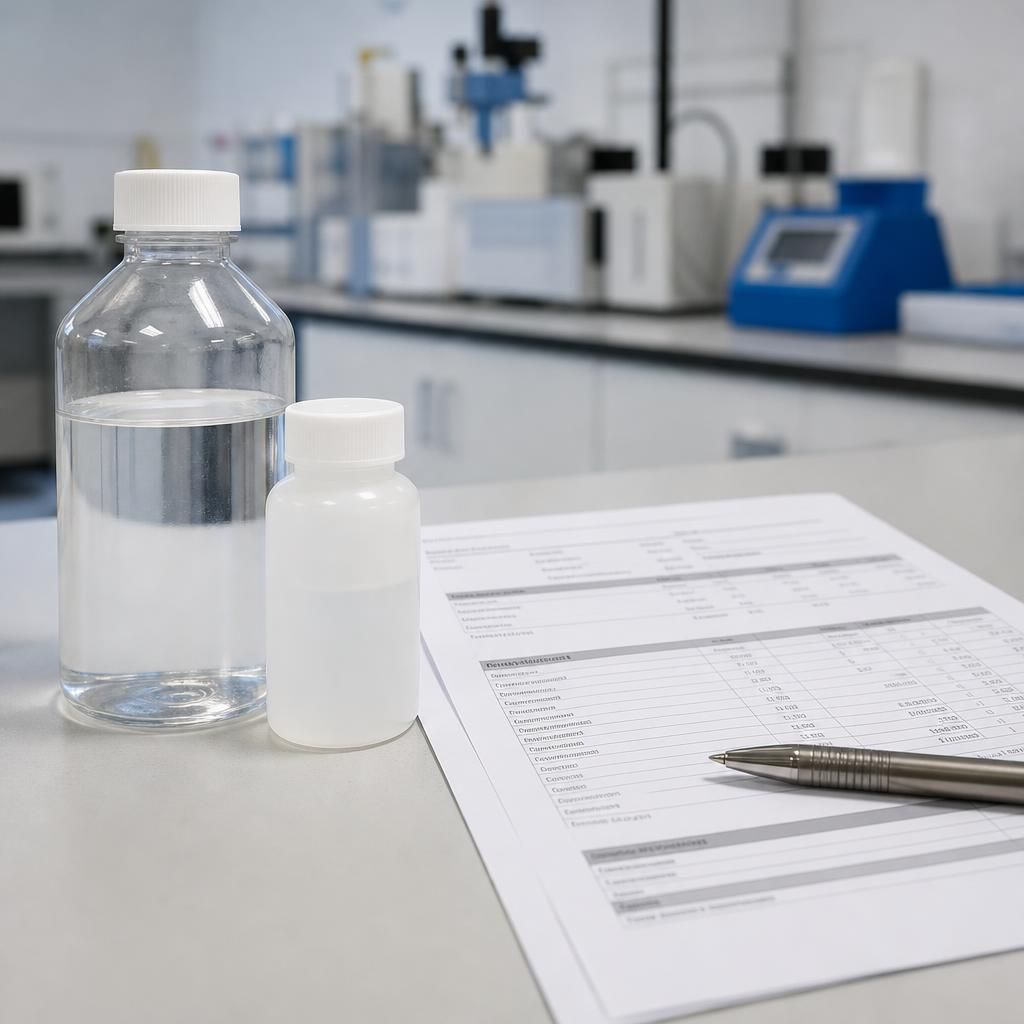
A water chemistry testing report should record the conditions under which each sample was taken, not just the laboratory result. Where relevant, this includes whether the sample was a spot or composite sample, the water temperature, flow or treatment status, and any field measurements taken at the sampling point. These details help establish whether the result represents normal operating conditions and provide useful context when comparing samples collected at different times.
Need help interpreting a water chemistry testing report?
If you need help assessing what your water chemistry results mean, speak to Blue Fish Water Management Ltd about reviewing the report and identifying appropriate next steps. Their team can provide practical advice on water quality investigations, monitoring and remedial requirements.