
How should I interpret legionella water testing results?
Legionella water testing results show whether Legionella was detected and, where applicable, the concentration reported in colony-forming units per litre (CFU/L). Interpret the result alongside the sample location, system type, relevant guidance and existing risk assessment, because the appropriate response depends on the wider water system as well as the laboratory finding.
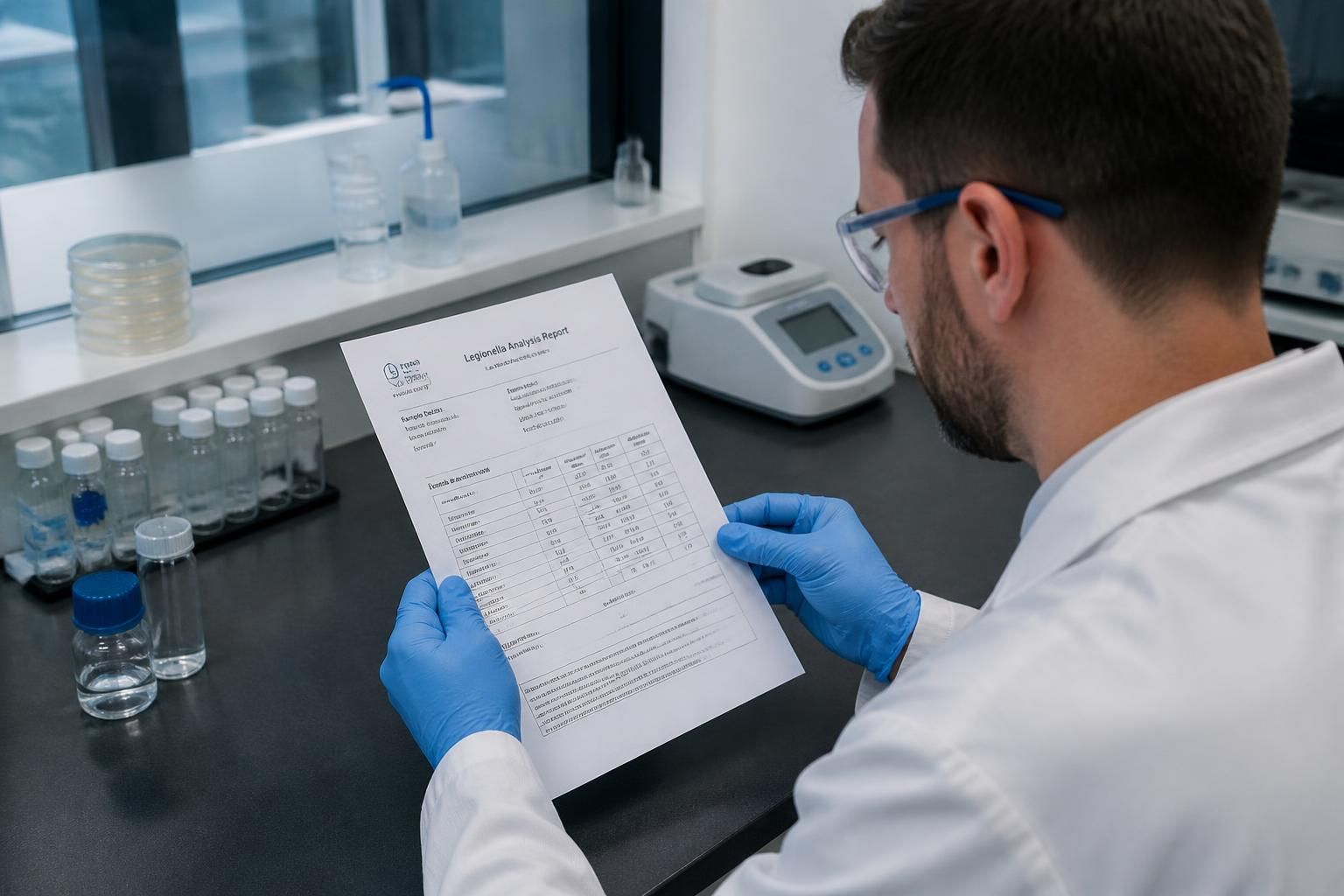
A legionella test report is a measurement from one water sample, taken at one location and time. It is not, by itself, a declaration that an entire water system is safe or unsafe. The result should be read with the sampling purpose, the laboratory’s reporting notes and the control measures already in place.
Start with the laboratory’s finding. Reports commonly state whether Legionella was detected and, if it was quantified, give a result in colony-forming units per litre (CFU/L). A non-detect result means the organism was not found above the laboratory’s reporting or detection capability in that sample. It does not prove that Legionella is absent from every part of the building, as bacteria may be unevenly distributed or present at another outlet.
A detected result should not be interpreted from the number alone. Consider:
- Where the sample was taken: a sentinel outlet, shower, storage tank, calorifier, hot-water return or other location may provide different information about the system.
- Why it was sampled: routine monitoring, investigation of a control failure, post-cleaning verification and sampling following remedial work have different purposes.
- The system’s users: the potential consequences are greater where water systems serve people who may be more vulnerable to Legionnaires’ disease.
- The sampling method and condition: whether the sample was taken before or after flushing, and whether it was a hot or cold sample, can affect what the result represents.
- The laboratory’s reporting limits: a numerical result should be distinguished from a result reported as below the limit of detection or below the limit of quantification.
Use the concentration as an action indicator, not a pass-or-fail score. Lower-level detection can still warrant investigation, particularly if it is unexpected, repeated or found in a higher-risk area. A substantially elevated result generally requires prompt control measures and a review of the system. The appropriate response should be checked against current HSE guidance, the organisation’s written control scheme and the findings of the legionella risk assessment.
When Legionella is detected, the responsible person should record the result and assess whether existing controls are working. The investigation may include checking stored-water temperatures, hot-water circulation, cold-water temperatures, stagnation, dead legs, infrequently used outlets, storage tanks, scale, sediment and the condition of associated equipment. It should also consider whether outlets have been altered, left unused or missed during routine flushing.
Possible follow-up actions include:
- reviewing the risk assessment and written control scheme;
- checking temperature monitoring, flushing and maintenance records;
- confirming that all relevant outlets and components are included in the control regime;
- carrying out targeted additional sampling where the source or extent of contamination is unclear;
- cleaning, disinfection or undertaking other remedial work where the investigation identifies a need; and
- retaking samples after remedial work when this is required to verify the result.
Remedial work should be proportionate and technically justified. Disinfecting a system without correcting poor circulation, unsuitable temperatures, stagnation or contamination within tanks may not provide lasting control. Conversely, a single positive sample should not automatically lead to an unnecessary whole-building response without considering the sample location, system design and wider risk evidence.
Check whether the result is reliable and comparable. Compare it with previous samples only where the locations, sampling approach and laboratory reporting basis are sufficiently consistent. A change in outlet, sample condition or laboratory method can make apparent increases or decreases difficult to interpret. Review any comments on the report, including sample temperature, receipt condition, delays, rejected samples and whether the result is estimated or below a quantification threshold.
A non-detect result also needs context. If the system has poor temperature control, known stagnation or other risk factors, one negative sample does not remove the need for routine control and monitoring. Sampling is an element of a broader water safety programme; it does not replace maintenance, temperature checks, flushing or periodic review of the risk assessment.
Escalate the matter where the result is high, repeated or unexpected, or where vulnerable people may be exposed. The responsible person should ensure that decisions, investigations, remedial measures and any follow-up samples are documented. If the report is unclear, ask the laboratory to explain its reporting terminology and obtain competent advice on the significance of the finding within the specific water system.
Blue Fish Water Management can help businesses interpret laboratory reports alongside risk assessments, system records and site conditions. This may include targeted investigation, compliance review, further UKAS-accredited testing and advice on proportionate remedial measures, where appropriate.
A legionella water test is an environmental result, not a medical diagnosis. Finding Legionella in a water sample shows that the organism was present at the sampled location when the sample was taken; it does not establish that anyone has been exposed or has developed Legionnaires’ disease. Conversely, a non-detect result cannot be used to diagnose or rule out illness.
If illness is suspected, clinical assessment and appropriate public health procedures are separate from interpreting the water testing report. For water management purposes, check whether the laboratory has identified a Legionella species or serogroup and retain the full report with the relevant investigation records. That information may help competent advisers understand the finding, but it should still be considered alongside the building’s water systems, control measures and risk assessment.
Need help interpreting your legionella water testing results?
Contact Blue Fish Water Management to discuss a legionella test report that requires clarification or further assessment. Their specialists can help determine the appropriate next step in the context of your building’s water management arrangements.