
What records should accompany UKAS legionella water testing?
UKAS legionella water testing should be supported by records that identify the site, water systems, sampling locations, dates, times, sample handlers and laboratory methods, together with the chain of custody and test results. Keep these alongside the legionella risk assessment, schematic or asset register, temperature and monitoring logs, previous results, and records of any remedial action so the findings can be traced and interpreted within the wider water safety plan.
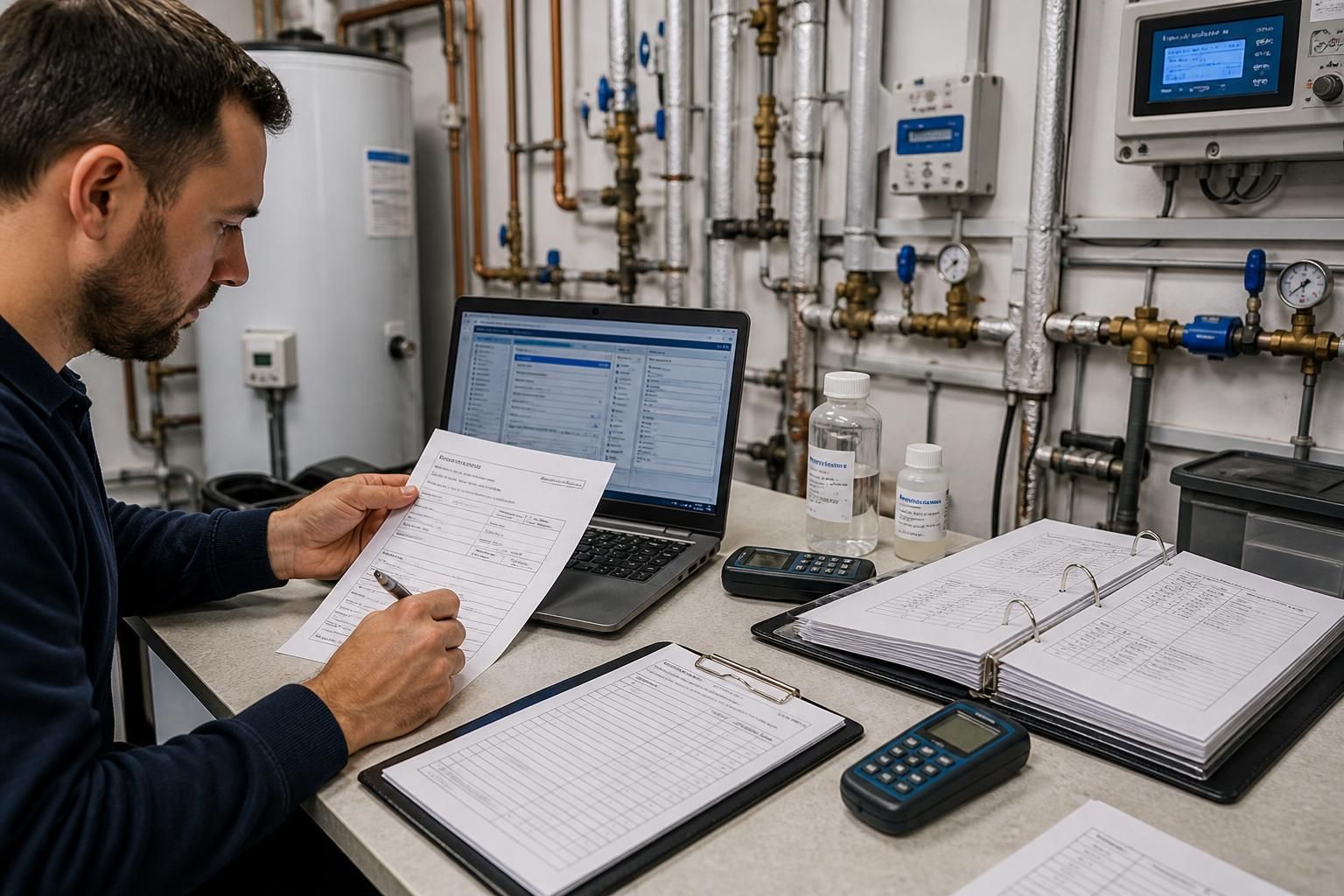
Records accompanying UKAS legionella water testing should show that the samples were authorised, collected and reported under a controlled process, and that the results were assessed and acted upon. The laboratory report is only one part of the evidence. A defensible record set links the test to the organisation’s water safety arrangements, explains any limitations or irregularities, and demonstrates how decisions were made after the results were received.
The laboratory report should be retained in its complete, unaltered form. It should identify the testing laboratory, the relevant accreditation status and scope, the analytical method used, the samples examined, the results obtained and the person or function responsible for authorising the report. Where relevant, the report should also state the reporting units, detection or quantification limits, any qualifiers attached to a result, and whether a sample was unsuitable or compromised. A result that is marked as estimated, qualified or invalid should not be treated in the same way as an unrestricted result.
The supporting file should also preserve the sampling instruction or request. This explains why the samples were taken, which risk or monitoring question they were intended to address, and whether the work formed part of routine verification, an investigation, commissioning, post-remedial checking or a response to an unsatisfactory result. Keeping this context prevents an isolated laboratory result from being mistaken for a complete assessment of the water system.
Where a contractor or laboratory identifies a departure from the planned process, the record should describe it rather than silently correcting the paperwork. Examples include a missed location, an inaccessible outlet, insufficient sample volume, a delay before receipt, unsuitable packaging, a broken seal, or a sampling point that could not be sampled as specified. The file should state the consequence of the departure and whether further sampling or another form of review was required.
Results should be considered alongside the records used to manage the system. Depending on the type and complexity of the premises, these may include:
- the current written control scheme or water safety plan;
- the relevant parts of the legionella risk assessment and any review history;
- records showing changes to plant, occupancy, use, water demand or operating conditions;
- temperature, disinfection, flushing, inspection and other control-monitoring records;
- maintenance records for storage tanks, calorifiers, outlets, dosing equipment and associated components;
- previous laboratory reports and trend reviews; and
- records of complaints, suspected exposure, investigations or other events that influenced the decision to test.
These documents do not replace the laboratory report. Their purpose is to help a competent person judge whether the result is consistent with the system’s operating history and whether the sampling programme remains suitable. A single negative result, for example, does not by itself demonstrate that all parts of a system remain adequately controlled. Equally, a positive result needs to be assessed in relation to the affected area, the level reported, the condition of the system and the vulnerability of exposed individuals.
Follow-up records are essential where a result or review identifies a concern. The file should record the decision taken, the reason for that decision, the responsible person, any agreed timescale, and the evidence used to close the action. Depending on the circumstances, this might include an investigation, additional sampling, cleaning or disinfection, temperature or flow adjustments, removal of redundant pipework, improved outlet management, or a review of the risk assessment. The relevant completion evidence should be retained with the original finding rather than recorded only in an informal email or verbal note.
For audit purposes, document control matters as much as content. Each record should be attributable, dated and protected from unauthorised alteration. Revisions should be identifiable, superseded documents should remain traceable where necessary, and the organisation should be able to show who reviewed the result and when. Electronic records should be stored so that the report, supporting evidence and follow-up decisions can be retrieved together, with access limited appropriately.
There is no single retention period that applies identically to every organisation and water system. The retention arrangement should follow the organisation’s document-control policy, the risk assessment, applicable health and safety duties, contractual requirements and any sector-specific rules. Records should remain available for as long as they are needed to demonstrate ongoing control, explain historical decisions or support an investigation. If the business changes contractor, premises manager or record system, responsibility for preserving the evidence should be clearly assigned.
A practical test is whether an independent reviewer could understand what was tested, why it was tested, how the result was judged, what happened afterwards and who approved the outcome without relying on undocumented conversations. If those links are missing, the testing may have produced a valid laboratory result but an incomplete compliance record.
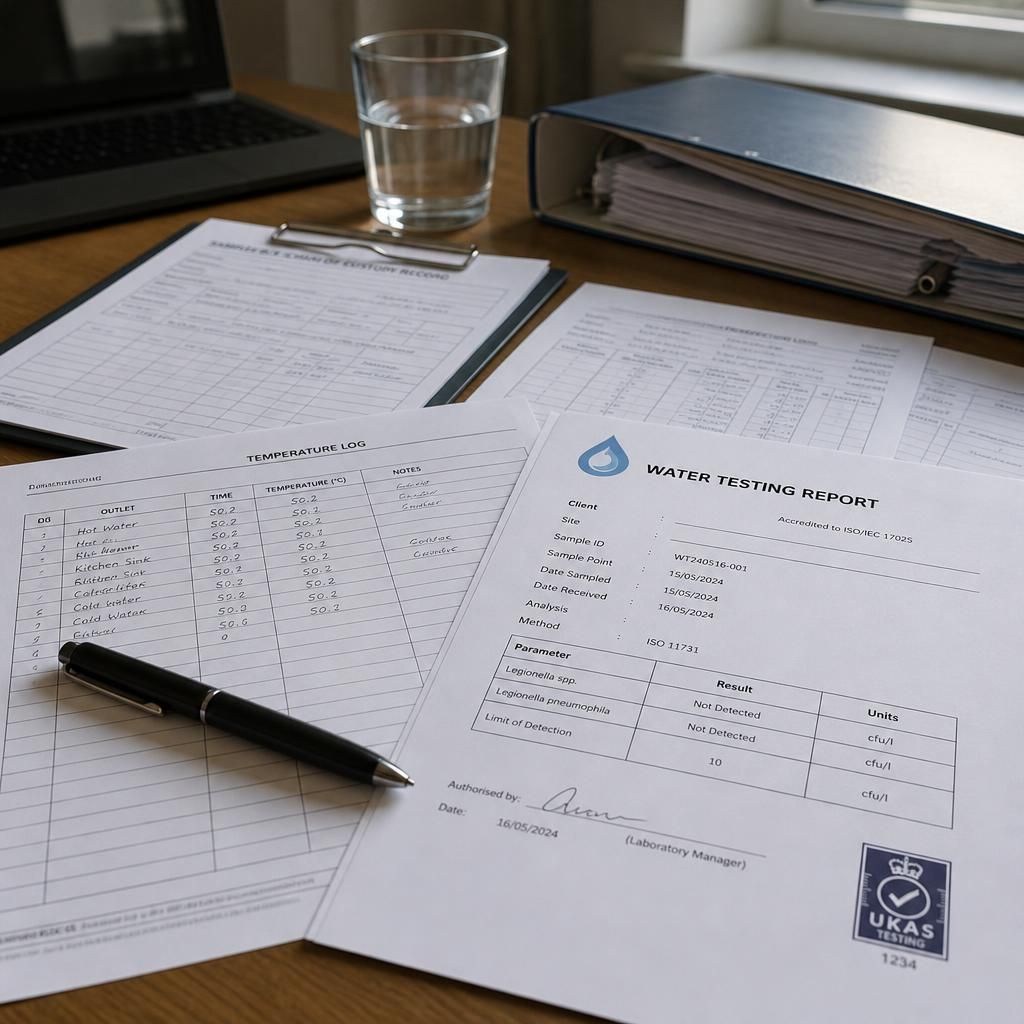
Field records for measurements taken during sampling should accompany the laboratory report where they help explain the result. These may include temperatures, disinfectant readings, pH or other relevant observations recorded at the sampling location, together with the instrument identification and evidence that the equipment was suitable for use.
The record should make clear who took each measurement, when it was taken and which outlet or system component it relates to. If an instrument was found to be outside its verification or calibration requirements, that limitation should be noted and its possible effect on the interpretation considered. These details give the competent reviewer important operational context that cannot be obtained from the legionella result alone.
Need help reviewing your UKAS legionella testing records?
If you need help assessing whether your testing documentation supports your wider water safety arrangements, Blue Fish Water Management Ltd can review your records and advise on appropriate next steps.