
What does UKAS legionella water testing reveal about system risk?
UKAS legionella water testing reveals whether Legionella was detected in sampled water and, where applicable, the level present. Results provide evidence of microbiological risk at the sampling points, but must be interpreted alongside system condition, temperature control, management practices and other findings to understand overall risk.

UKAS legionella water testing provides independent laboratory evidence of whether Legionella has been detected in a water sample and, where required, the quantity present. Its main value is that it turns a suspected or potential microbiological hazard into documented evidence that can be assessed against the design, use and control of the water system.
What a result can show
- Whether Legionella was detected: a positive result confirms that the organism was present in the submitted sample at the time of collection. A negative result means it was not detected by the test in that particular sample; it does not prove that every part of the system is free from Legionella.
- The extent of contamination at a location: where enumeration is carried out, the result indicates the level found in the sample. Comparing results from different outlets can help identify whether contamination appears isolated or more widely distributed.
- Changes over time: results from appropriately planned repeat sampling can reveal whether conditions are stable, deteriorating or improving after control measures, cleaning, disinfection or remedial work.
- Evidence for decision-making: the report can support a competent person when deciding whether further investigation, operational changes, additional sampling or remedial work is appropriate.
What a result cannot show by itself
A laboratory result represents the sample received, not necessarily the whole water system. Legionella may be unevenly distributed, particularly where systems contain low-use outlets, storage tanks, dead legs, scale, sediment, biofilm or areas with poor circulation. Sampling technique, location and timing therefore affect how representative the result is.
Testing also does not identify the underlying reason for contamination. A positive result may be associated with inadequate temperature control, stagnation, poor turnover, ineffective disinfection, contamination within a storage vessel or deficiencies in system design and maintenance. Those possibilities must be investigated rather than inferred from the laboratory report alone.
Similarly, a negative result cannot compensate for known weaknesses in system management. If temperatures are unsuitable, outlets are not being used, monitoring records are incomplete or remedial actions have not been verified, the absence of Legionella in one sample should not be treated as proof that risk has been eliminated.
How results help assess system risk
The significance of a result depends on the people potentially exposed, the type and complexity of the system, the way water is used and the effectiveness of existing control measures. A result from a little-used outlet may prompt a different investigation from a result found across several outlets or within a storage vessel. The vulnerability of building users is also relevant when deciding how urgently findings should be addressed.
Interpretation should therefore bring together the laboratory report and the wider evidence, including:
- the exact sample points, dates and sampling conditions;
- hot and cold water temperature records;
- the system schematic and information about tanks, calorifiers, outlets and return pipework;
- records of flushing, cleaning, disinfection, maintenance and monitoring;
- previous test results and any trends at the same or comparable locations;
- changes in occupancy, water demand, system use or configuration; and
- the findings of the legionella risk assessment.
Why UKAS accreditation matters
Testing through a UKAS-accredited laboratory provides confidence that the relevant laboratory activities are assessed against recognised competence requirements. The report should still be reviewed carefully: sample identification, collection details, method information and any limitations need to be consistent with the purpose of the investigation. Accreditation supports the reliability of the testing process, but it does not replace competent sampling or professional interpretation.
What should happen after an adverse result?
An adverse result should be recorded, communicated to the responsible person and considered alongside the existing control scheme. The appropriate response may include checking temperatures and monitoring records, reviewing recent system changes, inspecting tanks and outlets, increasing targeted sampling, correcting operational faults, or carrying out cleaning and disinfection. Any intervention should be followed by verification that the system is operating as intended and that the control measures remain effective.
The result, investigation, decisions and completed actions should form part of the water safety records. A specialist water hygiene provider can help interpret findings in the context of the system, rather than treating the laboratory report as a standalone pass-or-fail certificate. This approach makes UKAS legionella water testing useful not only for identifying microbiological findings, but also for exposing weaknesses in the way a water system is designed, operated and controlled.
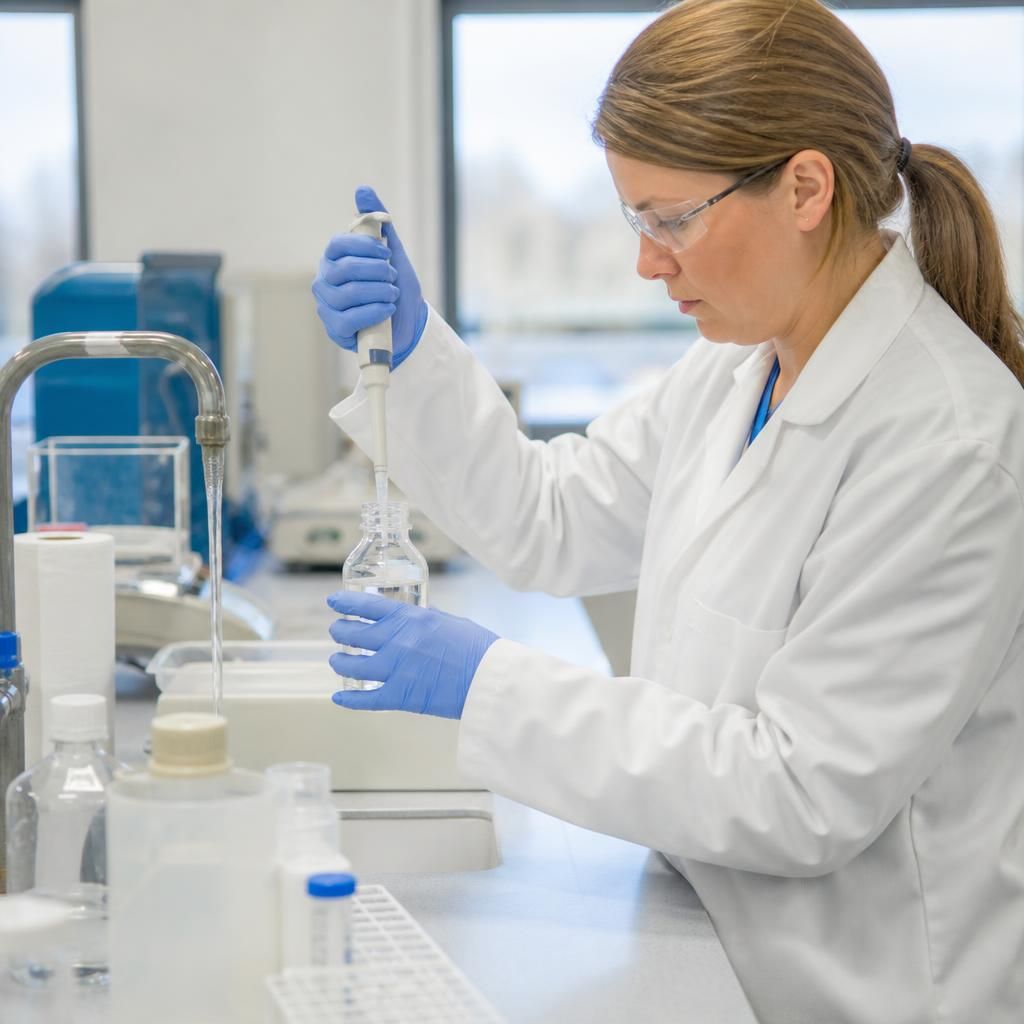
The sampling method affects what a UKAS legionella water testing result can reveal. A sample taken before flushing may provide information about water retained at an outlet, while a sample taken after flushing can offer evidence about water drawn from further upstream. The report and sampling notes should therefore be reviewed together before conclusions are drawn about the wider system.
This distinction helps separate an outlet-specific issue from a potential problem within distribution pipework, storage or circulation. It also shows why sample location, collection method and system layout should be documented clearly: without that context, the same laboratory finding may lead to an inaccurate assessment of where risk is concentrated.
Review your UKAS legionella water testing needs
Review your UKAS legionella water testing needs with Blue Fish Water Management Ltd and identify the appropriate next steps for your water system. Contact the team to discuss your sampling requirements and risk management priorities.