
Which reverse osmosis or UV water testing approach suits your business?
The most suitable approach depends on whether your business uses reverse osmosis, ultraviolet treatment, or both, together with the system’s purpose, condition and compliance requirements. Reverse osmosis testing assesses treated-water quality and membrane performance, while UV testing focuses on disinfection performance and microbial control.
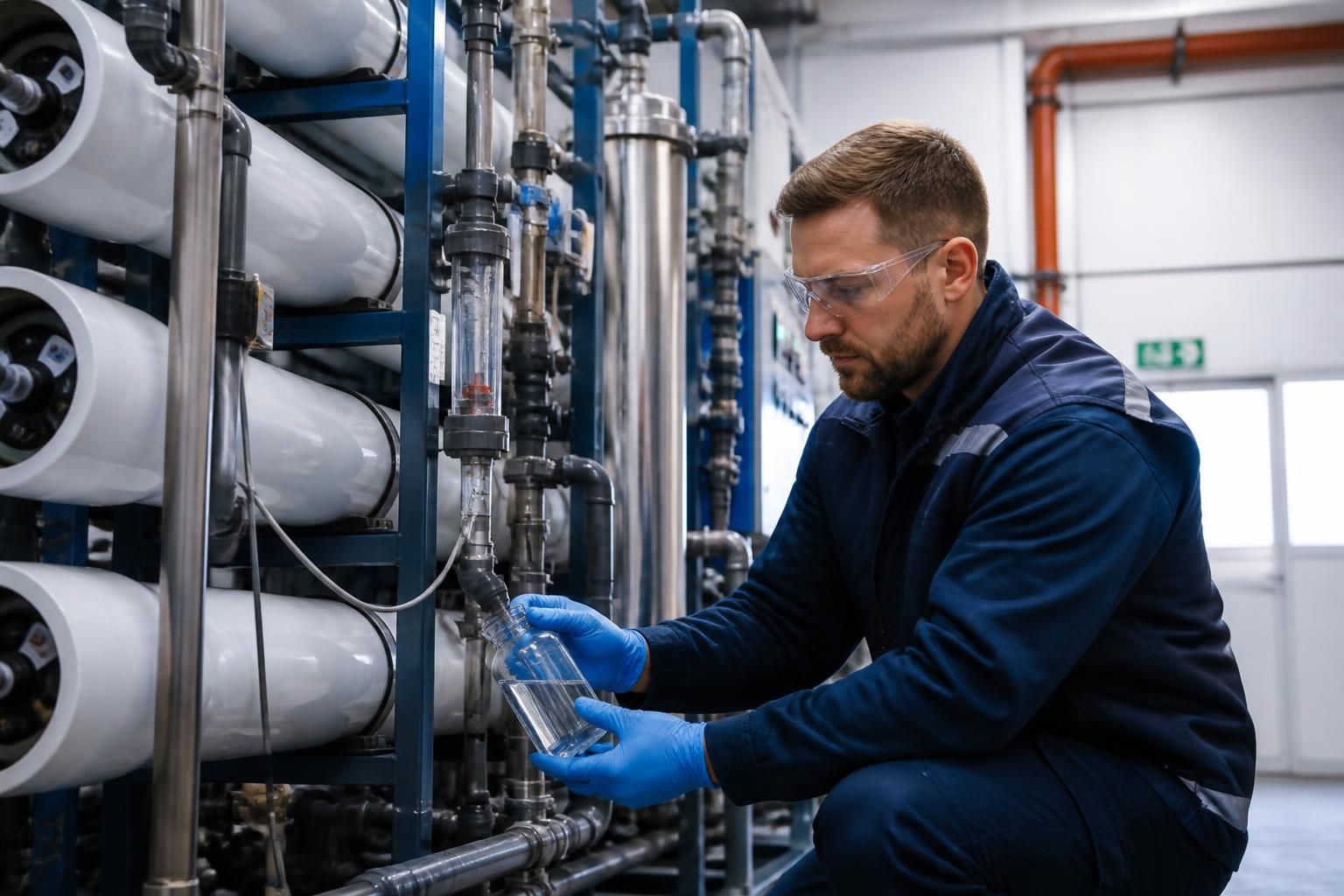
The right approach is determined by the treatment technology, the water’s intended use and the risks identified in the site’s water safety arrangements. Reverse osmosis (RO) testing is most relevant where dissolved contaminants and membrane performance are the concern; ultraviolet (UV) testing is appropriate where disinfection performance and microbiological control must be demonstrated. Businesses operating combined systems normally need a coordinated programme covering both treatment stages.
Start by defining what the treated water is expected to achieve. Water used as an ingredient, for production, in laboratory processes or in specialist equipment may require different quality criteria from water used for general business purposes. The testing plan should therefore identify the point of use, the required quality, any applicable industry or client specification, and the consequences of treatment failure. A result is only meaningful when it is assessed against the intended application and the system’s documented control limits.
- Choose an RO-led approach when the main question concerns the quality of permeate, the condition of membranes or the rejection of unwanted dissolved substances.
- Choose a UV-led approach when the main question concerns whether the unit is providing effective disinfection at the required flow and operating conditions.
- Use both approaches when RO and UV form separate stages of one treatment train, because satisfactory performance at one stage does not confirm that the other is operating correctly.
RO testing should consider the relationship between incoming water and treated water. Comparing feed-water and permeate results can help identify changes in membrane rejection, fouling, scaling, chemical damage or bypass. Depending on the use of the water, relevant checks may include conductivity or total dissolved solids, pH, temperature and other chemical or microbiological parameters specified by the risk assessment or process requirement. Sampling from the feed, permeate, storage vessel and final point of use can help distinguish a membrane problem from contamination introduced after treatment.
For an RO system, trend information is often more useful than a single isolated result. Gradual changes in conductivity, flow, pressure or recovery may indicate deterioration before treated-water quality falls outside the required specification. Testing should be interpreted alongside maintenance records, pre-treatment performance, filter changes, cleaning activity and any periods when the system has been idle. This provides a more reliable basis for deciding whether the issue requires investigation, servicing or remedial work.
UV testing should examine both the unit’s operating condition and the water leaving it. The assessment may include lamp status, UV intensity or dose indication, alarm operation, flow rate, contact conditions, sleeve cleanliness and the age or operating history of the lamp. Microbiological sampling can provide evidence of water quality, but a satisfactory sample does not by itself prove that the UV unit will continue to provide effective treatment. Conversely, an alarm, low intensity reading or excessive flow may require action even when a sample result appears acceptable.
Water clarity is particularly relevant to UV performance because suspended matter, colour or scaling can reduce the amount of UV reaching microorganisms. For that reason, upstream filtration and general system condition should be considered when selecting the testing approach. Where water passes through storage tanks or distribution pipework after UV treatment, sampling should also consider whether recontamination or stagnation could occur downstream.
The business’s operational risk should influence the balance between baseline assessment, routine monitoring and event-driven testing. A higher-risk application, a critical production process, significant changes in water demand or a history of failures may justify more detailed investigation and closer trend review. A change in source water, treatment equipment, storage arrangements, occupancy or process use should also prompt a review of the testing plan rather than relying automatically on an existing schedule.
- Map the system. Record the source, treatment stages, storage, distribution routes, sampling points and final uses.
- Define acceptance criteria. Establish which parameters matter, what limits apply and who is responsible for reviewing results.
- Assess system condition. Include maintenance history, alarms, instrument checks, filter and membrane condition, UV components, dead legs and storage hygiene.
- Select representative samples. Test locations should show the performance of the treatment stage and, where relevant, the quality at the point of use.
- Interpret results together. Laboratory findings, equipment readings, operating records and site observations should be reviewed as one evidence set.
- Document actions. Record failures, investigations, corrective work, repeat testing and any changes to the control programme.
Where a business is unsure whether its main concern is RO performance, UV disinfection or contamination elsewhere in the system, testing should not be selected by equipment type alone. A documented risk assessment and system review can identify the most informative combination of chemical, physical, microbiological and equipment checks. Testing by a competent laboratory, with sampling and interpretation appropriate to the application, supports defensible compliance records and helps separate treatment failure from issues arising in storage or distribution.
For a combined RO and UV installation, the most useful approach is usually staged testing: assess the incoming water and RO output, verify UV operating parameters, then examine water quality at relevant downstream points. This avoids treating the system as a single black box and makes it easier to identify where control has been lost. The resulting programme can then be incorporated into routine monitoring, compliance reviews and planned remedial work.
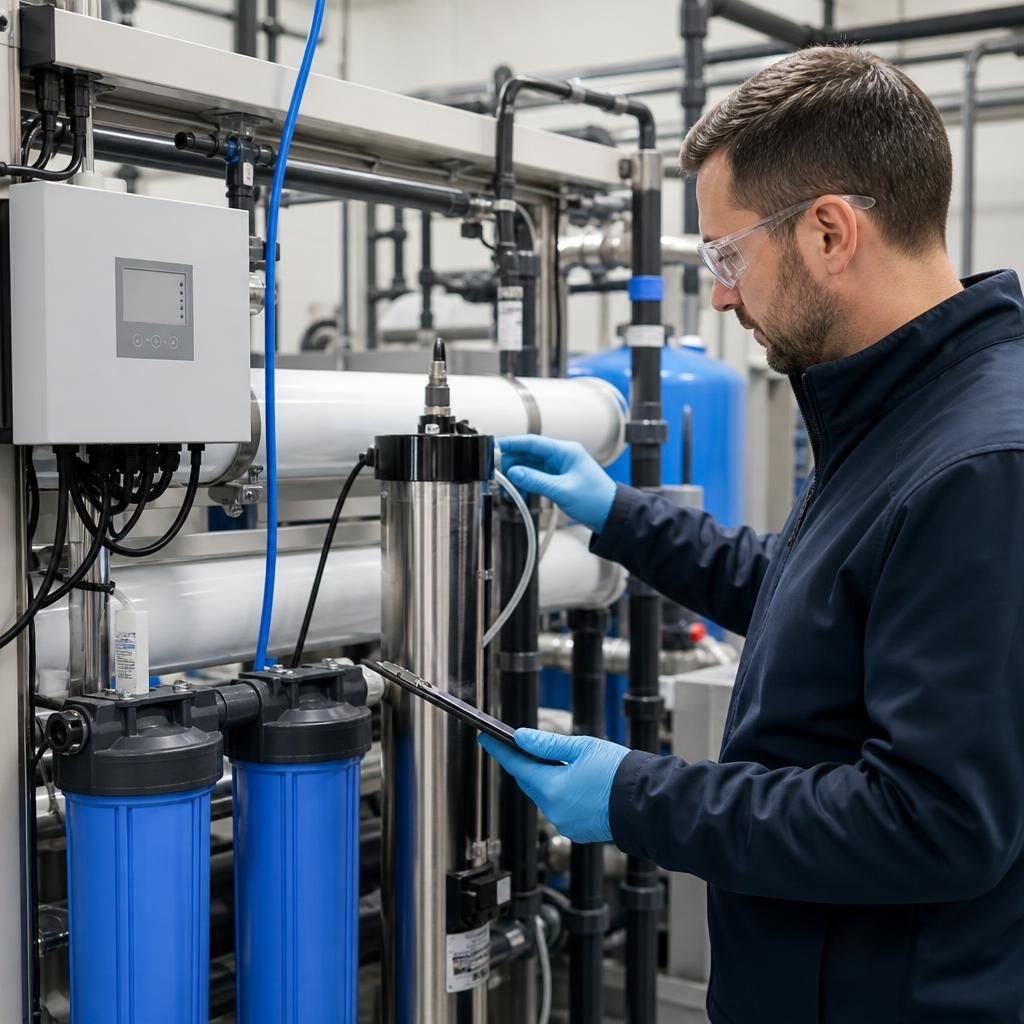
The testing method must be suitable for the decision the business needs to make, not simply for the treatment equipment installed. An RO investigation may require analytical methods capable of identifying changes in treated-water chemistry, while a UV assessment may depend on reliable equipment readings alongside microbiological sampling. In both cases, the sampling and laboratory method should produce results that can be compared with the system’s defined acceptance criteria.
When comparing testing options, check whether they provide:
- the parameters needed for the water’s intended use;
- sampling instructions that protect the integrity of the sample during collection, storage and transport;
- reporting limits appropriate to the specification or control limit being assessed;
- clear identification of the sampling location, treatment stage and collection conditions; and
- results presented with enough context for a competent person to decide whether further investigation is needed.
This distinction is important when results may be used to approve a system change, investigate a failure or support a compliance record. A technically accurate result can still be unhelpful if it was collected from the wrong point, measured against an unsuitable criterion or reported without the operating information needed to interpret it.
Discuss your reverse osmosis or UV water testing requirements
Discuss your reverse osmosis or UV water testing requirements with Blue Fish Water Management Ltd. Share your system details and intended use so the appropriate testing scope can be considered for your business.