
What should a commercial RO and UV testing report include?
A commercial RO and UV testing report should identify the system tested, define the inspection and sampling scope, record test methods and results, and state whether findings meet relevant compliance requirements. It should also document defects, risks, corrective actions and any recommended retesting or ongoing monitoring.

A useful commercial RO and UV testing report is a traceable record that allows a responsible person, auditor or maintenance contractor to understand exactly what was examined, how the results were obtained, and what those results mean for the system’s operation. It should contain enough detail for another competent person to review the conclusions without relying on verbal explanations.
System and site details
- Client, site and building details, including the area or process supplied by the treatment system.
- A unique report reference, inspection date and the names or roles of the people who carried out and authorised the work.
- The equipment configuration, including the RO plant, pre-treatment stages, storage vessels, distribution pipework and UV unit where these form part of the system.
- Relevant asset identification, such as equipment labels, serial numbers, plant-room location and photographs where identification could otherwise be unclear.
- The system’s intended use and any significant changes since the previous inspection, such as alterations to demand, pipework, storage or treatment equipment.
Scope and inspection record
The report should make clear which components were accessible and examined, and which were outside the agreed scope. For an RO system, this may include feedwater conditions, pre-filters, membranes, pressure readings, reject flow, permeate flow, storage and distribution points. For a UV system, it may include the chamber, lamp, quartz sleeve, intensity monitor, alarms, control panel, flow conditions and service indicators.
Any restrictions should be recorded rather than left implicit. Examples include equipment that was isolated, inaccessible, operating under abnormal conditions, missing documentation or unavailable for sampling. This distinction helps the reader understand whether a satisfactory result applies to the complete installation or only to the parts that could be assessed.
Methods and supporting evidence
Each measurement or sample should be linked to a stated method. The report should identify the sampling point, sample or instrument reference, collection date and time where relevant, preservation or transport conditions where applicable, and the method used for examination. For on-site instruments, it should record the instrument identity and any calibration or verification information needed to support confidence in the reading.
Results should be presented in a form that can be checked easily. A table is often appropriate, with units, reporting limits and any applicable action or acceptance criteria shown alongside the result. The report should distinguish between a measured result, an observation, an estimate and a result that could not be obtained. It should also explain abbreviations and avoid presenting a numerical result without its unit or sampling location.
RO-specific information
A technically useful RO section may include:
- Feedwater and treated-water readings, with the relevant sampling locations clearly identified.
- Conductivity or total dissolved solids results where these are used to assess permeate quality.
- Operating pressures, flow rates and recovery information, where these are relevant to performance.
- Evidence of membrane condition, including indications of fouling, scaling, damage or loss of rejection.
- Pre-treatment condition, filter status and any chemical dosing or conditioning arrangements that affect membrane protection.
- Storage and distribution observations, including stagnation risks, dead legs, leaks, overflow arrangements and signs of contamination or deterioration.
The report should explain what the readings indicate rather than simply listing them. For example, a change from the system’s established baseline may warrant investigation even where a single result does not appear abnormal in isolation. Comparisons should be made with appropriate historical data, design information or documented operating criteria.
UV-specific information
A UV section should show whether the unit was capable of delivering the required treatment under the conditions observed. It may include:
- Lamp operating status, age or service history and the condition of the quartz sleeve.
- UV intensity or dose indication, including the reading observed during the test.
- Flow conditions and any flow limitation or control that affects exposure time.
- Alarm, interlock and failure-indication checks, including whether an unsuitable condition would be identified to operators.
- Evidence that the unit was correctly installed, maintained and positioned in relation to upstream filtration and downstream storage or distribution.
- Inspection findings such as fouling, scale, leaks, damaged components or bypass arrangements.
Where UV performance depends on water clarity, the report should connect the UV finding with the condition of upstream treatment. A satisfactory lamp reading alone may not demonstrate effective treatment if filtration, flow control or the quartz sleeve is unsuitable.
Interpretation and risk significance
Results should be interpreted against the criteria relevant to the installation, its intended use and the risks identified for the site. The report should explain the significance of each non-conformity, adverse trend or maintenance defect, rather than treating every observation as equally important. It should also identify whether an issue affects water quality, treatment reliability, legal or procedural compliance, system integrity, or the ability to demonstrate control.
Where a result is outside the expected range, the report should state whether it may have been influenced by sampling conditions, recent maintenance, commissioning, unusual demand or another known factor. It should not conceal uncertainty: limitations, inconclusive findings and the need for additional investigation should be stated plainly.
Actions and follow-up
Recommendations should be specific enough to manage. A good report identifies the defect or risk, the corrective action, its priority, the person or role responsible where agreed, and the evidence needed to close the action. Examples might include replacing a filter, cleaning a quartz sleeve, investigating a pressure change, repairing a leak, reviewing a bypass, correcting an alarm fault or assessing a storage vessel.
The report should state whether further sampling, performance verification, maintenance inspection or independent review is appropriate. If retesting is recommended, it should explain what needs to happen before the test and which result will demonstrate that the issue has been addressed. Open actions should remain visible in the final document rather than being hidden in general observations.
Document control
Finally, the report should include the document version, issue date, amendment history and approval details. Supporting photographs, laboratory certificates, instrument records, sample schedules, drawings or previous trend data should be labelled and cross-referenced. This creates an auditable link between the physical system, the recorded evidence and the decisions made from the findings.
Before accepting a report, the duty holder should check that it covers the complete relevant installation, identifies all samples and measurements, explains exceptions, and converts significant findings into clear actions. A report that contains results without context may be technically accurate but is unlikely to provide a reliable basis for managing a commercial RO and UV system.
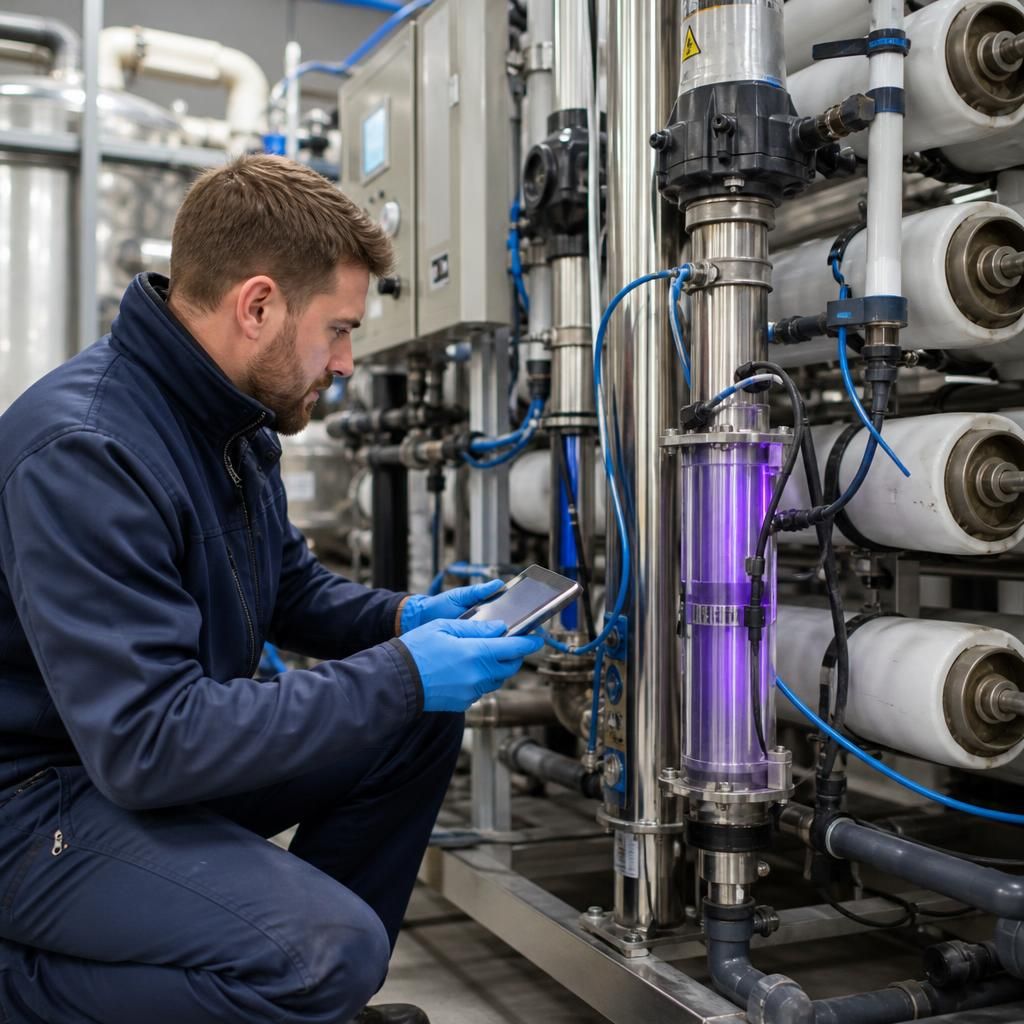
A commercial RO and UV testing report should give separate conclusions for the RO unit, the UV unit and the connected water system, rather than reducing the outcome to one overall pass or fail. This makes it clear whether a concern relates to membrane performance, ultraviolet treatment, storage, distribution or the interaction between components.
For example, the RO plant may be producing water within its operating criteria while the UV unit has an alarm fault, or both treatment stages may be satisfactory while a downstream storage vessel requires attention. The report should therefore explain the status of each stage, identify any conditions that affect the combined system and state whether the installation is suitable for continued operation, subject to specified actions.
Need help reviewing your commercial RO and UV testing report?
If you need help assessing whether a commercial RO and UV testing report provides sufficient evidence for compliance and ongoing system management, speak to Blue Fish Water Management. Their team can advise on testing requirements, report findings and any appropriate follow-up.