
How does risk influence commercial RO and UV system testing?
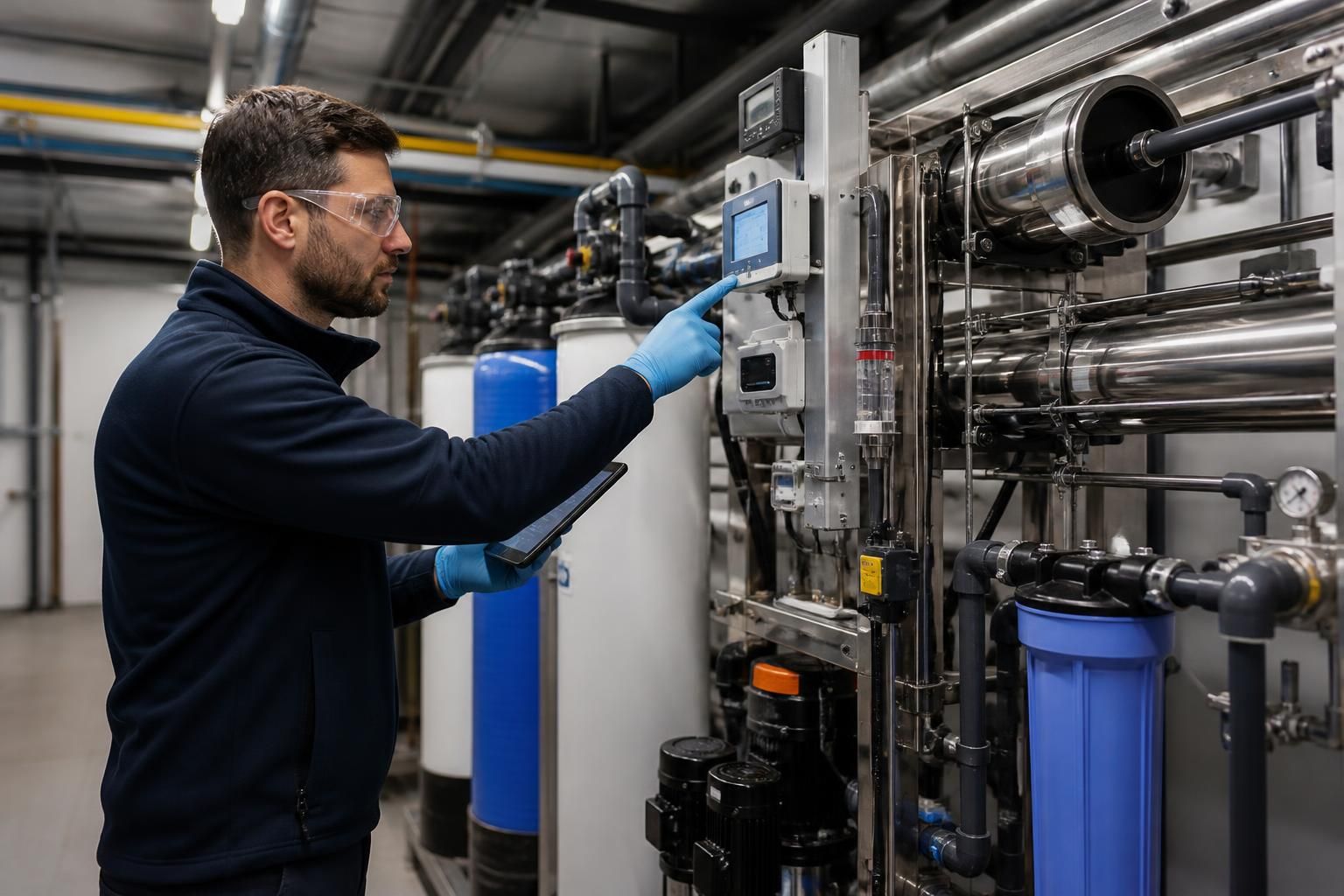
Risk influences commercial reverse osmosis (RO) and ultraviolet (UV) system testing by setting the scope, frequency and level of verification required. A system supplying drinking water, healthcare activities, food production, laboratory processes or other critical uses may need tighter controls than one serving a low-consequence application. The testing programme should therefore follow a documented assessment of the water source, system design, end use, users, operating conditions and consequences of failure.
Risk affects what is tested. RO and UV units control different hazards and performance indicators, so a suitable programme does not rely on a single test. For RO systems, relevant checks may include:
- feed-water quality and changes in the incoming supply;
- permeate conductivity or total dissolved solids as an indication of membrane performance;
- pressure, flow and recovery conditions;
- microbiological quality at appropriate points in the system;
- the condition of pre-treatment, filters, membranes, storage vessels and distribution pipework; and
- evidence of fouling, scaling, membrane damage or contamination.
For UV systems, risk may determine the need to verify UV intensity or dose, lamp operation, alarm functions, sleeve cleanliness, flow conditions and the performance of associated filtration. Microbiological sampling can provide additional evidence that the treatment is controlling the intended risk. UV treatment is dependent on the water reaching the lamp in a suitable condition; excessive turbidity, fouling or flow outside the design range can reduce treatment effectiveness even when the lamp is operating.
Risk affects how often checks are carried out. Routine operational observations may be appropriate for indicators such as alarms, pressure, flow, conductivity or UV intensity. Laboratory testing is used where a more detailed assessment of chemical or microbiological quality is needed. The interval between tests should reflect the assessed risk rather than an arbitrary calendar period. Higher-risk systems may require more frequent monitoring, more sampling points or independent verification, while lower-risk arrangements may be adequately controlled through a proportionate programme.
Frequency should also be reviewed when circumstances change. Relevant triggers include:
- a change in the water source, treatment configuration, end use or occupancy;
- installation of new membranes, lamps, filters, tanks or distribution pipework;
- extended shutdown, low use or periods of stagnation;
- maintenance, cleaning, disinfection or remedial work;
- an alarm, failed result, unexplained change in conductivity, flow or UV intensity;
- evidence of poor storage or temperature control; and
- a change in the vulnerability of people relying on the treated water.
Risk affects where samples are taken. Sampling only at the treatment outlet may confirm the condition of water leaving the RO or UV unit, but it may not identify deterioration in a storage tank or distribution network. A risk-based plan can include feed water, treated water, storage outlets, representative points of use and locations where water may stagnate. Sample locations should be selected to investigate the way the system is actually used and to identify the point at which a problem could be introduced or amplified.
Risk also affects the response to results. A result should be assessed against the system’s intended performance, previous results, operational readings and any relevant water quality requirements. A minor change in a low-consequence system may require investigation and closer observation. The same change in a critical application, or a result indicating possible contamination, may require immediate restrictions on use, further sampling, cleaning, disinfection, component replacement or engineering review. The appropriate action depends on the hazard, the result, the reliability of the sample and the potential consequences of failure.
Testing is only one part of control. The responsible organisation should retain the risk assessment, system schematic, operating instructions, maintenance records, calibration information, laboratory reports, corrective actions and evidence that actions were completed. These records allow trends to be identified. For example, gradually increasing permeate conductivity may indicate declining RO membrane performance, while repeated reductions in UV intensity may point to fouling, lamp ageing, incorrect flow conditions or a fault in monitoring equipment.
RO and UV systems should be assessed together where they operate as a treatment train. RO may alter the mineral and microbiological characteristics of water, while UV provides treatment only at the point where the correct dose reaches the water. Storage and downstream pipework can introduce additional risks after treatment. Testing should therefore consider the complete route from source to point of use, not just the individual equipment in isolation.
Blue Fish Water Management Ltd can support this process through risk-based water hygiene advice, system monitoring, compliance audits, UKAS-accredited water testing and recommendations for remedial work where findings require action. The value of the assessment is in connecting test results with the system’s actual use, documented controls and a clear plan for investigation or improvement.

Risk should influence the action thresholds written into a commercial RO and UV testing plan, not only the frequency of testing. For each important parameter, the plan can define when a result requires investigation, a repeat sample, temporary restriction of use or engineering review. Setting these criteria in advance helps operators deal consistently with borderline results rather than relying on personal judgement after an unexpected finding.
This approach is particularly useful when performance deteriorates gradually rather than failing at once. A slow change in conductivity, UV intensity or another monitored indicator may justify a different response from an isolated reading, depending on the application and its consequences. The testing plan should therefore identify who reviews trends, who authorises escalation and how the decision is recorded, creating a clear link between measured risk and practical action.
Arrange a risk-based commercial RO and UV testing review
Arrange a risk-based commercial RO and UV testing review with Blue Fish Water Management Ltd to assess whether your current programme reflects the system’s use, operating conditions and documented controls.