
How are hot water system legionella test results interpreted for compliance?
Hot water system legionella results are interpreted by considering the detected concentration alongside the system’s risk assessment, control measures, sampling locations and previous results. A result does not by itself establish compliance: competent water hygiene advice is needed to determine whether investigation, remedial action, resampling or continued routine monitoring is appropriate.
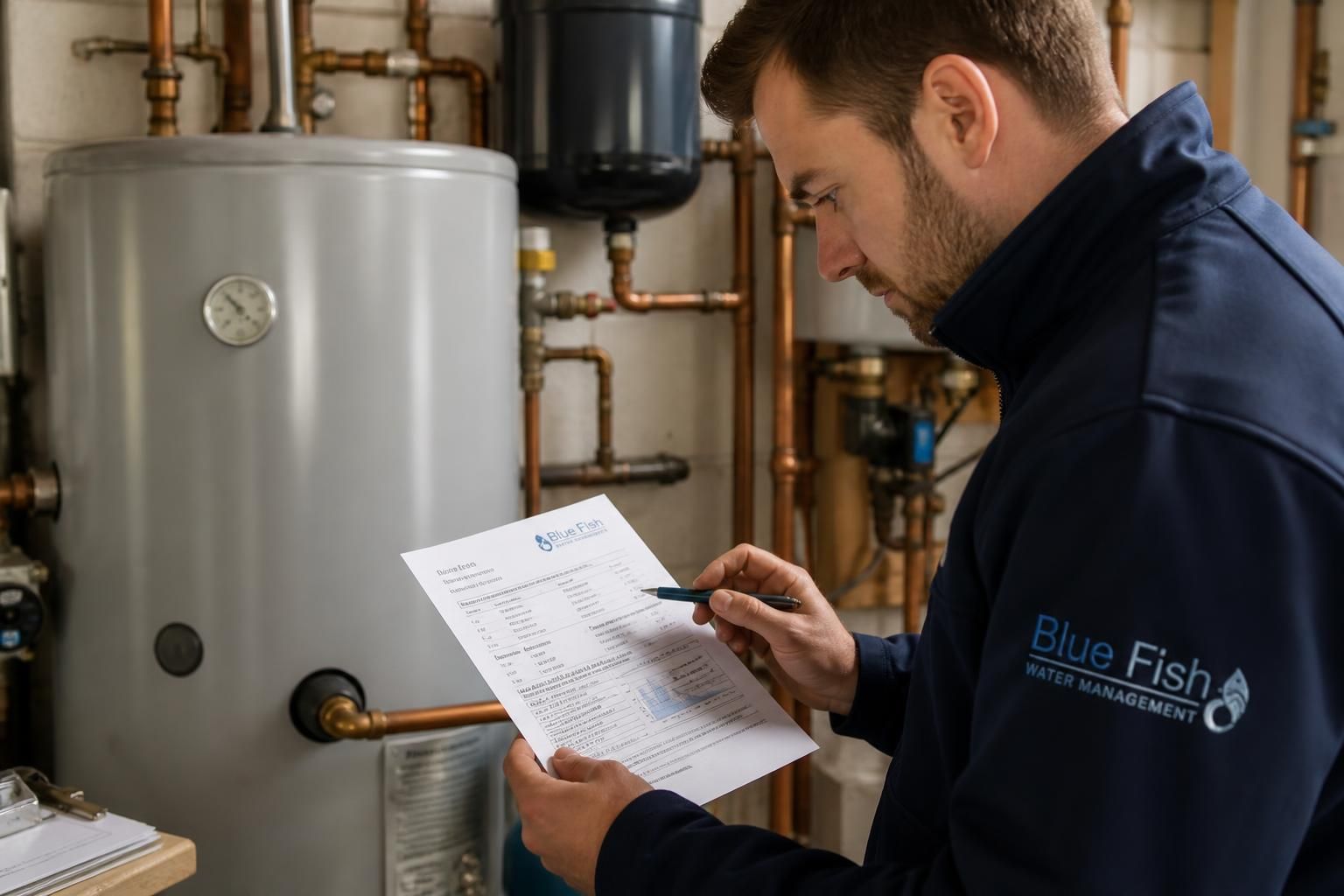
Hot water system legionella test results are interpreted against recognised investigation levels, the purpose of the sample and the organisation’s documented control regime. In UK practice, laboratory findings are treated as evidence for a risk-based decision, rather than as a simple pass-or-fail certificate.
Understanding the reported result
Results from culture-based testing are commonly reported as colony-forming units per litre (CFU/L). The report should identify the organism detected, the concentration measured, the sample point and the testing method used. A result reported as “not detected” means that legionella was not recovered under the conditions of that test; it does not prove that the organism is entirely absent from the system.
For hot and wholesome water systems, HSE guidance commonly uses the following investigation framework:
- Below 100 CFU/L: the result is generally considered satisfactory, provided the system is operating as intended and other control evidence is acceptable.
- Between 100 and 1,000 CFU/L: the result calls for a review of the system’s control measures and sampling history. Resampling may be appropriate, particularly where results are recurring or rising.
- Above 1,000 CFU/L: the finding normally requires prompt investigation and corrective action. The response should reflect the system design, the affected outlets and the vulnerability of people exposed.
These levels are used to guide action and should not be presented as universal statutory limits. A lower result may still be significant where there are known control failures, high-risk occupants or repeated detections. Conversely, a single higher result must be assessed in context, with attention to whether the sample accurately represents the system.
What affects the compliance interpretation?
- Sample location: a result from a sentinel outlet, return, storage vessel or rarely used outlet may indicate different conditions. One sample cannot necessarily represent every branch of a complex system.
- Temperature control: stored and distributed hot water should be assessed against the organisation’s specified control regime. An acceptable temperature record does not cancel out a positive microbiological result, but a temperature failure can help explain one.
- Trend over time: repeated low-level detections, an upward trend or results from several connected outlets may be more significant than an isolated finding.
- System use and design: dead legs, low-use outlets, redundant pipework, blending valves, storage arrangements and periods of stagnation can all affect the risk.
- People exposed: hospitals, care settings, residential accommodation and workplaces with vulnerable occupants may require a more cautious response than a comparable result in a lower-risk setting.
- Sampling and laboratory information: the report should be checked for collection details, transport conditions, sample volume, detection method and any limitations that could affect confidence in the result.
Culture, PCR and other test methods
A culture result measures viable organisms recovered in the laboratory and is commonly used for operational decisions. Polymerase chain reaction (PCR) testing detects genetic material and may identify organisms that are no longer viable, so its result cannot always be compared directly with a culture concentration. The test method, reporting units and laboratory interpretation should therefore be considered before deciding that two results show an increase or decrease.
What a result means for compliance records
Compliance is demonstrated through a coherent body of evidence. This normally includes the current risk assessment, written control scheme, temperature and monitoring records, inspection findings, cleaning or disinfection records, staff competence, sampling plans and actions taken in response to abnormal results. A laboratory certificate alone does not demonstrate that the water system is being effectively managed.
Where a result requires investigation, the review should establish whether the issue is local or system-wide. This may involve checking connected outlets, storage tanks, calorifiers, secondary returns, thermostatic mixing valves and areas of infrequent use. The organisation should record the decision, the person responsible, the corrective work, any additional samples required and the evidence used to close the action.
When expert interpretation is appropriate
Competent water hygiene advice is particularly important when results are above an investigation level, when detections recur, when sample findings conflict with temperature records, or when the system serves people at increased risk. An expert review can distinguish between a sampling anomaly and a broader control problem, assess whether remedial work is proportionate, and define a suitable resampling strategy.
Blue Fish Water Management Ltd provides legionella risk assessment, UKAS-accredited water testing, compliance audits, system monitoring and remedial support for organisations managing hot water systems. The relevant evidence can then be assessed as part of a practical, documented approach to water safety compliance.

A defensible compliance interpretation links the laboratory finding to a recorded decision. The responsible person should document what the result indicates, whether it changes the existing control assessment, what action is required, who owns that action and when its effectiveness will be reviewed.
- Record the report reference, sample point and date.
- Explain the significance of the finding in relation to the system’s risk assessment.
- State whether further investigation, corrective work or follow-up sampling is required.
- Retain evidence that the decision was completed and reviewed by a suitably competent person.
This approach allows an auditor or enforcing authority to follow the reasoning behind the response, rather than seeing an unexplained laboratory result in isolation.
Get Expert Advice on Hot Water System Legionella Test Results
Share your hot water system legionella test report with Blue Fish Water Management Ltd for an informed review of the findings and their compliance implications. Their water hygiene specialists can help identify a proportionate next step based on the evidence available.