
What qualifications should a water tank servicing provider have?
A water tank servicing provider should demonstrate relevant legionella and water hygiene training, practical competence in inspecting and maintaining storage tanks, and a clear understanding of current UK water safety guidance. They should also be able to provide evidence of suitable testing arrangements, documented procedures, competent personnel and experience managing systems similar to yours.
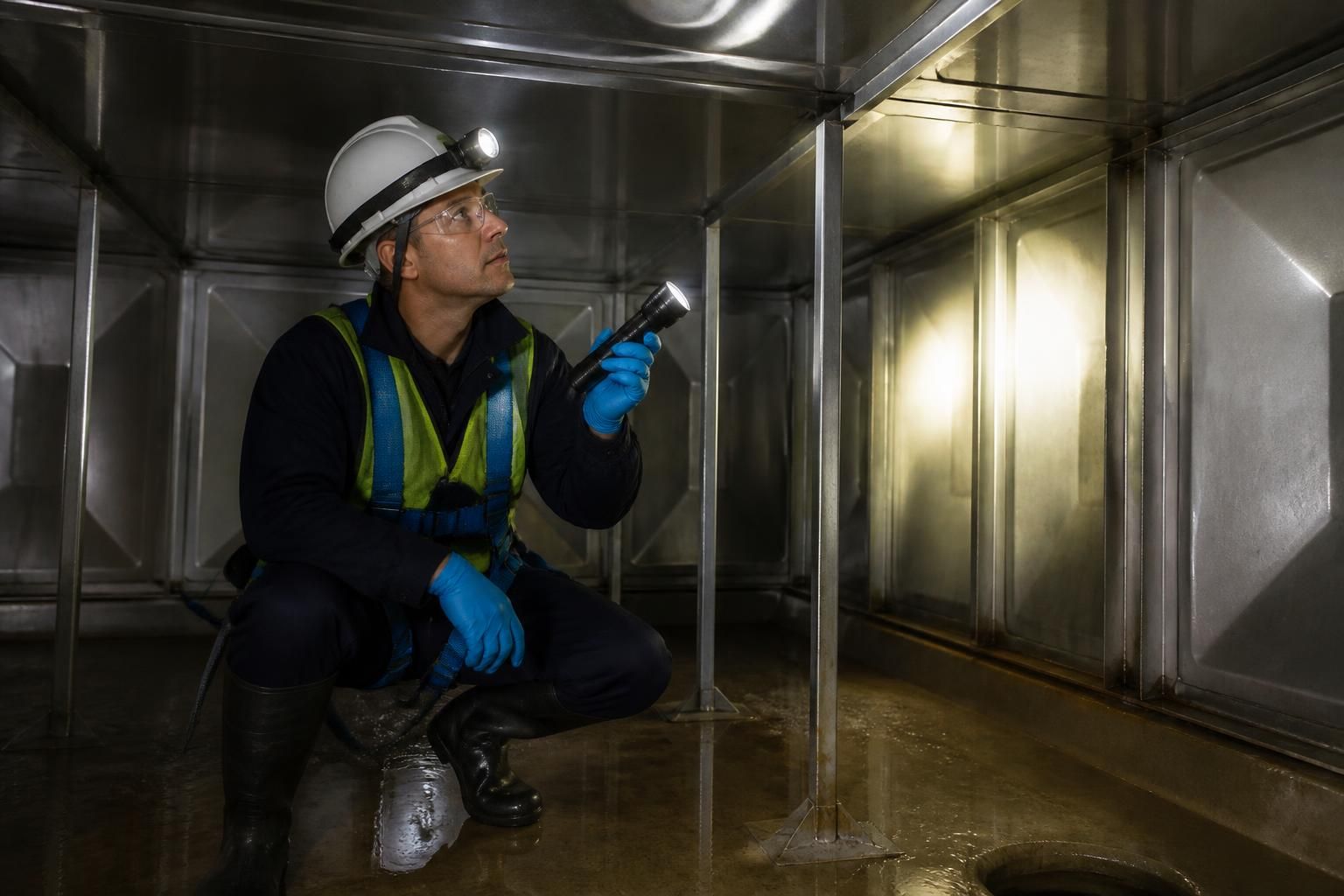
There is no single statutory qualification called a “water tank servicing qualification”. A suitable provider should instead be able to demonstrate competence through relevant formal training, supervised practical work, appropriate technical knowledge, and a documented quality system. The evidence should match the type of tank, the water system and the risks present at the premises.
For legionella control, personnel should have training that is relevant to their actual duties rather than relying solely on a general awareness course. The qualifications and learning records should show an understanding of topics such as:
- how stored water systems operate, including cold-water storage tanks, expansion arrangements and associated pipework;
- conditions that encourage microbial growth, including stagnation, inadequate temperature control, poor turnover and contamination;
- safe inspection, cleaning, disinfection and recommissioning practices;
- the importance of preventing contamination while carrying out maintenance; and
- the need to record findings, defects, corrective actions and follow-up checks.
Training should be supported by practical competence. A certificate on its own does not prove that an operative can assess the condition of a tank, identify deficiencies in its installation or complete maintenance without creating an additional water hygiene risk. Ask how new staff are supervised, how competence is assessed and how refresher training or continuing professional development is managed.
The provider should also understand the UK framework that applies to the work. This normally includes the Health and Safety Executive’s Approved Code of Practice L8 and the associated technical guidance in HSG274, alongside applicable water fittings, health and safety and environmental requirements. The provider should be able to explain which guidance is relevant to the system and how it affects the proposed inspection or remedial work, rather than simply listing guidance documents in a quotation.
Where the service includes sampling, look for a clear distinction between the contractor carrying out the sampling and the laboratory analysing the sample. A competent provider should use suitable sampling methods, preserve sample integrity, maintain chain-of-custody records where appropriate and arrange analysis through a laboratory accredited for the relevant tests. UKAS accreditation applies to the accredited laboratory and its defined scope; it does not automatically mean that every contractor describing itself as “UKAS accredited” is accredited to service tanks. The provider should therefore identify the laboratory and explain what its accreditation covers.
For work that alters or reconnects plumbing supplying wholesome water, additional competence may be needed under the Water Fittings Regulations or Scottish Byelaws, depending on the location. In those circumstances, check whether the organisation or operative is appropriately approved, notified or otherwise qualified for the relevant plumbing work. This is separate from legionella training and should not be treated as an alternative to it.
A provider’s management arrangements are also part of its professional competence. Before appointing one, ask for evidence of:
- named competent personnel and the duties each person is qualified to undertake;
- training certificates, refresher records and practical assessment arrangements;
- method statements, risk assessments and safe systems of work;
- calibrated or suitably maintained inspection and testing equipment;
- procedures for isolating tanks, protecting occupants and managing chemical or biological hazards;
- sample reports, service records and defect photographs with sensitive client information removed; and
- a process for escalating serious defects and verifying that remedial actions have been completed.
Accreditation and membership can provide useful assurance, but their scope matters. An audited quality or environmental management system may indicate that the business controls its processes, while a relevant industry membership can show engagement with professional standards. Neither automatically proves that an individual has the competence to inspect or clean a particular water tank. Check what the scheme assesses, which services and locations it covers, and whether the certificate is current.
Experience should be assessed by relevance rather than by a general claim about time in business. A provider working on a small domestic storage tank may not have the resources or technical understanding required for a large commercial system, healthcare setting, industrial process or complex building with multiple tanks and outlets. Ask for examples of comparable systems and establish whether the work will be completed by the personnel whose qualifications have been presented.
The final report should make the provider’s competence visible. It should identify the tank and system inspected, describe its condition, record measurements and observations where relevant, list defects by significance, and state what action is recommended. It should also distinguish between work completed, work advised and matters requiring investigation by another specialist. Clear records allow the responsible person to demonstrate that maintenance decisions were based on competent advice rather than on a routine checklist alone.
In practical terms, the strongest qualification profile combines role-specific legionella and water hygiene training, relevant plumbing or mechanical knowledge where the work requires it, demonstrable experience with comparable systems, sound sampling arrangements and transparent records. A provider that can explain the limits of its competence and bring in a suitably qualified specialist when necessary is generally more credible than one offering broad claims without supporting evidence.
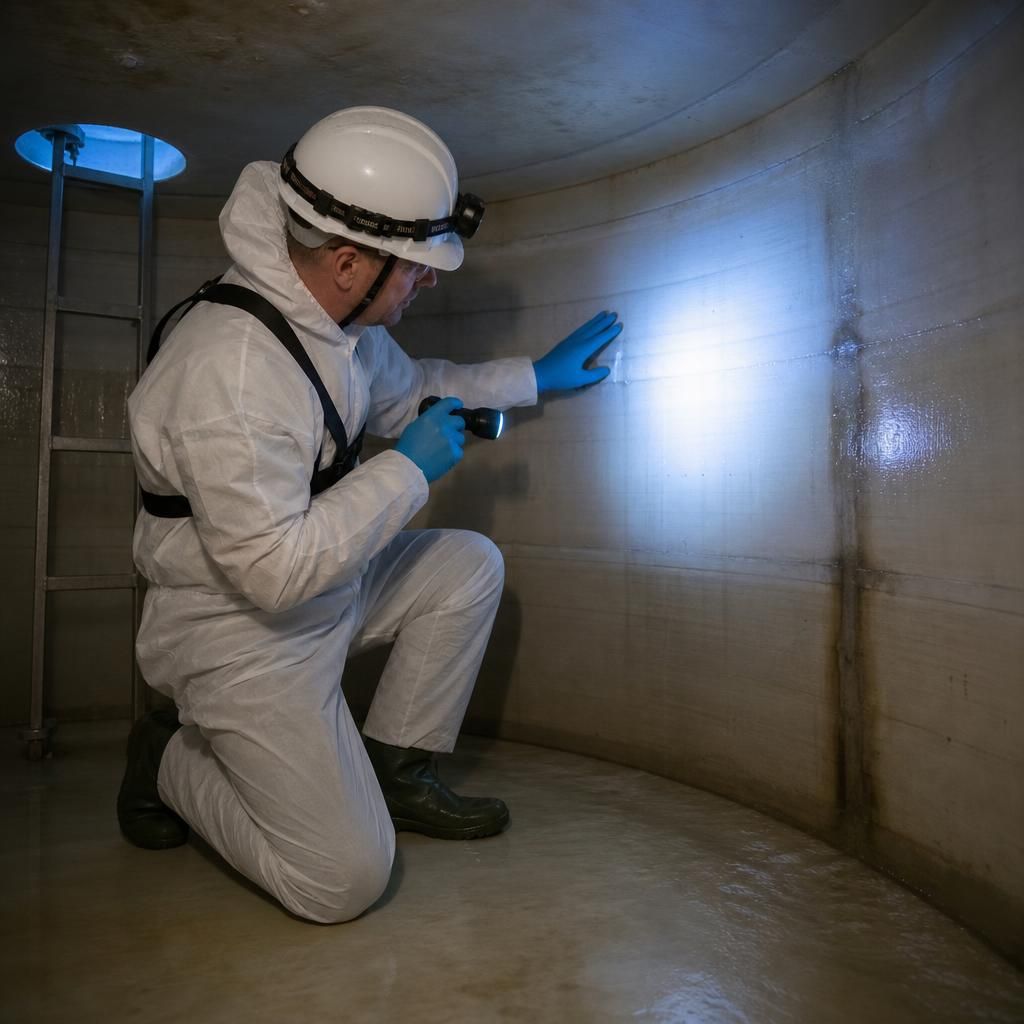
Water tank servicing qualifications should cover the hazards of the work as well as water hygiene. Depending on the tank’s location and the proposed task, operatives may need suitable training for confined spaces, work at height, hazardous substances, manual handling or the use of access equipment.
These requirements are not automatic for every service visit. A competent provider should first assess the task and confirm which controls and qualifications apply. For example, entering a tank is materially different from inspecting it from an access point, while chemical disinfection may require additional knowledge of substance handling, personal protective equipment and emergency procedures.
Ask the provider to explain:
- whether tank entry is required and, if so, how entry, communication and rescue arrangements are managed;
- which task-specific training the attending personnel hold;
- how access equipment, lifting arrangements and protective equipment are selected and checked; and
- what happens if site conditions make the planned work unsafe or fall outside the team’s competence.
This helps distinguish a provider with qualifications relevant to the actual work from one relying only on general water hygiene certificates.
Discuss the qualifications your water tank servicing provider should have
Use these criteria to assess potential providers and ask Blue Fish Water Management Ltd to discuss the qualifications and competence relevant to your water tank and planned maintenance work.