
How is the source of a water tank leak identified?
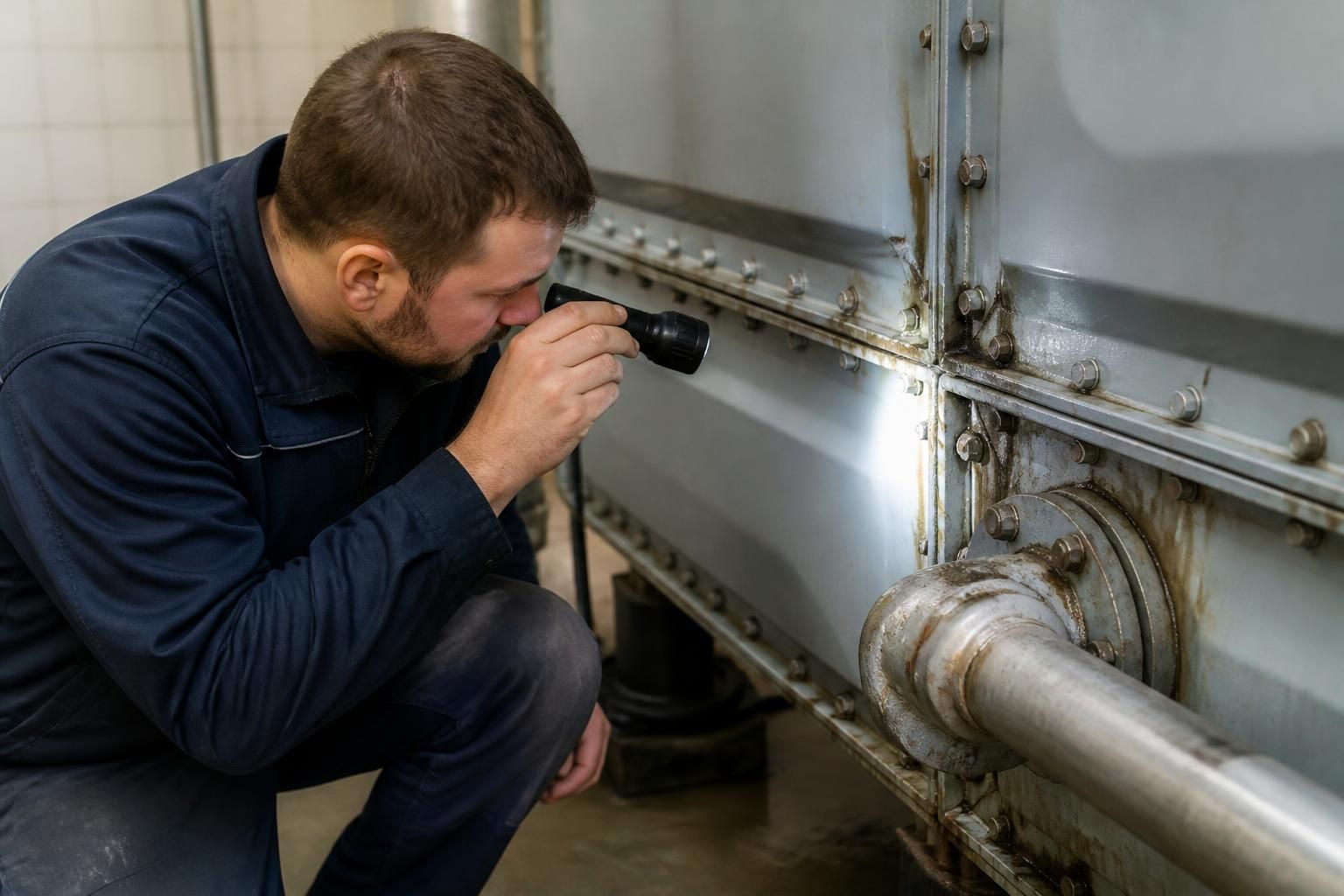
The source of a water tank leak is confirmed by establishing the route taken by the water and then eliminating other possible sources. A competent investigation combines operating information, controlled isolation, level or pressure observations and targeted examination of the tank installation. The aim is to identify the original failure point rather than simply repair the area where dampness happens to appear.
Start with the operating history
The timing and pattern of the leak can provide important evidence. The investigator will establish whether water appears continuously or only when the system is filling, heating, circulating or being used. Recent changes such as valve replacement, alterations to pipework, frost exposure, maintenance activity or changes in water demand may also indicate where the fault began.
The tank’s normal operating level is recorded and compared with the level reached when water is observed. This helps distinguish a leak from an overfilling event. For example, water escaping only when the tank reaches a particular level may indicate a problem with level control, an overflow arrangement or a joint positioned at that height. Water loss while the tank is below that level points towards a different part of the installation.
Use controlled isolation to narrow the source
Where the system design permits, individual feeds, outlets and connected equipment can be isolated in a planned sequence. The effect on the water level, pressure or visible dampness is then monitored. If the leak stops when one branch is isolated, that branch becomes the focus of further investigation. If the tank continues to lose water with all suitable outlets isolated, the tank body, its base or a concealed drain path becomes more likely.
Isolation must be carried out with regard to operational requirements, stored water risks and the consequences of interrupting supply. On pressurised systems, appropriate pressure testing may help identify a defect in connected pipework, but the test method and pressure must be suitable for the equipment. A pressure test should not be used as a substitute for investigating the tank itself.
Trace the path rather than relying on the wettest point
Water can travel along insulation, supports, floors and pipe surfaces before it becomes visible. The lowest or wettest area may therefore be secondary damage. Investigators follow the direction of staining, mineral deposits, corrosion and moisture beneath the installation, including around access points and penetrations. Moisture readings or thermal imaging may assist where the route is concealed, although these methods need to be interpreted alongside the system’s construction and operating conditions.
Where appropriate, a controlled tracer method can help distinguish water from separate sources. Any dye or tracing material must be compatible with the system and must not compromise potable water or other safety requirements. It should only be introduced under a planned procedure, with the system’s condition and subsequent flushing or verification taken into account.
Check for common alternative sources
An investigation should assess whether the apparent leak is actually caused by:
- condensation forming on a cold tank, pipe or fitting;
- water discharged through an overflow or drain arrangement;
- a nearby pipe, pump, valve or appliance;
- rainwater entering through the building fabric;
- cleaning water or an earlier escape that has been retained by insulation or flooring; or
- corrosion products and staining left after the original leak has stopped.
The characteristics of the water can help with this distinction. Temperature, clarity, odour, staining and the location of deposits may be compared with the water held in the system. This does not replace proper water hygiene controls, but it can help separate a tank defect from condensation or a leak originating elsewhere.
Confirm the failure point
Once the likely area has been narrowed down, the tank and its associated components are examined under controlled conditions. The inspection may consider seam integrity, penetrations, joint faces, support points, corrosion, deformation and areas subject to movement or vibration. The surrounding structure is checked for evidence that the water began at that point rather than arriving from above or behind it.
A sound diagnosis normally requires the investigator to reproduce or observe the escape under safe conditions. The confirmed location, operating state, water level, isolation steps and any test results should be recorded. Photographs and a simple marked-up diagram are useful where several tanks, branches or concealed routes are involved.
In a commercial or industrial setting, the findings should be incorporated into the relevant maintenance and water safety records. If the source cannot be confirmed without opening up the installation or affecting water quality, the limitation should be documented and the next investigative step agreed before intrusive work begins. This approach helps ensure that any remedial work addresses the cause of the leak and does not conceal an unresolved defect elsewhere in the system.
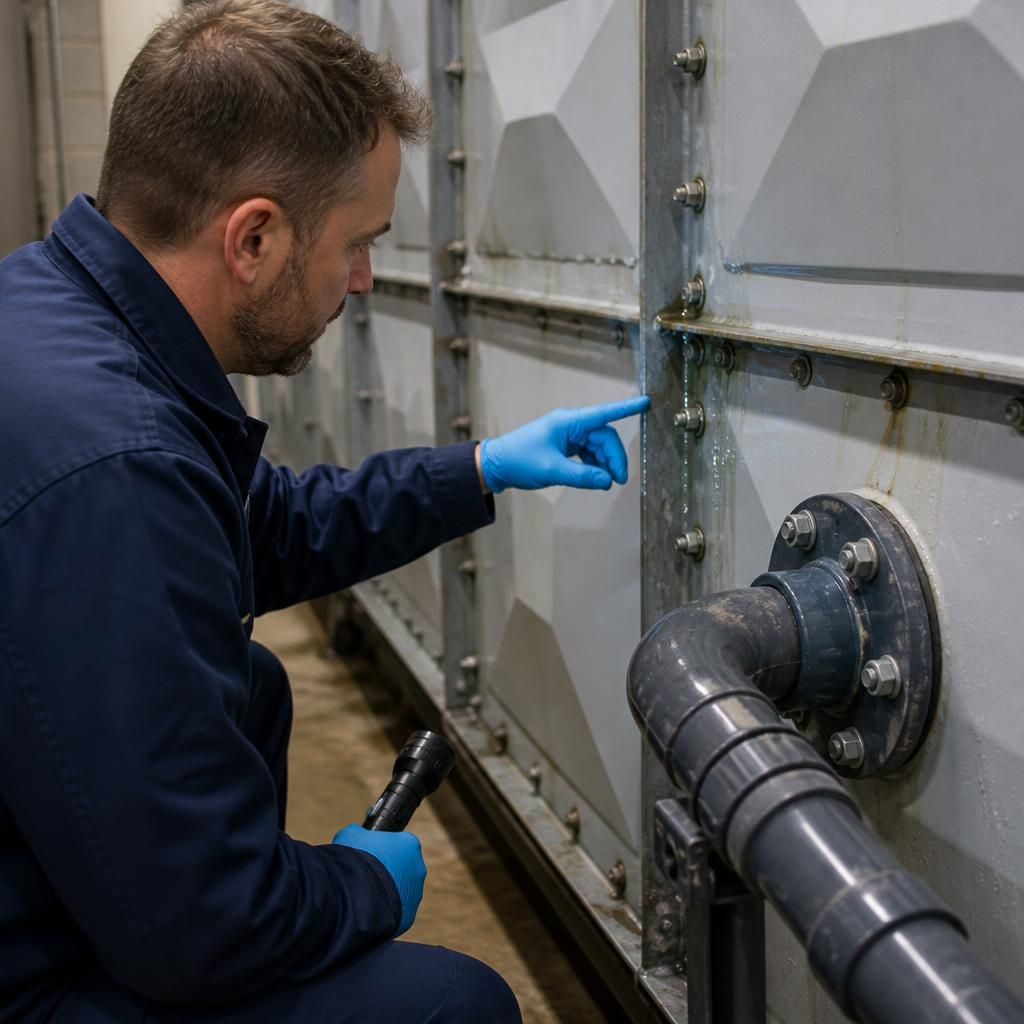
The tank’s construction helps determine where a leak is most likely to originate. In a sectional tank, attention is usually given to panel joints, gasketed connections and bolt assemblies. In moulded tanks, connections for valves, outlets and other fittings may be more significant than the tank wall itself. Concrete or metal tanks require a different assessment of cracks, corrosion and penetrations.
Inspection findings are compared with the tank design and its installation details rather than judged by appearance alone. A defect at a joint, fitting or penetration should correspond with the observed escape route and the conditions under which water is lost. This comparison helps distinguish a failed component from a defect in the tank body and supports a more precise repair specification.
Request a Water Tank Leak Investigation
If the source of a water tank leak remains uncertain, request a structured investigation to establish the likely failure point and inform appropriate remedial work.