
How should businesses assess contractor competence for water tank leak repair?
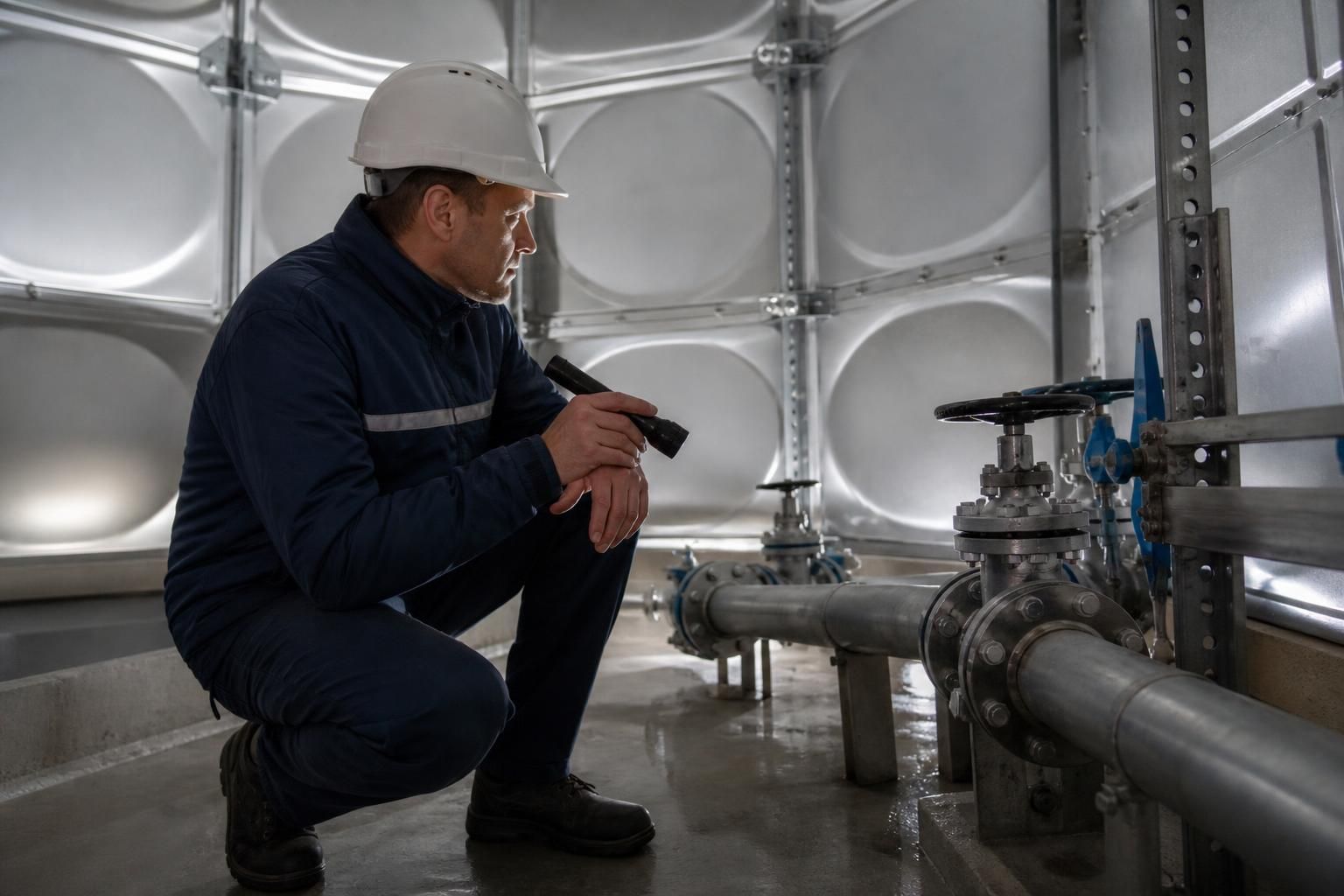
Contractor competence for water tank leak repair is demonstrated by task-specific technical knowledge, suitable procedures, properly supervised staff and reliable evidence that the proposed work will protect the water system as well as stop the leak. Businesses should assess the contractor’s ability to diagnose the failure, select an appropriate repair or replacement option, control contamination and disruption, and provide an auditable handover.
Check the contractor’s understanding of the failure. A competent contractor should be able to distinguish between a damaged tank body and a leak caused by a flange, gasket, outlet connection, valve, overflow or connected pipework. Ask how the fault will be confirmed before work begins and what conditions could have caused it, such as corrosion, movement, poor support, failed seals, excessive pressure or inadequate installation. A response that simply proposes sealing the visible leak may indicate that the underlying cause has not been considered.
Assess experience against the actual system. The relevant experience may differ between a cold water storage tank, sectional tank, break tank, header tank or a tank serving a specialist process. Consider the tank’s construction, capacity, location, access arrangements, connected equipment and the consequences of taking it out of service. Evidence should relate to comparable systems rather than relying only on a general claim of plumbing or maintenance experience.
Verify the people who will carry out and supervise the work. Ask which individuals will attend, what training is relevant to the task and who has authority to make technical decisions on site. Depending on the premises and repair method, competence may also involve work at height, confined-space precautions, manual handling, electrical isolation, hot works or the safe use of access equipment. Where specialist activities are subcontracted, establish who controls that work and how responsibilities are divided.
Review the proposed repair method in practical detail. It should explain how the tank will be isolated, drained or bypassed where necessary, how stored water and connected services will be protected, and how the work area will be kept clean. It should identify the repair materials and explain why they are suitable for the tank and its use. For systems supplying potable water, ask how the contractor will ensure that materials, sealants and procedures meet the applicable water hygiene and water fittings requirements.
- the sequence of isolation, access, preparation, repair and reinstatement;
- how residual water will be managed and disposed of;
- how tools, debris, coatings and foreign material will be kept out of the tank;
- what happens if further deterioration is found after access is gained; and
- the criteria for deciding that repair is unsuitable and replacement or wider remedial work is required.
A competent contractor should be willing to explain limitations rather than presenting every leak as a straightforward patching exercise. Extensive corrosion, deformation, failed supports or repeated leaks may make a local repair short-term or inappropriate. The recommendation should take account of the tank’s condition, the consequences of another failure and the cost and practicality of future maintenance.
Examine the contractor’s management controls. Before appointment, request the relevant risk assessment and method statement, insurance documents, training or competence records and any required site-specific information. These documents should match the proposed job, not be generic paperwork copied from an unrelated activity. Check that the arrangements cover access, isolation, water contamination, interaction with building occupants and the protection of plant and surrounding areas.
Compare quotations by scope, not just price. A useful quotation separates investigation, preparation, labour, materials, access equipment, draining and reinstatement. It should state assumptions and exclusions, including whether related valves, supports, insulation, pipework or tank coatings are included. Clarify who is responsible for arranging isolation, providing access, managing temporary service arrangements and approving additional work. The cheapest quotation may omit essential preparation or leave the cause of the leak unresolved.
Ask how the completed work will be accepted. Agree in advance how the repair will be inspected and tested, who will confirm that the tank is fit to return to service and what information will be supplied afterwards. Depending on the system and the work undertaken, this may include visual inspection, leak testing, operational checks, cleaning or disinfection arrangements, and updates to the water system’s maintenance records. If the repair affects a monitored or risk-assessed system, the responsible person should know what findings need to be recorded and whether further specialist assessment is appropriate.
Warning signs include uncertainty about the source of the leak, reluctance to identify the person responsible for the work, unexplained substitutions of materials, a quotation with no defined scope, or advice to return a tank to service without appropriate checks. Businesses should also be cautious where a contractor cannot explain when a repair is temporary, what defects remain, or how recurring failure will be monitored.
The strongest assessment combines documentary checks with technical questioning. Ask the contractor to explain the proposed solution in terms of the particular tank, water use and site constraints, then test whether the quotation, method statement and handover arrangements are consistent with that explanation. This gives the business a more reliable basis for selecting a contractor than a broad competence statement alone.

Reference checks help verify whether a contractor has applied its stated competence to comparable water tank leak repairs. They should confirm the quality of the investigation, repair decisions and handover rather than simply establish that the contractor attended site.
Ask references about:
- the type, construction and use of the tank involved;
- whether the contractor identified the underlying cause rather than treating only the visible symptom;
- how clearly the proposed scope, exclusions and any risks were explained;
- whether the completed repair matched the agreed method and materials;
- the quality of inspection, testing and documentation provided at completion; and
- whether any follow-up defects or limitations were identified after the work.
Use references from organisations with similar operational constraints, such as premises where water storage is important to building use or where access is restricted. Request permission to verify the reference directly and record the name and role of the person providing it. A useful reference should describe the contractor’s actual role and the work delivered, not offer only a general statement that the firm was satisfactory.
Discuss Your Water Tank Leak Repair Requirements
Contact Blue Fish Water Management Ltd to discuss your water tank leak repair requirements and the information needed to plan suitable remedial work.