
What documentation should a water tank cleaning service provide afterwards?
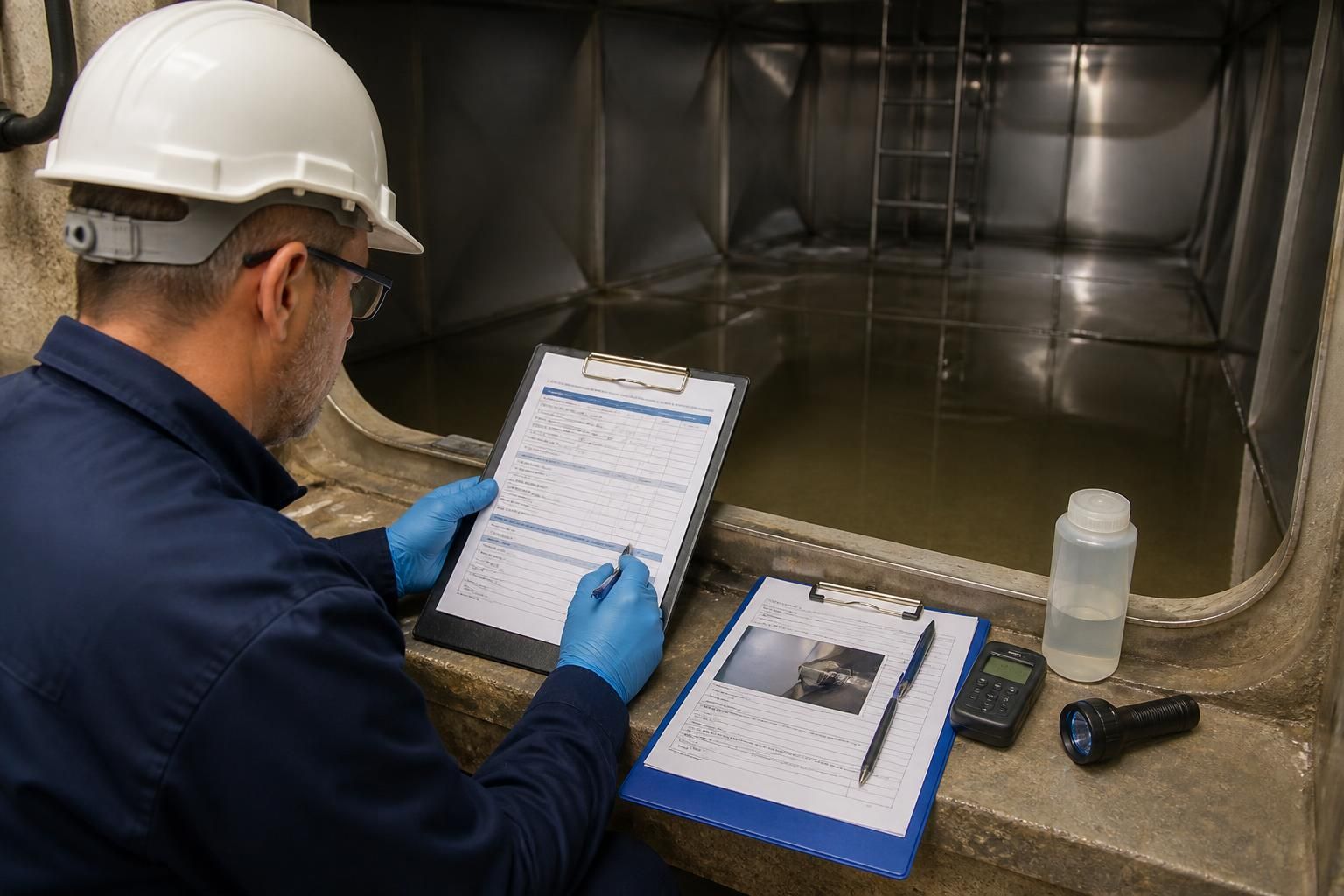
Documentation from a water tank cleaning service should create a clear, auditable record of what was authorised, how the work was carried out, and whether the tank was suitable to return to service. It should be detailed enough for the responsible person or facilities team to reconcile the work with the site’s water safety plan, asset records and any relevant risk assessment.
A well-prepared service pack will normally include the following information:
- Work order and site details: the client, premises, location, tank reference, service date and the person who authorised or received the work. Where a site contains several tanks or linked systems, each asset should be distinguishable rather than described only as “the water tank”.
- Scope and method statement: the agreed work scope, access arrangements, isolation requirements and the cleaning and disinfection method used. The record should identify relevant chemicals or treatment products, dilution or concentration checks where applicable, contact times, flushing arrangements and any departure from the planned method.
- Safety and control records: information showing how the system was isolated, protected from contamination and returned to use. This may include details of temporary controls, drainage, waste handling, confined-space precautions and the checks made before the system was put back into operation.
- Condition information: observations about the tank, cover, screens, overflow, inlet and outlet arrangements, internal surfaces, supports and surrounding area. The service record should distinguish between contamination removed during cleaning and defects that require separate repair or investigation.
- Evidence of verification: relevant readings, inspection checks and test results should be linked to the correct tank and sampling point. If samples have been sent to a laboratory, the documentation should make clear who took them, when and where they were taken, the laboratory used, the parameters tested and whether the result is pending or final.
- Traceability: the names or identifiers of the technicians involved, the equipment or instruments used where this matters, and any laboratory or sample reference numbers. This makes it possible to investigate a query without relying solely on an informal statement that the work was completed.
- Limitations and exclusions: any areas that could not be accessed, components not included in the contract, abnormal operating conditions or work postponed because of safety or operational constraints. These points are important because a signed report does not necessarily mean that every associated part of a water system has been inspected or remedied.
- Close-out actions: a clear separation between completed work, outstanding defects, recommended priorities and actions assigned to the client or another contractor. If reinspection, retesting, tank repair or additional monitoring is advised, the record should explain the reason and the condition that would trigger it.
Where disinfection has been carried out, the paperwork should make the treatment traceable from preparation through to completion. A generic statement such as “tank disinfected” provides less assurance than a record showing the procedure used, relevant checks, flushing or neutralisation arrangements and the basis on which the system was considered ready for use. The exact records required will depend on the system, the agreed specification and the risks identified at the premises.
Laboratory results should not be confused with proof that cleaning itself was completed. A water test provides information about the sample taken at a particular time and location; it does not by itself confirm that the whole tank was physically cleaned, that all defects were corrected or that the wider distribution system is free from risk. Conversely, a cleaning report may be complete even where testing was not included in the instruction. The documents should therefore state what was and was not tested.
The completed records should be reviewed by the organisation’s responsible person or water safety lead, not simply filed without consideration. They can be used to update the asset register, amend planned maintenance tasks, record outstanding actions and support future decisions about cleaning, repair or replacement. Any significant defect or unexpected contamination may also require the site’s water safety arrangements and risk assessment to be reviewed.
For audit purposes, retain the final report and its supporting records together, including laboratory correspondence, photographs, quotations or remedial recommendations where they explain an outstanding action. Electronic records should have a consistent file name and version or revision trail, while paper records should be legible and signed or otherwise attributable. The retention period should follow the organisation’s document-control policy and any applicable contractual, regulatory or sector-specific requirements.
Before accepting the service as complete, the client should check that the documentation identifies the correct asset, explains the work sufficiently, records any limitations, links supporting evidence to the correct location and makes outstanding actions unambiguous. If any of these elements is missing, the client should ask for clarification while the visit and findings are still readily traceable.

Documentation requirements should be agreed before the water tank cleaning work is instructed. The quotation or work order should state which final documents are included, such as the completed service report, photographic evidence, disinfection record or laboratory report, and whether these are supplied as separate files or one consolidated pack.
It is also reasonable to request a redacted example of the contractor’s report before appointing them. This allows the responsible person to check whether the format is suitable for the site’s water safety records and whether it captures the level of detail needed for internal review, audit or handover to a facilities team.
Discuss your water tank cleaning documentation requirements
Discuss your water tank cleaning documentation requirements with Blue Fish Water Management Ltd before arranging the work, so the final records match your site’s compliance and handover needs.