
What does hot water tank cleaning and disinfection involve?
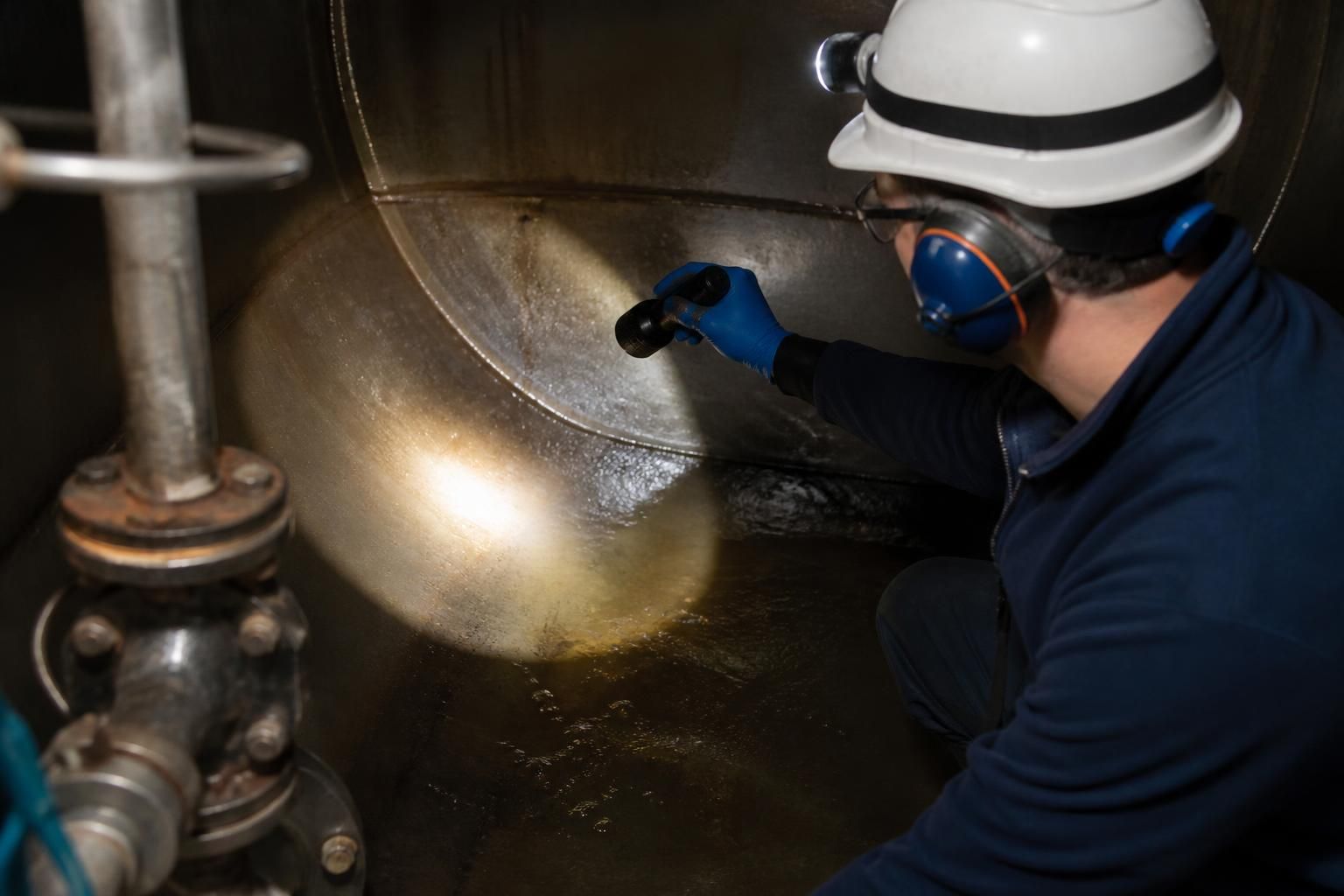
Hot water tank cleaning and disinfection is a controlled maintenance process that removes accumulated deposits and reduces microbial contamination before the tank is returned to service. It combines planned isolation, physical cleaning, an appropriate disinfection method, thorough flushing and documented verification, with the exact approach determined by the tank design, condition, water system and site risk assessment.
1. Review the system and plan the work
Before work begins, the contractor should review the site’s water safety arrangements, schematic drawings, written scheme of control and previous inspection or sampling results where available. This establishes which tank is being treated, how it connects to the wider hot water system, what services may be affected and whether the tank can be safely isolated.
The planning stage should also consider tank access, confined-space risks, electrical or mechanical hazards, drainage arrangements and the protection of users who could be exposed to water during the work. Where the tank supplies critical facilities or business operations, the method should set out how disruption and temporary loss of supply will be controlled.
2. Isolate the tank and make it safe to enter
The tank is isolated from the incoming supply and connected outlets in accordance with the agreed method statement. Stored water is removed through a suitable discharge route, taking care to avoid uncontrolled release, cross-connection or contamination of other parts of the system. The isolation should be checked rather than assumed, particularly where valves are old, poorly labelled or shared with other tanks.
Access covers and inspection points are opened using suitable precautions. If entry into the tank is proposed, this requires a separate assessment because tanks may constitute confined spaces. In many cases, cleaning can be completed without a person entering the vessel.
3. Inspect the tank before cleaning
Once accessible, the tank is examined for sediment, scale, biofilm, corrosion, damaged coatings, defective insulation, loose components and signs of deterioration. The condition of the lid, seals, overflow, warning pipe, inlet arrangements and internal fittings is also relevant. Findings may indicate that cleaning alone is insufficient and that repair, replacement or further investigation is needed.
The inspection also helps the contractor select a cleaning method that will remove deposits without damaging the tank or disturbing components unnecessarily. Heavy deposits can conceal defects, so the condition should be reassessed after cleaning.
4. Remove deposits and clean internal surfaces
Accumulated sludge, scale and other debris are removed from the base and internal surfaces. Depending on the tank construction and the nature of the deposits, this may involve controlled mechanical cleaning, manual methods, low-pressure washing or a suitable cleaning product. Any chemical used must be compatible with the tank and system materials, controlled by the contractor’s method statement and removed from the system afterwards.
Cleaning is not limited to the visible base of the vessel. The contractor should address areas where deposits can remain, including corners, seams, inlet zones, outlets, lids and internal fittings. Waste material must be collected and disposed of appropriately rather than allowed to pass into downstream pipework.
5. Apply the disinfection treatment
After physical cleaning, the tank and relevant connected components are disinfected using a method suitable for the system and the identified risk. The treatment must achieve the required contact conditions throughout the parts of the system included in the work. This may require controlled dosing, circulation or another documented technique selected by a competent person.
Disinfection is not simply the addition of a chemical to a tank. The contractor must control the treatment, prevent unauthorised use of the water and follow the product and site safety requirements. Where a chemical treatment is used, concentration and contact conditions should be monitored in accordance with the method statement, with appropriate precautions for handling, storage and discharge.
6. Flush, refill and return the system to service
Following disinfection, the tank and affected pipework are flushed with wholesome water until the treatment has been removed or reduced to an acceptable level. The system is then refilled, checked for leaks and returned to its normal operating arrangement. Any strainers, filters or fittings affected by the work should be checked and reinstated as required.
Where the work has involved a wider system, outlets may need to be flushed and checked individually. The contractor should confirm that the tank is correctly connected, that temperatures and controls are operating as intended, and that there are no abnormal flow, pressure or heating issues created by the intervention.
7. Verify and document the outcome
Verification may include visual checks, treatment records, flushing records, operational checks and water samples, depending on the risk assessment and the scope of the work. Sampling is not a substitute for proper cleaning and disinfection, but it can provide additional evidence when required by the site’s control regime or following a known problem.
- the tank and system section treated;
- the reason for the work and the condition found;
- the cleaning and disinfection methods used;
- relevant treatment or monitoring results;
- details of flushing, reinstatement and any defects;
- recommendations for remedial work or further monitoring; and
- the date, responsible personnel and confirmation of completion.
These records should be retained with the site’s water hygiene documentation so that the work can be demonstrated during internal reviews, compliance audits or subsequent risk assessment. Any unresolved defect should be clearly distinguished from completed cleaning and assigned for action.
Blue Fish Water Management provides legionella control and water hygiene support for domestic, industrial and commercial environments, including risk assessments, water testing, compliance audits, system monitoring and remedial works. Its approach is to relate tank cleaning and disinfection to the wider water safety arrangements rather than treat it as an isolated maintenance task.
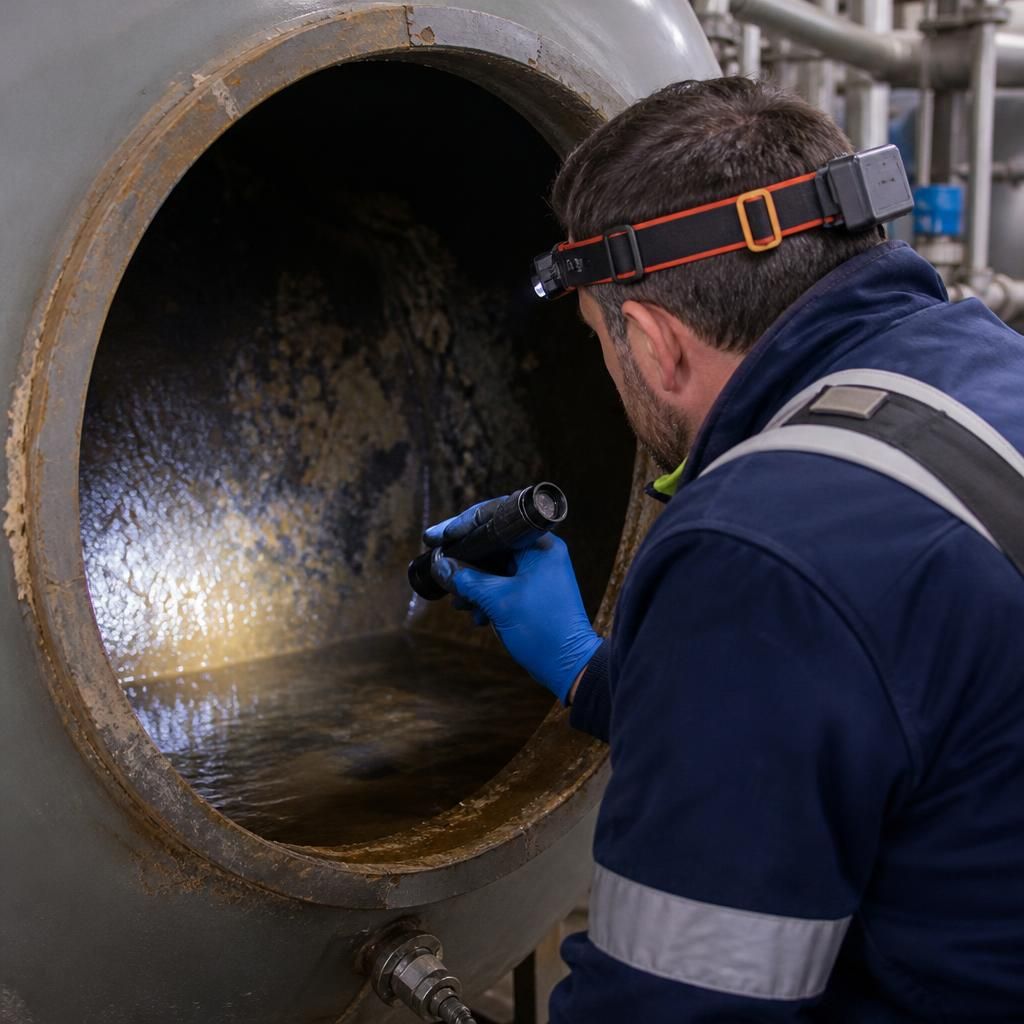
Inspection determines whether cleaning alone is sufficient. A tank may contain corrosion, damaged surfaces, defective fittings or an insecure cover that disinfection cannot correct. These conditions can affect the tank’s suitability for continued service and may require repair, replacement or further investigation before it is returned to normal use.
The contractor should therefore assess the tank both before and after deposits are removed. This provides a clearer basis for deciding whether the completed work has restored the tank to an acceptable condition or whether additional action is needed.
Discuss Your Hot Water Tank Cleaning and Disinfection Requirements
Discuss your hot water tank cleaning and disinfection requirements with Blue Fish Water Management to establish an appropriate scope of work for your system and site.