
What records should follow sewage tank cleaning?
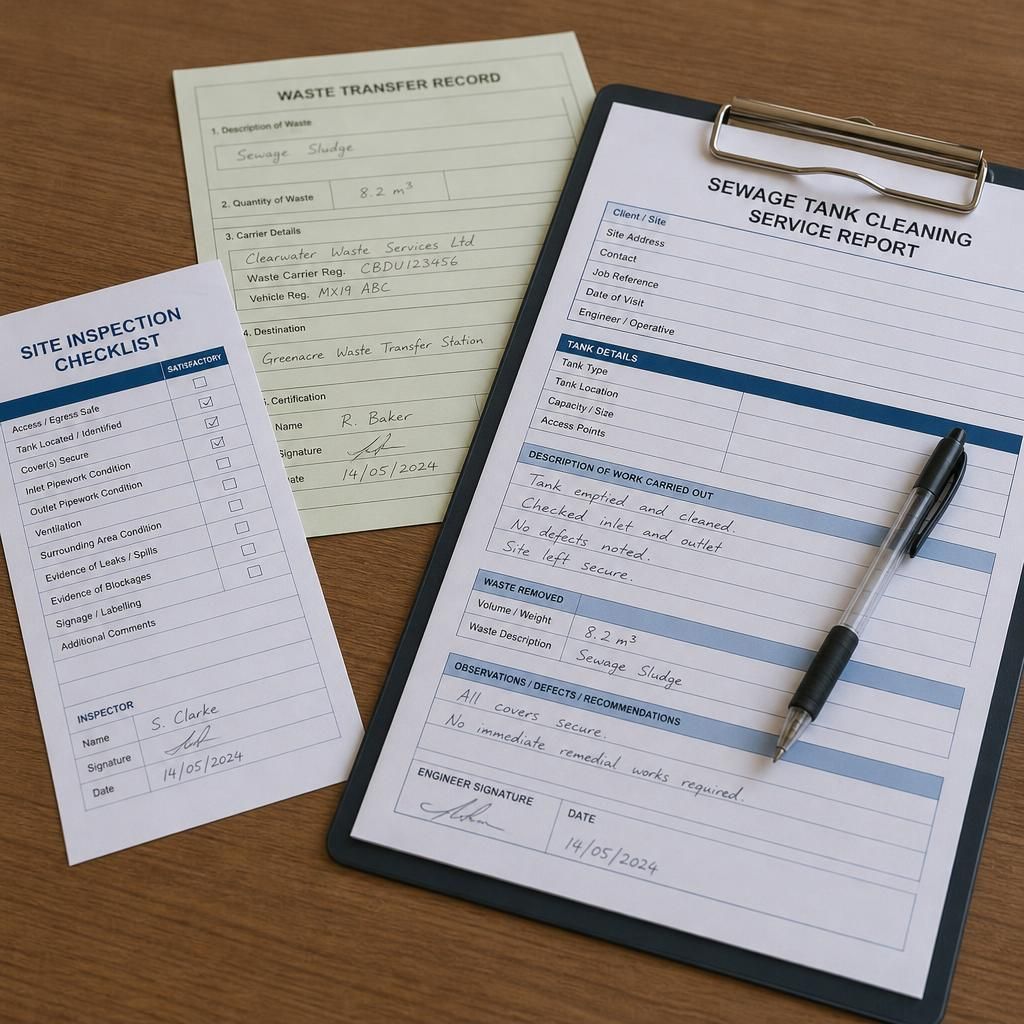
After sewage tank cleaning, keep the contractor’s service report, waste transfer documentation, date of work, tank or site identification, waste volume or description, and any defects or remedial recommendations. Retain these records with inspection and maintenance information to demonstrate that the tank was serviced appropriately and to support future compliance checks.
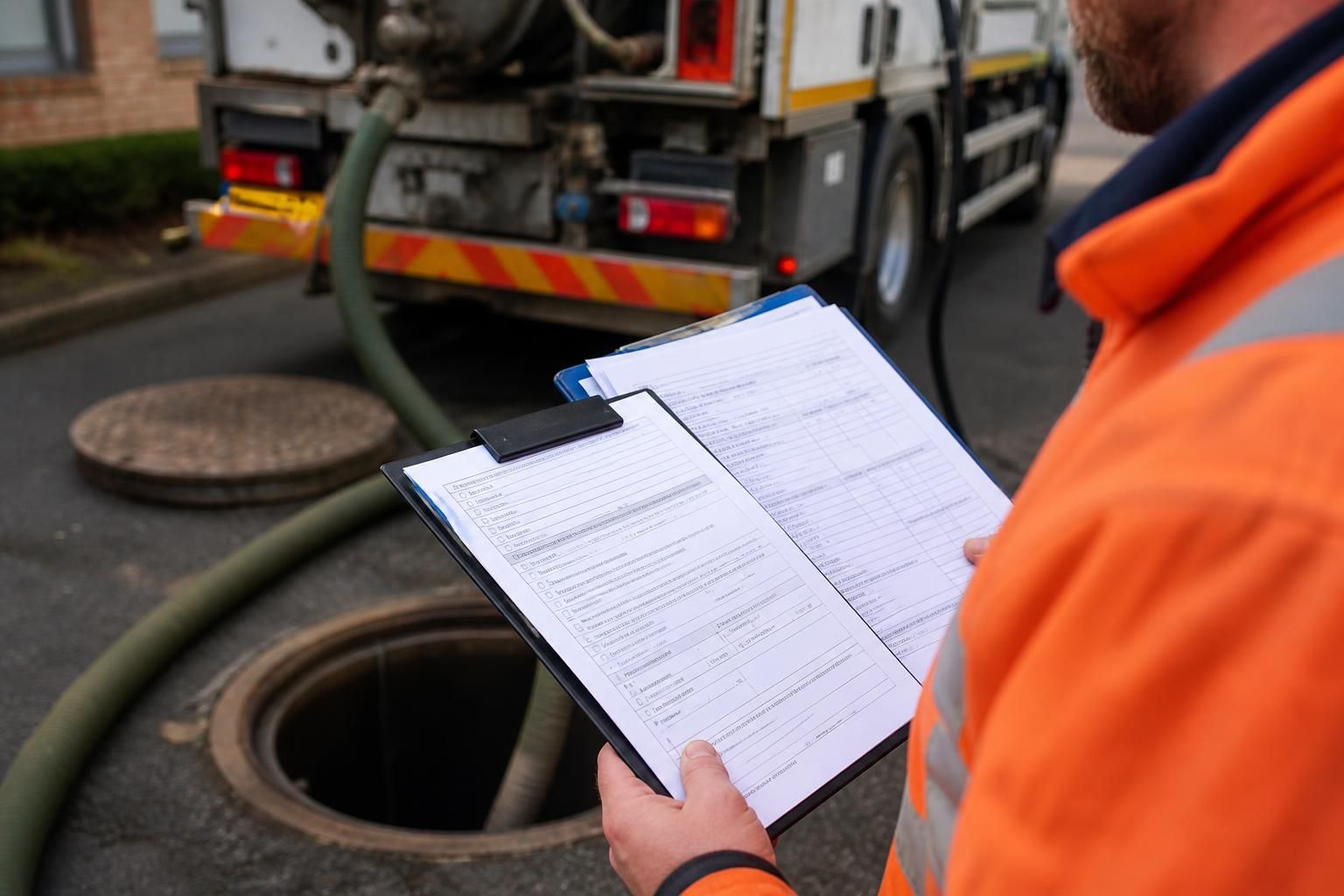
A suitable sewage tank cleaning record is more than an invoice or a brief attendance note. It should form an auditable service file showing what was authorised, how the work was controlled, what waste was removed, where it went, and whether any follow-up action remains open.
In addition to the contractor’s core service documentation, retain the following records where they apply to the site and the work undertaken:
- Work instruction or purchase order: Keep the request that defines the tank, the required service, access arrangements and any site-specific restrictions. This helps demonstrate that the work was planned rather than arranged without reference to the asset or its risks.
- Contractor and vehicle details: Record the servicing company’s legal name, contact details, relevant waste-carrier information and the vehicle or crew identification where supplied. If the work involves controlled waste, check that the documentation and permissions are appropriate to the waste and retain evidence of those checks.
- Site safety documentation: File the method statement, risk assessment, permit-to-work or other control documents used for the task. These should address vehicle positioning, hose routing, biological exposure, spills, access restrictions and any confined-space risk. A tank should not be entered simply because it is being emptied; entry requires separate, task-specific controls and competent arrangements.
- Site induction and handover records: Where contractors work under site rules, retain evidence of the relevant induction, contact arrangements and handover. This can be particularly useful where a tank is shared by several buildings, sits within a restricted compound or serves a process area.
- Waste destination evidence: Keep information showing the receiving facility or treatment route, together with a weighbridge ticket, acceptance receipt or equivalent document when one is issued. This completes the audit trail from removal to final destination; a collection document alone may not establish what happened afterwards.
- Photographic or condition evidence: Before-and-after photographs can document access covers, surrounding ground, inlet and outlet arrangements, liquid levels or visible damage without requiring anyone to enter the tank. Images should be dated, linked to the correct asset and stored securely.
- Incident and abnormal-event reports: Record spills, leaks, overflows, damaged covers, vehicle damage, exposure events, complaints or any departure from the planned method. Include the immediate containment measures, notifications and corrective actions rather than relying on an informal email.
- Action closure evidence: If the service identifies a repair, cleaning limitation or operational issue, link the original finding to the responsible person, target date, approval and completion evidence. A closed maintenance order, contractor completion note or photograph may demonstrate that the issue was dealt with.
Keep the cleaning file alongside the site’s wider drainage and environmental records. Useful cross-references include the asset register, drainage drawings, tank capacity information, previous servicing history, inspection findings, overflow or pollution-response procedures and records of related repairs. Cross-referencing prevents a new contractor or facilities team from treating each visit as an isolated event.
The record should also make clear whether the work was routine, reactive or part of a planned maintenance programme. A reactive emptying after an overflow may require a separate investigation into the cause, while routine cleaning may be reviewed against the site’s planned frequency and operating conditions. The documents should not suggest that cleaning alone proves the tank or drainage system is fit for continued use.
Use the correct waste paperwork for the classification of material removed. For example, a non-hazardous waste transfer record and a hazardous waste consignment note serve different purposes, so the paperwork should reflect the classification determined for that load. Where classification is uncertain, obtain advice before the collection and retain the basis for the decision. Do not alter or retrospectively recreate waste documents to fill a gap in the audit trail.
Records should be legible, dated and attributable to the person or organisation that created them. Digital files should use a consistent naming convention, identify the relevant site and asset, and include the final version of amended documents. Access should be limited where photographs, names, signatures or vehicle details contain personal information. Back up the records in accordance with the organisation’s document-control arrangements.
There is no single retention period that applies to every document connected with sewage tank cleaning. Apply the longest period required by the relevant environmental, health and safety, contractual, insurance or quality-management arrangements, and follow any current legal requirement for the particular waste stream. If the site operates under an environmental permit, consent, customer standard or certified management system, its document-retention rules may add further requirements.
Before closing the service record, check that the asset can be identified unambiguously, the waste trail is complete, safety documents are present where relevant, exceptions have been escalated and outstanding actions have an owner. This final review turns a collection of paperwork into useful evidence for internal audits, environmental inspections, maintenance planning and future contractor handovers.
A sewage tank cleaning record should show whether the work changed the site’s assessed risk, not simply that the tank was emptied. If the contractor identifies an overflow route, damaged cover, altered inlet arrangement, unusual contents or another condition that could affect safe operation, refer the finding to the person responsible for the site’s drainage or environmental controls.
Record the review decision, including whether the existing assessment remains suitable, needs updating or requires further investigation. This creates a clear link between the cleaning visit and any later change to operating controls, inspection arrangements or maintenance planning.
Need help with your sewage tank cleaning records?
If you need to review how sewage tank cleaning records fit within wider site water and environmental controls, speak to Blue Fish Water Management Ltd for practical guidance on the information your organisation should hold. Have the latest service report and related site records available when seeking advice.