
What safety controls are needed during sewage tank cleaning?
Safe sewage tank cleaning requires a task-specific risk assessment, isolation of incoming flows and mechanical equipment, atmospheric testing, controlled access and suitable ventilation. Workers should use appropriate PPE, follow confined-space entry and rescue procedures where applicable, maintain hygiene controls, and keep unauthorised people away from the work area.
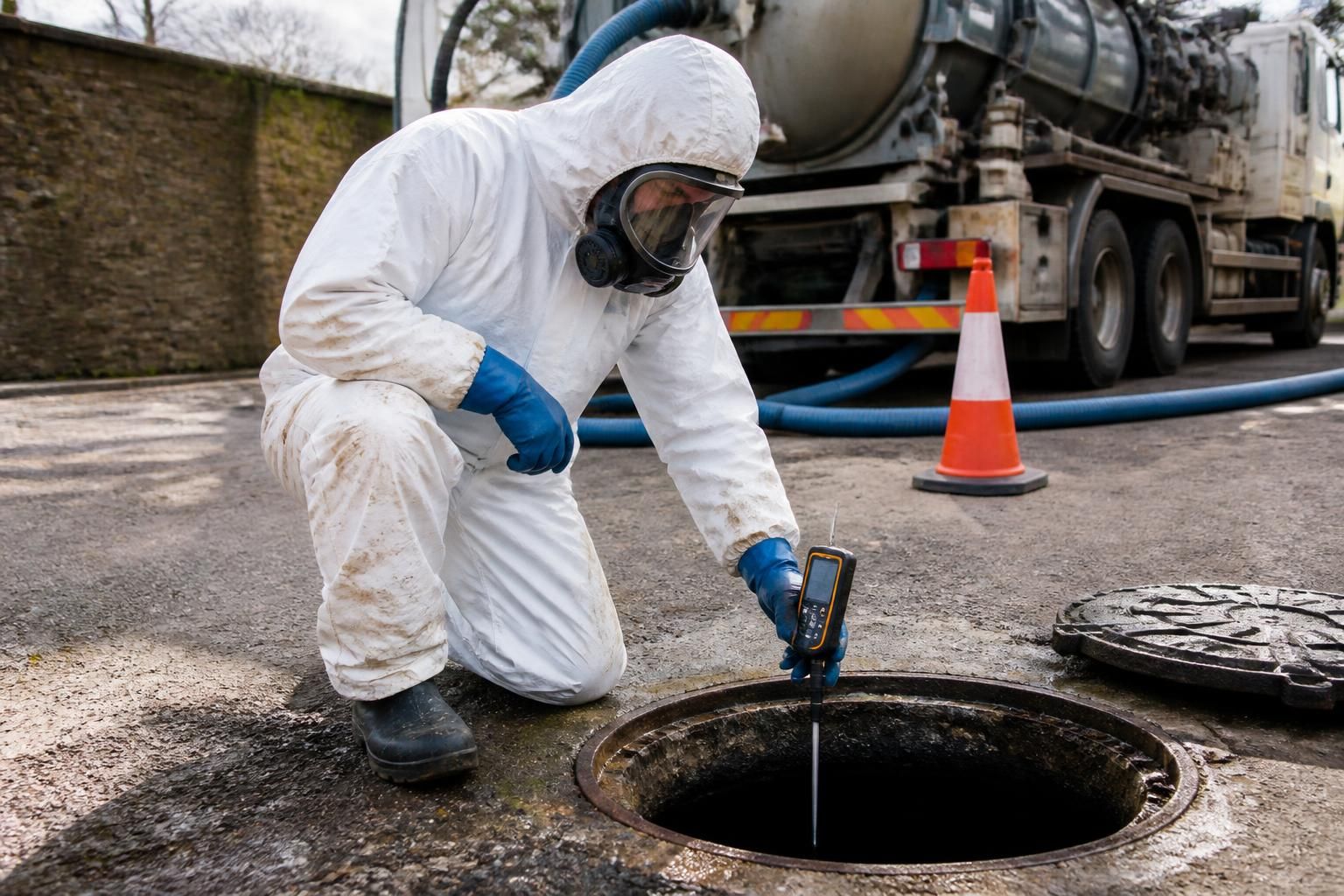
The essential safety controls during sewage tank cleaning are planned work methods, competent supervision, safe use of jetting and lifting equipment, protection from biological and physical hazards, and clear arrangements for stopping and reporting unsafe work. Cleaning should be carried out without entering the tank wherever a suitable remote method is available. If entry is genuinely necessary, it requires a separate, formally controlled confined-space operation rather than being treated as a routine cleaning task.
Plan the work around the tank and site conditions. Before work begins, the contractor should obtain information about the tank’s construction, access points, capacity, contents, connected drainage, previous use and any known contamination. The work plan should identify hazards such as fragile covers, deteriorated concrete, unstable ground, flooding, nearby traffic, overhead services and restricted vehicle access. A competent person should brief everyone involved, confirm individual responsibilities and set clear stop-work criteria.
The plan should also consider whether the tank can be cleaned using suction equipment, jetting equipment or other methods operated from outside. Remote cleaning reduces the need for people to approach hazardous openings and limits exposure to sewage. The method selected should be suitable for the tank’s size, construction and condition, rather than relying on equipment that could damage the structure or create additional hazards.
Use competent people and suitable supervision. Workers should understand the cleaning method, the hazards of sewage and the operating limits of the equipment they use. Anyone carrying out specialist tasks, such as high-pressure water jetting, lifting operations or electrical work, should have appropriate training and experience. A supervisor should remain able to monitor the work, maintain communication with the team and stop the operation if conditions change.
Health considerations should be addressed before attendance on site. The employer should consider relevant medical advice, occupational health arrangements and any factors that could increase an individual’s vulnerability to biological exposure, contaminated environments or strenuous work. Workers should know how to report symptoms, skin injuries, contamination incidents and defective equipment.
Control high-pressure water and mechanical equipment. Jetting can cause serious injection injuries, impact injuries and loss of control. The equipment should be inspected before use, operated only by trained personnel and used within its specified pressure and flow limits. Hoses, couplings, guards and trigger controls should be suitable for the task and secured against sudden movement. Operators should keep people clear of the jet path and never direct a jet towards another person, even when the equipment appears to be switched off.
Where pumps, mixers, augers or other machinery are used, guards should remain in place and moving parts should not be approached while equipment is operating. Any blockage or adjustment should be dealt with using the planned isolation and maintenance procedure, not by reaching into the equipment. Equipment should be positioned on stable ground, with cables and hoses routed to prevent trips, crushing or damage from vehicles.
Manage lifting and manual handling. Covers, hoses, suction equipment and waste containers can be heavy and awkward. Lifting points and accessories should be suitable for the load and examined as required. Loads should not be lifted over people, and no one should stand beneath a suspended load. Mechanical assistance should be used where practicable, with a clear route for moving equipment and materials.
Manual handling should be planned around the distance, posture, weight and frequency of the task. Covers should be lifted with the correct tools rather than improvised methods. Once removed, they should be placed where they cannot fall back into an opening or create a trip hazard.
Prevent contact with sewage and contamination of clean areas. Sewage may contain harmful microorganisms, sharp debris, chemical residues and other contaminants. Work areas should be arranged so that dirty equipment, used materials and waste do not contaminate vehicle cabs, welfare facilities, clothing storage or clean tools. Eating, drinking and smoking should be prohibited in contaminated work areas. Workers should wash thoroughly after the task, and any cuts or abrasions should be protected before work starts.
Reusable equipment should be cleaned and disinfected using a method appropriate to its materials and the contaminants involved. Contaminated clothing should be handled separately from everyday clothing and laundered or disposed of in accordance with the employer’s procedure. A splash, needlestick, cut or suspected ingestion incident should be reported immediately so that appropriate first aid and medical advice can be arranged.
Protect the surrounding site. Tank cleaning can affect pedestrians, vehicles, nearby operations and drainage systems. The work area should be arranged to prevent people or vehicles striking equipment, hoses or open access points. Where vehicles are involved, a planned route, suitable reversing controls and a banksman may be needed. Spills should be contained promptly, with absorbent materials and waste arrangements available before cleaning starts.
Cleaning residues, sludge and contaminated water should be collected, transported and disposed of through an appropriate waste process. The waste description should reflect its actual contents, and records should be retained where required. Waste must not be discharged to ground, surface water or drainage infrastructure unless this is specifically permitted.
Keep emergency arrangements practical. The team should know how to summon assistance, provide first aid, report a spill and deal with equipment failure. Emergency arrangements should account for the site’s location, access for emergency services and the hazards created by sewage, machinery and the tank itself. A worker who becomes contaminated or injured should not be left to manage the incident alone.
On completion, the supervisor should confirm that equipment, hoses, tools and waste have been removed, covers have been securely replaced and the area has been left safe for normal use. The client should be informed of defects such as damaged covers, structural deterioration, blocked connections or unusual deposits. Any incident, near miss or change from the planned method should be recorded and reviewed before similar work is undertaken.
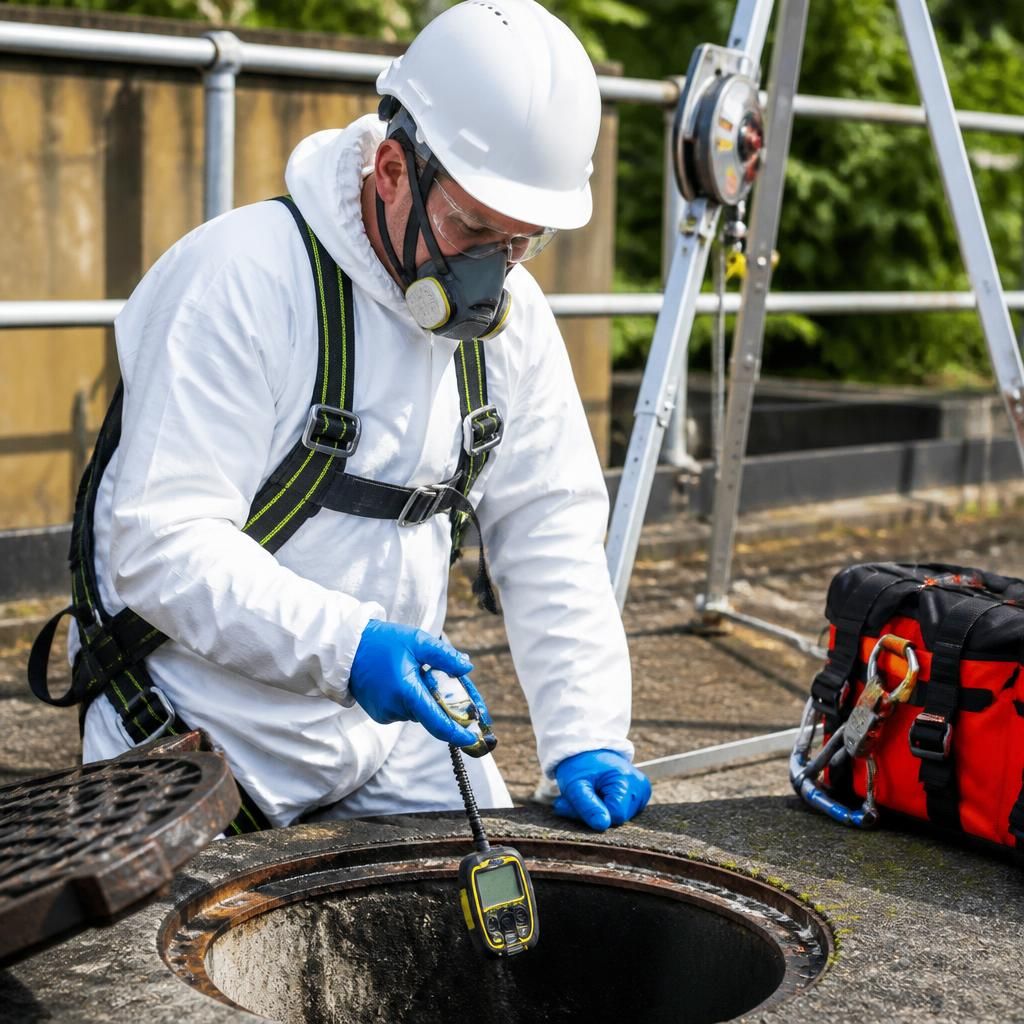
Personal protective equipment (PPE) is the final layer of protection during sewage tank cleaning and must be selected for the specific exposure identified by the risk assessment. Typical controls may include waterproof gloves, protective footwear, coveralls and eye or face protection where splashing is possible. The equipment should be compatible, inspected before use and removed in a way that prevents contaminated surfaces touching skin or clean clothing.
Respiratory protective equipment (RPE) may be needed where the assessment identifies a risk from contaminated aerosols, gases or inadequate air quality. It must be the correct type for the hazard, fit-tested for the individual and maintained according to the employer’s procedure. RPE does not replace source control, ventilation or atmospheric monitoring, particularly where tank entry or a potentially oxygen-deficient atmosphere is involved.
Discuss your sewage tank cleaning safety requirements
If you need help applying these principles to a particular site or cleaning method, speak to Blue Fish Water Management Ltd about your sewage tank cleaning safety requirements.