
How should businesses assess competence for sewage tank cleaning?

Businesses should assess sewage tank cleaning competence by verifying that the contractor can plan, control and document the work for the particular tank and site, rather than relying on a price or a general claim of experience. The assessment should cover the people carrying out the work, the quality of the proposed method, legal and environmental controls, communication arrangements and the evidence supplied after completion.
Check experience relevant to the installation
Ask whether the contractor has worked with the type of tank, sewage system and access arrangement present at the site. A domestic septic tank, a large commercial holding tank and an industrial wastewater installation may involve different cleaning methods, waste volumes, access constraints and contamination risks. Relevant experience is more useful than a long list of unrelated drainage jobs.
The contractor should be able to explain how it would approach the specific installation, including:
- identifying the tank location, capacity and construction;
- confirming where the tanker can safely position and how hoses will reach the tank;
- considering nearby buildings, plant, public areas, traffic routes and overhead or underground services;
- dealing with restricted access, fragile covers, poor ground conditions or flooding; and
- determining what cleaning standard is required for the tank's intended use.
Answers should be practical and consistent with the information available from the site. A contractor that proposes the same approach for every installation may not have assessed the work properly.
Examine the competence of the actual team
Competence belongs to the people undertaking and supervising the work, not solely to the company name. Ask who will attend, who is responsible for the job and how relevant training and experience are kept current. Where work involves entry into or close approach to a confined space, the contractor should clearly distinguish between cleaning from outside the tank and any proposed entry. Tank entry requires a much higher level of planning and control and should not be treated as a routine part of emptying.
It is also reasonable to ask how new or temporary staff are supervised, how subcontractors are assessed and who has authority to stop the work. The answers should identify named responsibilities without relying on informal assurances. A competent contractor should be willing to explain its escalation process if the tank is damaged, unexpectedly deep, contaminated by unusual material or different from the description provided.
Review the proposed work method
Before appointing a contractor, request a written quotation or method statement that describes the work in enough detail to compare providers fairly. It should state what is included, what is excluded, how the tank will be opened and cleaned, how spillage will be prevented, and how the area will be left afterwards.
Pay particular attention to whether the proposed method controls exposure to sewage, harmful gases, biological contamination, moving vehicles, hose movement and manual handling. The document should also explain how barriers, warning signs and exclusion zones will be used where other workers, visitors or members of the public could approach the work area. Generic wording is not automatically unacceptable, but it should be supplemented with information specific to the site.
A sound assessment also considers what the contractor will do if conditions change. For example, the work may need to stop if the cover is unstable, gas readings are unsafe, access becomes unsuitable, the tank is structurally compromised or the contents cannot be identified. The contractor should explain who will make that decision and how the client will be informed before additional work is undertaken.
Test the quality of compliance information
Ask to see relevant examples of completed service documentation, with confidential client details removed if necessary. Useful records may include a pre-work inspection, the date and location of the service, observations about the tank, any defects identified, the work completed, waste transfer information and recommendations for follow-up action.
These records help establish whether the contractor can provide a reliable audit trail rather than simply remove waste and leave. They also allow the client to identify recurring problems, plan maintenance and demonstrate that sewage-related work has been managed responsibly. The provider should explain which documents will be issued, who will receive them and how exceptions or incomplete work will be recorded.
Compare quotations on scope, not just cost
Low prices can result from important elements being omitted. Compare whether each quotation includes travel, opening and securing the tank, cleaning, removal and disposal, dealing with excess hose length, reinstatement and written completion records. Clarify how additional charges would be agreed and whether the contractor will seek approval before carrying out work beyond the stated scope.
Check that the quotation identifies the client's responsibilities as well. These may include providing accurate site information, keeping access clear, identifying underground services, arranging access to private land and notifying the contractor about known contamination or hazards. Clear allocation of responsibilities reduces the risk of unsafe assumptions on the day.
Use references and questioning carefully
References should relate to comparable sewage tank work and should confirm more than punctual attendance. Ask whether the contractor followed the agreed method, communicated unexpected findings, supplied the promised records and dealt appropriately with any defects or follow-up requirements. A short technical discussion before appointment can be revealing: ask the provider to describe the main risks at the site and the evidence it would provide after cleaning.
For a business with repeated or higher-risk requirements, competence should be reviewed periodically rather than only at first appointment. Keep the contractor's submitted information, service records, incidents, complaints and performance observations together. Reassess the arrangement if the tank changes, the site becomes busier, the waste stream changes or the contractor begins using subcontractors. This creates a defensible basis for selecting and retaining a sewage tank cleaning provider.
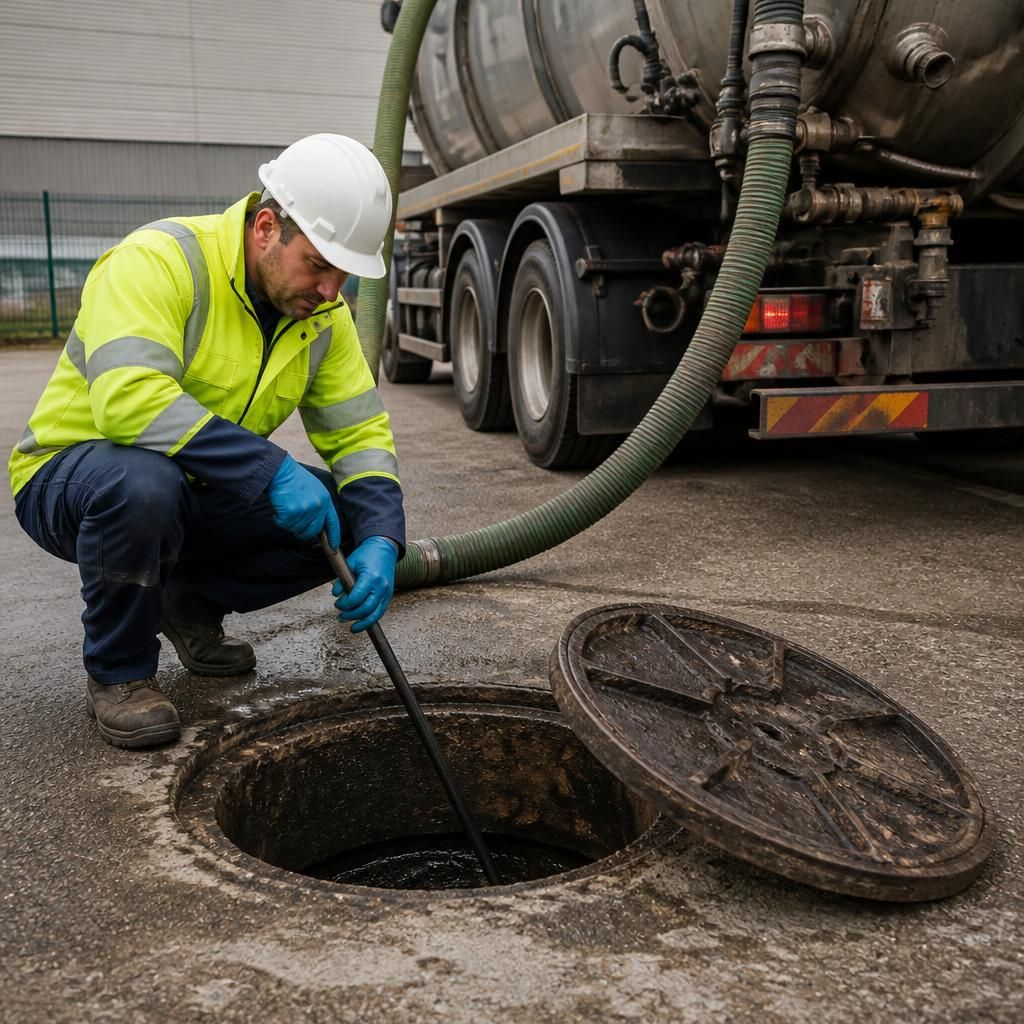
Insurance should be checked as part of assessing sewage tank cleaning competence, although it is not a substitute for technical evidence. Ask for current policy details and confirm that the cover is relevant to the work being proposed, including sewage exposure, pollution incidents, damage to client property, vehicle operations and any subcontracted activities.
The business should also be able to explain who is responsible if a spill, accidental discharge or property damage occurs during cleaning. Check whether the policy remains valid for the type of site and waste involved, and record any exclusions that could affect the contract. A contractor that can clearly connect its insurance arrangements with its working method is more likely to have considered the consequences of foreseeable incidents.