
What records should businesses retain after unvented hot water tank cleaning?
Businesses should retain the cleaning report, including the date, system or tank identified, work completed, findings, defects and any remedial action recommended or carried out. Keep related photographs, water test results where applicable, certificates, contractor details and follow-up records with the site’s water hygiene and legionella management documentation.
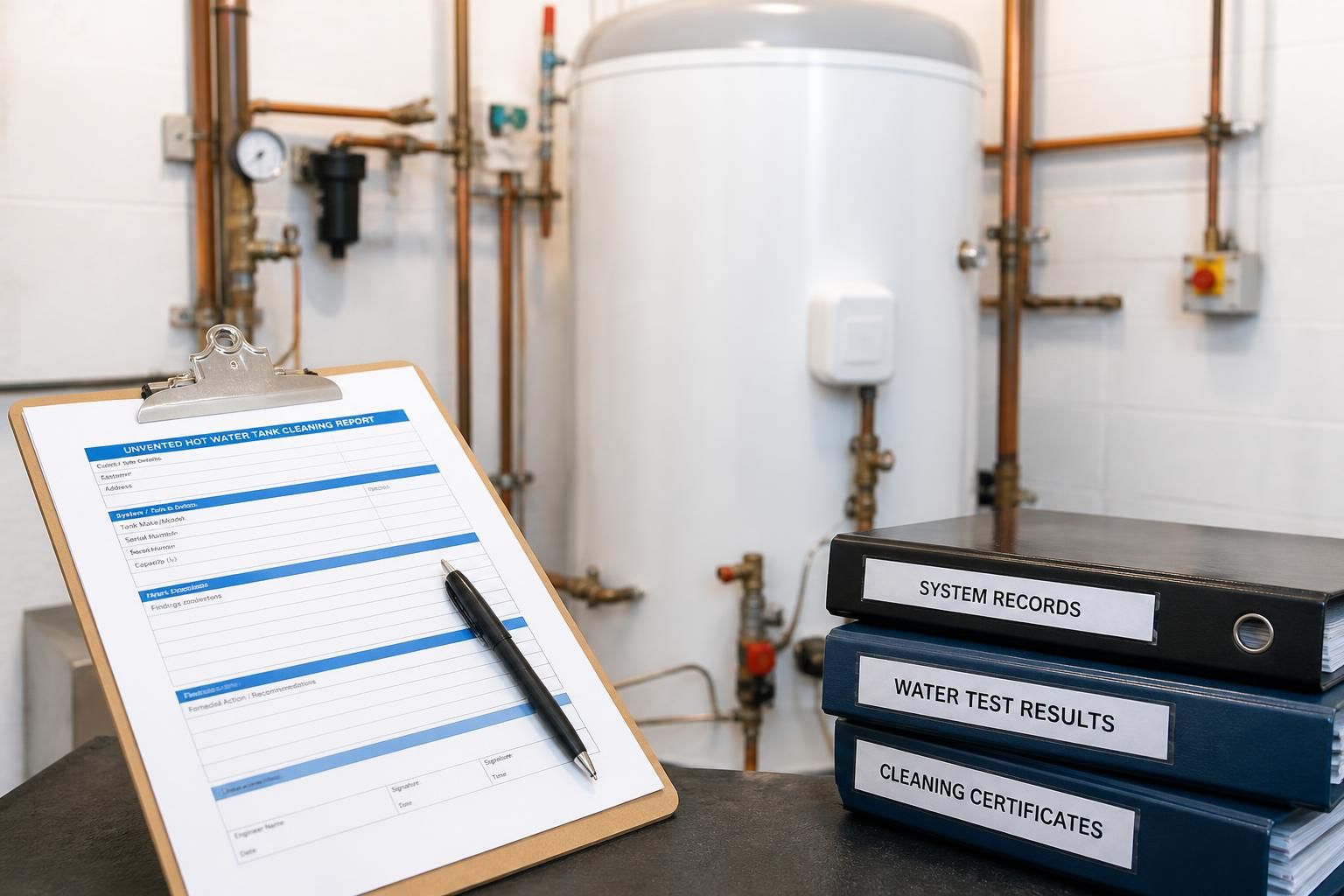
Businesses should retain a complete, traceable record of the cleaning activity and its implications for the water system. The record should allow a competent person, auditor or enforcing authority to establish what was cleaned, why the work was required, what condition the system was in afterwards, and whether any further action remains outstanding.
In addition to the cleaning report itself, the following supporting records may be relevant:
- Asset identification: the site, building, plant area, tank or cylinder reference, and any associated outlets, secondary return or linked water-heating equipment. Clear identification prevents a report being attributed to the wrong asset, particularly where several tanks have similar specifications.
- Scope and authorisation: the instruction for the work, the reason for cleaning, the agreed scope, access restrictions and any approval required before the system was taken out of service.
- Method statement and risk controls: the safe system of work, relevant hazards, isolation arrangements, hygiene precautions and control measures used during the task. Keep the version that applied on the date of the work, together with evidence of any site-specific amendments.
- System condition before and after work: relevant observations about scale, sediment, corrosion, contamination, damage, temperature control or defects affecting safe operation. Where a condition was accepted temporarily, record who accepted it, the reason and the required review date.
- Isolation and reinstatement evidence: details showing how the supply was isolated, how the tank and associated equipment were returned to service, and whether leaks, abnormal operation or loss of pressure were identified afterwards.
- Competence and attendance: the cleaning operative or contractor’s identity, company details, relevant competence information and the names of site personnel who supervised, witnessed or accepted the work. This helps demonstrate that the task was assigned appropriately without treating a cleaning record as evidence of qualifications that were not actually held.
- Outstanding actions: a dated action log for repairs, replacement components, investigation, repeat cleaning, further sampling or review. Each action should have an owner, priority and completion status, rather than simply being noted as a general recommendation.
- Communications and decisions: important emails, handover notes, permits, approvals and decisions relating to defects, restricted access, temporary controls or changes to the planned scope. These can explain why the work differed from the original instruction.
The cleaning record should also be cross-referenced to the relevant asset register, schematic or written scheme where one exists. This creates a clear link between the physical tank, the organisation’s water safety arrangements and later monitoring. If the tank forms part of a wider hot water system, retain enough information to show whether connected components were included, excluded or affected by the work.
There is no single retention period that applies identically to every business or every record. The appropriate period depends on the organisation’s risk assessment, the complexity and use of the premises, applicable health and safety duties, contractual requirements, insurer requirements and any sector-specific rules. A practical policy should state which records are retained, the retention period for each category, who controls them and how disposal is authorised. Records relating to unresolved defects or continuing risks should not be destroyed merely because the cleaning visit has been completed.
Records should remain readable, dated and protected from unauthorised alteration. For digital files, use consistent asset references, preserve the original report, record revisions and maintain a backed-up audit trail. Scanned documents should be legible, while photographs and test files should retain their date and connection to the correct asset. Access should be limited appropriately where reports contain personal information, but the information must still be available to those responsible for water safety, maintenance, compliance and audit.
Before closing the job, the responsible person should check that the report is internally consistent, all actions have been allocated, any required follow-up has been scheduled and the final documents have been filed in the correct system. Good record-keeping does not replace effective cleaning or risk control, but it provides the evidence needed to manage the system properly and demonstrate that identified issues have been considered and addressed.
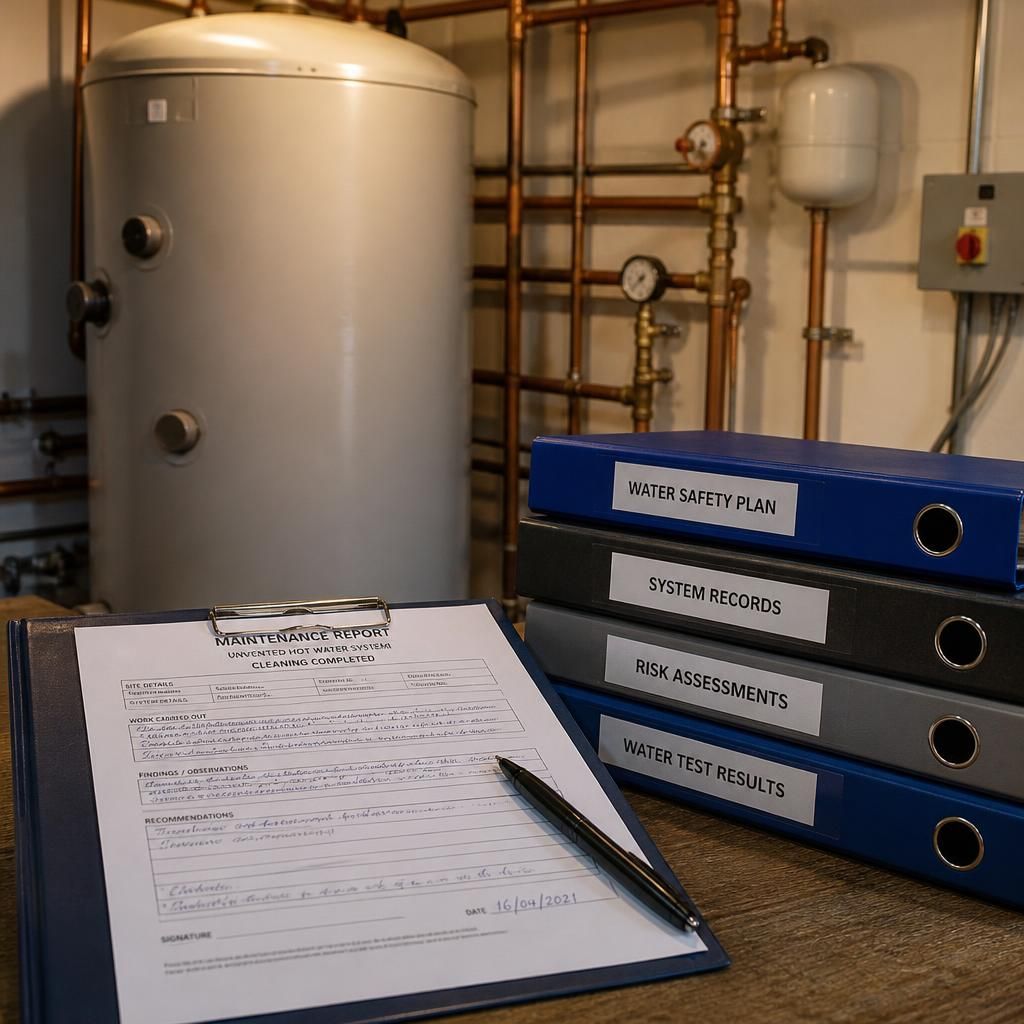
A cleaning certificate confirms that the specified work was completed; it does not, by itself, demonstrate that the wider hot water system remains under control. Where the risk assessment requires verification after cleaning, retain the separate evidence alongside the completion record, such as post-work checks, sampling reports or monitoring entries.
This distinction helps prevent a completed maintenance task being treated as proof that every connected part of the system is safe. The retained documents should show which evidence confirms the cleaning itself and which evidence supports the ongoing management of the water system.
Discuss your unvented hot water tank cleaning records
Discuss your unvented hot water tank cleaning records with Blue Fish Water Management Ltd to identify evidence gaps and align the documentation with your wider water hygiene arrangements.