
What checks confirm an industrial tank has been cleaned properly?
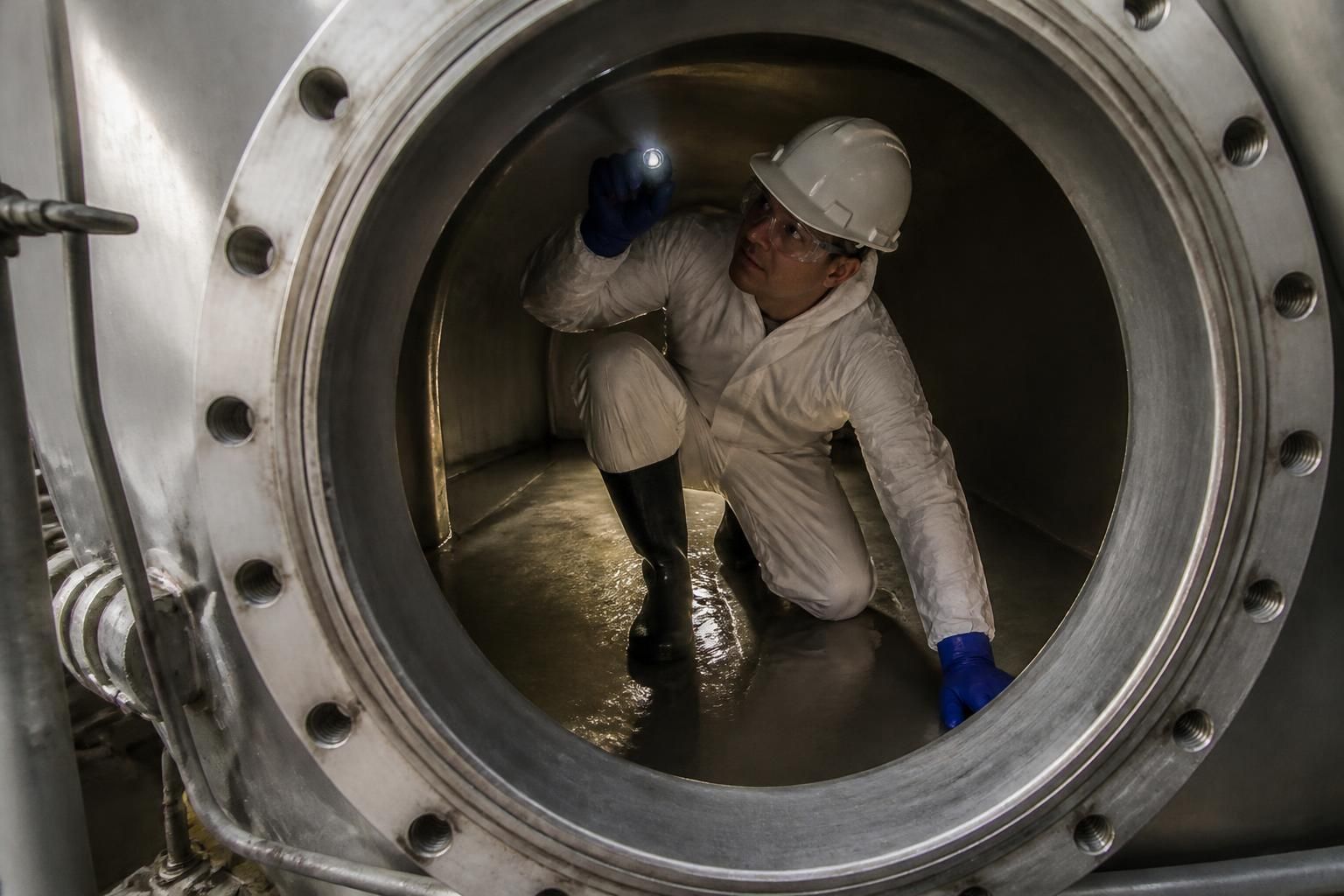
An industrial tank has been cleaned properly when it meets predefined cleanliness criteria across its accessible and hard-to-reach areas, contains no unacceptable cleaning-agent residue, and is safe to return to service. Confirmation should combine physical checks, any appropriate chemical or microbiological verification, and evidence that the tank was correctly reassembled and left in a hygienic condition.
The acceptance criteria should be agreed before cleaning begins. These criteria depend on the tank’s use, the material previously stored, the water or product that will enter it, and the relevant risk assessment. They should identify which surfaces, fittings and connected components require examination, what residue is unacceptable, whether sampling is needed, and what findings would require further cleaning.
Inspection should cover more than the main shell of the tank. Particular attention is needed around welds, seams, joints, internal supports, outlet points, low spots, valves, overflow arrangements, inlet pipes, drain points, access covers and areas with restricted circulation. A tank may appear clean from the access hatch while deposits remain in pipework, dead legs or fittings. Where a section cannot be inspected directly, the contractor should explain the limitation and state how cleanliness was verified instead.
Rinse-water checks can identify residues that a visual inspection cannot. Depending on the cleaning method and the tank’s intended use, relevant checks may include pH, conductivity, turbidity or a test for a specific cleaning chemical. These checks are meaningful only when compared with an agreed baseline or acceptance limit. A result should therefore show the sample location, collection point, test method and interpretation rather than simply state that the tank was rinsed.
Microbiological or other water-quality sampling is used where the risk assessment requires it. Samples should be taken from representative points after the cleaning and rinsing process, using a defined sampling method. Laboratory results need to be assessed against the applicable specification and the tank’s intended service. A satisfactory sample does not, on its own, prove that every surface was physically cleaned; sampling is one part of the verification process rather than a substitute for examining the tank and its associated fittings.
The condition of the tank after cleaning should also be checked. The inspection should identify damage, corrosion, loose coatings, failed seals, blocked screens, defective valves or other defects that could compromise hygiene or safe operation. Access covers, gaskets, vents and connections should be refitted correctly, with no tools, cloths, packaging or other foreign material left inside. If cleaning has exposed a defect, the tank should not be treated as ready for service until the defect and its effect on water safety have been assessed.
Operational checks help confirm that cleaning has not created a new problem. These may include checking for leaks during filling, confirming that outlets and drains operate correctly, verifying that connected pipework has been flushed where necessary, and ensuring that the tank is protected from recontamination before it is returned to use. The final condition should be compared with the agreed scope, including any items excluded because they required separate remedial work.
A robust verification pack will normally bring the findings together in a traceable sequence:
- the tank or asset identification and the cleaning specification;
- the cleaning method, products used and relevant safety controls;
- inspection notes, photographs or other observations for significant areas;
- rinse, chemical or water-quality results where required;
- details of defects, inaccessible areas, deviations and corrective actions;
- confirmation of refitting, operational checks and return-to-service status; and
- the names, dates and signatures of the people responsible for the work and review.
If a check fails, the correct response is not simply to issue a completion statement. The cause should be investigated, such as remaining deposits, inadequate rinsing, contaminated fittings or a sampling problem. The affected work should then be repeated or corrected, followed by the relevant verification check. This approach provides stronger evidence of a properly cleaned industrial tank than a generic certificate based only on the fact that cleaning was carried out.
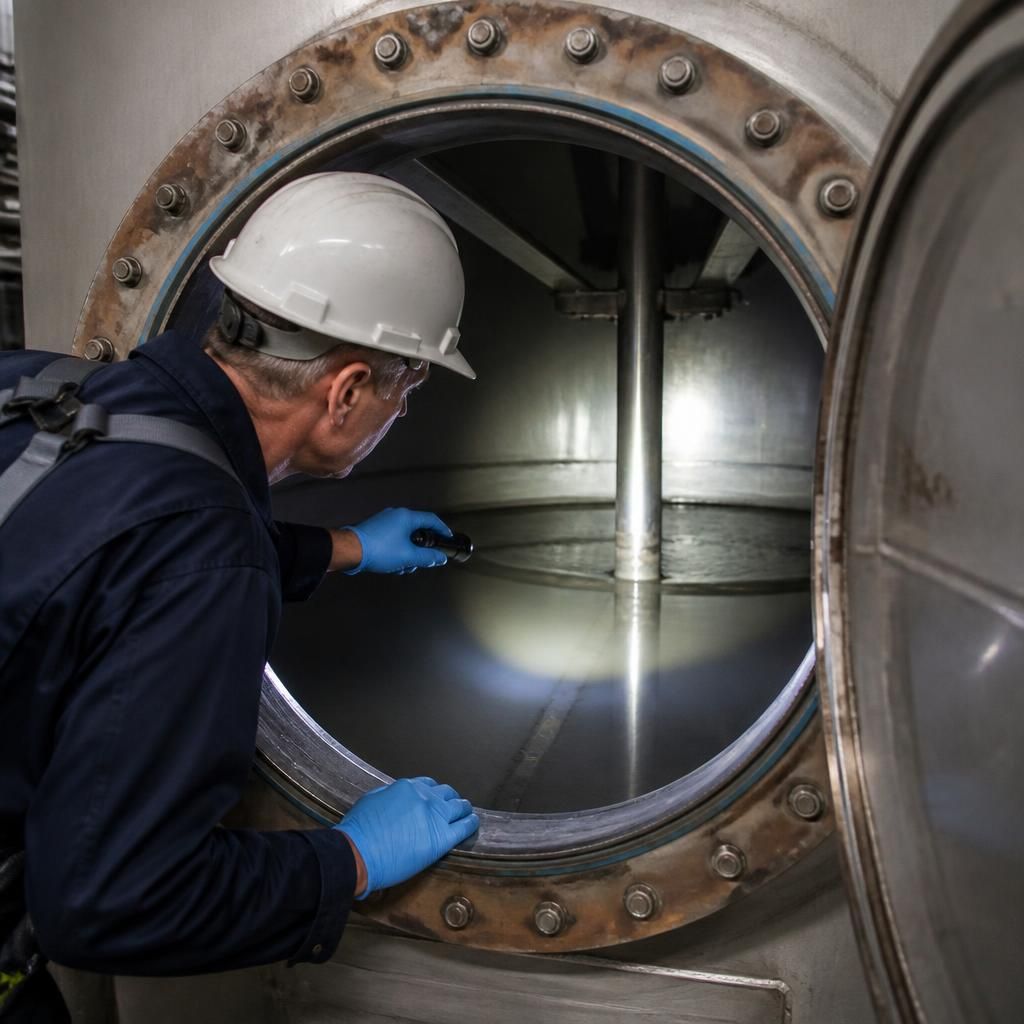
Confirmation should distinguish between validation and verification. Validation establishes that the chosen cleaning method is suitable for the tank, its construction and the material removed. Verification then confirms that the method was applied effectively during this particular cleaning operation.
This distinction matters because a method can be suitable in principle while a specific job still falls short through incomplete coverage, unsuitable conditions or an unexpected deposit. The final review should therefore relate the inspection and test findings to the approved cleaning method, recording any deviation and explaining whether it affects the decision to return the industrial tank to service.
Discuss your industrial tank cleaning verification requirements
Speak to Blue Fish Water Management Ltd about planning verification for an industrial tank cleaning project, including the level of inspection and evidence required for your site.