
What methods are used for industrial tank cleaning?
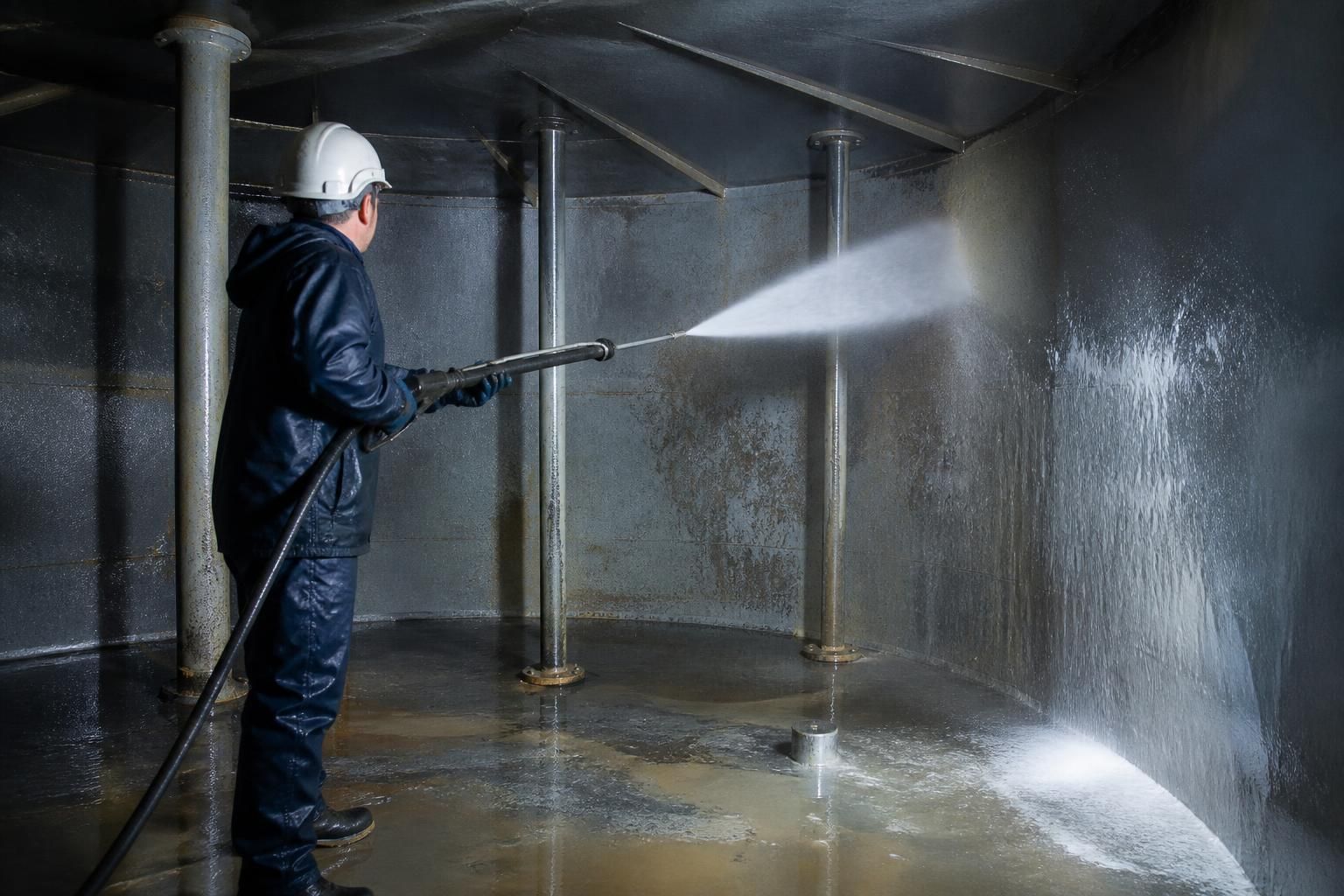
Industrial tank cleaning methods are selected according to the tank’s material, contents, contamination, access arrangements and intended use. Common approaches include manual cleaning, mechanical agitation, high-pressure or low-pressure water jetting, vacuum extraction and controlled chemical cleaning. In practice, a safe and effective job often combines several methods rather than relying on one technique.
Method selection begins with an assessment of the tank and its hazards. The cleaning plan should consider whether the tank can be isolated and drained, whether entry is avoidable, the nature of the residue, the condition of internal coatings, available drainage, and the risks created by chemicals, contaminated water or confined spaces. The tank’s operating history and the substances previously stored in it are also relevant, as residues can react with cleaning agents or become hazardous when disturbed.
- Manual cleaning: Operators may use suitable hand tools, brushes, scrapers or non-sparking equipment to remove loose material and deposits from accessible surfaces. This can be useful where contamination is localised or where a lining could be damaged by aggressive equipment. Manual work may be completed without entering the tank, using extended tools, which can reduce confined-space exposure. If entry is necessary, it must be controlled through an appropriate confined-space procedure, including isolation, atmospheric checks, supervision and emergency arrangements.
- Mechanical cleaning: Rotary brushes, powered scrubbers, agitators or specialist attachments can loosen deposits that are difficult to remove by hand. The equipment must be compatible with the tank construction and any internal coating. Excessive mechanical action can score surfaces, remove protective finishes or create debris that later blocks valves and pipework, so the method should be matched to the condition of the tank.
- High-pressure water jetting: Pressurised water can break away hardened deposits, biofilm, scale and other residues from walls, floors, roofs and fittings. Nozzle selection, working pressure, spray pattern and operator position all affect the result. Pressure that is suitable for steel may be inappropriate for a coated, lined or plastic tank. Jetting can also aerosolise contaminated water, so containment, personal protective equipment, ventilation and wastewater control are essential.
- Low-pressure or controlled-pressure washing: Where high-pressure jetting presents a risk to coatings, joints, seals or internal components, a lower-pressure approach may provide better control. It is generally used with detergent, brushing or vacuum recovery to lift deposits rather than disperse them. This method may take longer on heavily encrusted surfaces but can be more appropriate for vulnerable construction materials.
- Vacuum extraction: Industrial vacuum equipment can remove sludge, sediment, loose solids and contaminated wash water. It is particularly useful where residues must not be allowed to pass into drainage systems or migrate to clean sections of a water installation. Extraction may be carried out during cleaning to keep the work area clear and reduce the amount of manual handling required.
- Chemical cleaning: Detergents, descalers, degreasers or other approved agents may be used to dissolve, soften or detach specific residues. The chemical must be suitable for the stored substance, tank material, lining, seals and downstream drainage arrangements. A chemical assessment should cover exposure, storage, mixing, contact time, rinsing, recovery and neutralisation. Chemical cleaning is not automatically a substitute for disinfection where microbiological control is required.
Cleaning a water storage tank commonly follows a controlled sequence. The system is isolated, the tank is drained where practicable and residual water or sludge is removed. Gross contamination is extracted first, followed by manual, mechanical, jetting or chemical treatment as appropriate. Surfaces, welds, access points, outlets, inlet arrangements and internal fittings are then checked for remaining deposits or damage. Rinsing removes loosened material and cleaning residues, with the wash water collected or discharged in accordance with the relevant environmental and site requirements.
For tanks connected to a building or process water system, the work must also prevent contamination from returning to clean pipework. Valves, outlets, hoses and tools should be managed so that dirty water does not flow back into the system. Temporary connections and equipment may need cleaning or disinfection before use, particularly where the tank forms part of a domestic or other health-sensitive water installation.
The final stage depends on the tank’s purpose and the findings from the cleaning operation. This may include a further disinfection treatment, rinsing, visual inspection, checking of fittings and controlled refilling. Water testing can provide evidence that the system is suitable for its intended use where testing is required by the risk assessment, site procedures or applicable compliance arrangements. Records should identify the tank, method used, chemicals or equipment involved, waste arrangements, inspection findings and any remedial work recommended.
Some conditions indicate that cleaning alone will not resolve the underlying problem. Persistent sediment may point to poor inlet flow or ineffective filtration; recurring scale may relate to water characteristics; and damaged coatings, corroded fittings or inaccessible dead areas may require repair or redesign. A professional method statement should therefore address both removal of the existing contamination and the factors that could allow it to return.
For commercial and industrial sites, the most appropriate method is the one that achieves the required level of cleanliness without damaging the tank, exposing workers or spreading contamination. A specialist water hygiene provider can assess the installation, select compatible techniques, coordinate cleaning and disinfection where required, and document the work for the site’s water safety and maintenance records.
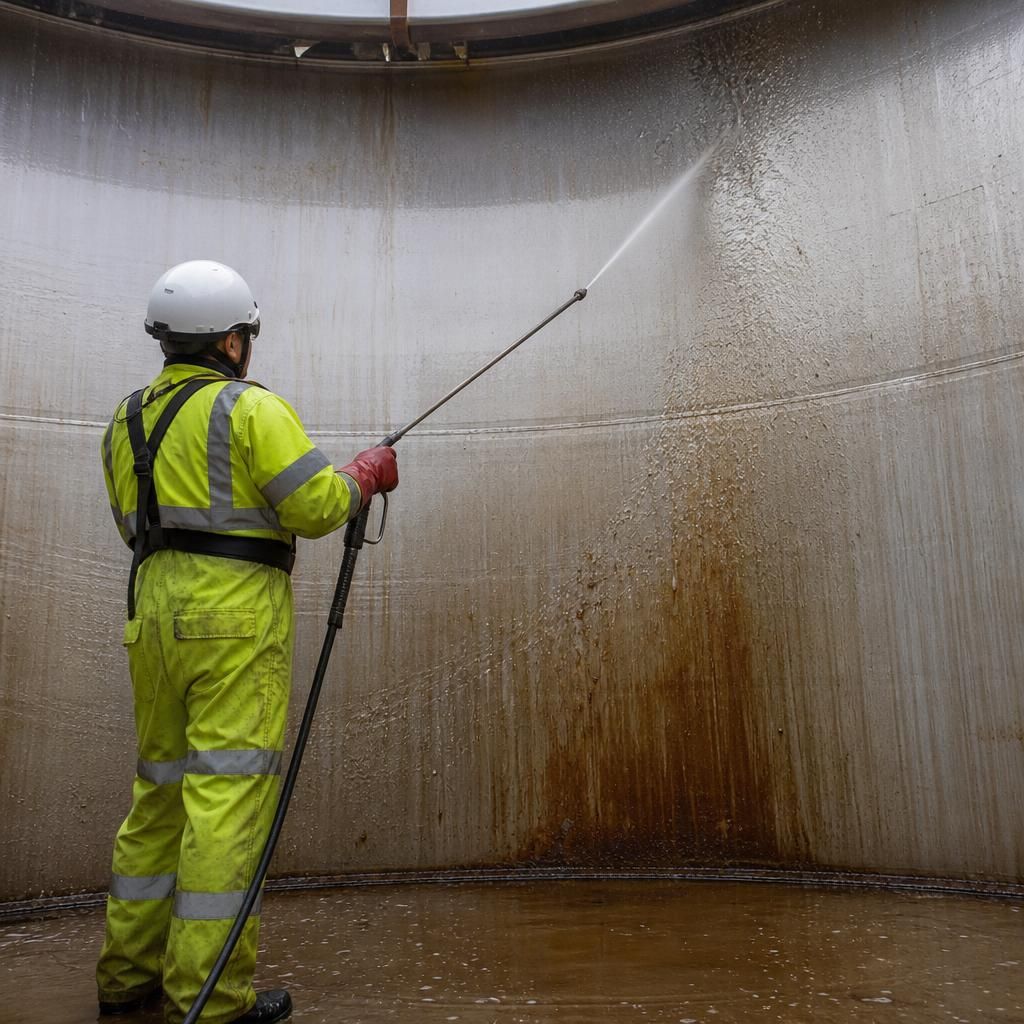
Where tank entry is a concern, cleaning may be carried out from outside using long-reach lances, fixed spray devices or remote rotary heads, depending on the tank’s design. These systems direct water or cleaning solution onto internal surfaces without placing a worker inside the tank. Their effectiveness depends on nozzle coverage and the condition of the deposits; baffles, roof supports, fittings and poorly reached areas can remain untreated. Inspection is therefore needed to confirm that remote cleaning has reached all relevant surfaces rather than assuming that operating the equipment alone has achieved a complete clean.
Discuss your industrial tank cleaning requirements
If you need to determine which industrial tank cleaning method is suitable for your installation, discuss the tank’s construction, contents, access and contamination with Blue Fish Water Management Ltd. The team can help scope the cleaning requirements and identify any related inspection, disinfection or remedial work.