
Who should oversee hot water tank maintenance within a business?
The business’s appointed responsible person should oversee hot water tank maintenance, with sufficient authority, knowledge and resources to manage water safety risks. Competent contractors can carry out inspections, cleaning and remedial work, but the duty holder retains overall responsibility for ensuring maintenance is planned, completed and properly recorded.

Oversight of hot water tank maintenance should be assigned as a defined water-safety governance function, rather than left solely to a plumber or the person who happens to manage the building. The appointed lead should coordinate the risk assessment, maintenance programme, monitoring records and corrective actions, while ensuring that senior management provides the authority and budget needed to control identified risks.
Who normally holds the role? In many businesses, the role sits with a facilities manager, estates manager, property manager or health and safety lead. The job title is less important than the person’s practical control over the premises and their ability to obtain competent advice and arrange work. In a larger organisation, responsibility may be divided between an operational lead, an engineering team and a health and safety function. Even where tasks are shared, the business should document who coordinates the overall process and who must be informed when a risk is found.
For rented or managed premises, responsibilities should be checked against the lease, service agreement and relevant statutory arrangements. A landlord or managing agent may control plant-room access or major repairs, while the occupier may control day-to-day use and reporting. These boundaries should be recorded rather than assumed. Unclear ownership can result in missed inspections, duplicated work or defects remaining unresolved.
What should the overseeing person control? The role should cover the complete maintenance cycle, including:
- identifying every hot water storage tank, associated cylinder, feed and expansion arrangement, outlet and connected distribution system;
- understanding how the system is used, including periods of low occupancy, infrequent outlets, seasonal shutdowns and changes to building use;
- ensuring that the legionella risk assessment reflects the actual tank, pipework, operating temperatures, users and vulnerable occupants;
- setting out inspection, cleaning, disinfection, temperature monitoring and repair requirements in a suitable written programme;
- checking that planned tasks have been completed at the required intervals and that missed work is investigated;
- reviewing monitoring results and escalating abnormal temperatures, contamination indicators, sludge, scale, corrosion or other defects;
- authorising remedial work when a tank or connected system is not being maintained in a condition that supports safe operation; and
- retaining clear records so that the business can demonstrate what was checked, by whom, when and what action followed.
The lead does not need to carry out every technical task personally. They do need enough understanding to recognise whether the work requested is appropriate, whether the findings are significant and whether the contractor’s recommendations have been acted upon.
How should duties be divided? A simple responsibility matrix can help. For example, the responsible person may own the maintenance plan; a facilities or engineering employee may take routine temperature readings; an external specialist may inspect, clean or disinfect the tank; a health and safety adviser may review the control arrangements; and a senior manager may approve expenditure or closure of affected facilities. Each assignment should include a named substitute for periods when the usual person is unavailable, without transferring accountability to an unidentified team.
Routine monitoring and specialist maintenance are also different activities. An employee may be competent to carry out a defined temperature check after suitable instruction, but that does not automatically make them competent to assess internal tank condition, determine the significance of sediment or design remedial work. The business should match each task to the required knowledge, experience, equipment and supervision.
What does competent contractor oversight involve? The internal lead should provide the contractor with accurate system information, site access arrangements, known hazards and relevant risk assessment findings. Before work starts, the scope should state which tank and connected components are included, whether cleaning or disinfection is required, how the system will be returned to service and what evidence will be supplied afterwards.
After the visit, the overseeing person should examine the service report rather than filing it without review. The report should make it possible to identify the equipment inspected, work undertaken, observations, samples or readings taken where applicable, defects found and further action recommended. If the report uses broad wording such as “system satisfactory” without explaining what was checked, clarification may be needed. Specialist advice should be challenged or referred for a further opinion when it is inconsistent with the risk assessment, site conditions or monitoring records.
Contractors can advise on technical controls and carry out agreed work, but the business should not treat the appointment of a contractor as a transfer of its management responsibilities. The overseeing person remains responsible for confirming that recommendations are considered, actions are allocated and unresolved risks are escalated to the appropriate decision-maker.
What knowledge is required? The person overseeing the arrangement should understand the principles of hot water storage and distribution, the conditions that can support legionella growth, the purpose of temperature control, the effects of stagnation and low use, and the importance of preventing scalding while controlling microbiological risk. They should also understand the limits of their own competence and know when specialist input is required.
Relevant guidance includes the Health and Safety Executive’s approved code of practice and guidance for the control of legionella bacteria in water systems, together with guidance on hot and cold water systems. The applicable risk-control approach will depend on the system and premises; a small, straightforward arrangement may be managed differently from a complex site with several tanks, multiple outlets, healthcare use or vulnerable occupants.
How should performance be reviewed? The oversight arrangement should be reviewed whenever the system, building use, occupancy or maintenance provider changes, and whenever monitoring or inspection identifies a significant issue. A review should also follow refurbishment, a prolonged period of disuse, alterations to storage capacity or repeated failures to achieve expected operating conditions.
Useful review questions include:
- Is the responsible person still the right person to coordinate the controls?
- Does the current risk assessment describe the installation as it now exists?
- Are routine checks being completed and recorded consistently?
- Are defects closed out, or merely carried forward between service visits?
- Can the business show why the chosen maintenance frequencies and methods are suitable?
- Do staff and contractors know how to report an unsafe condition or abnormal result?
Where a business lacks the necessary internal expertise, it can obtain competent external support for risk assessment, inspection, testing, training or remedial advice. The appointed internal lead should still retain a clear view of the system and the decisions made. Effective oversight is therefore not about performing every maintenance task in-house; it is about maintaining control of the risk, verifying that work is suitable and ensuring that evidence and corrective actions remain visible to the business.
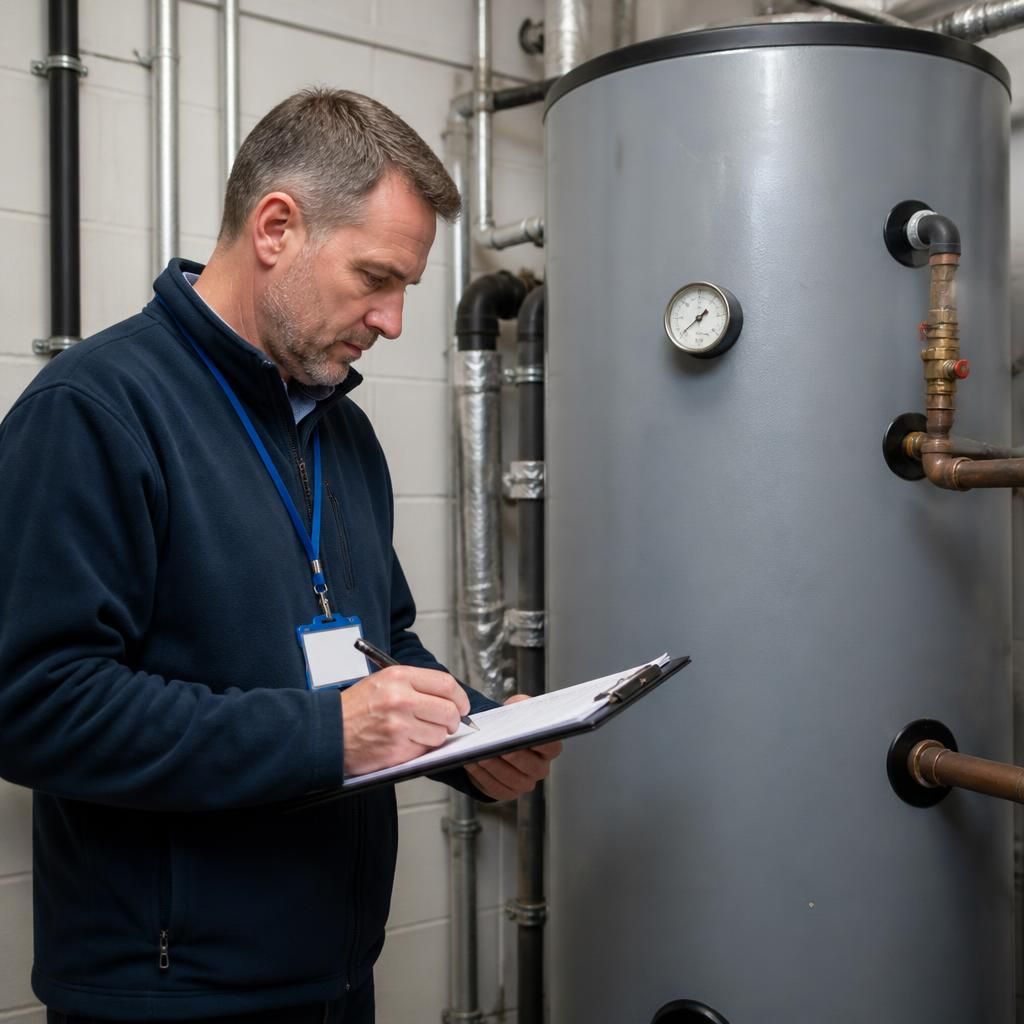
In a business with several premises, hot water tank maintenance should be overseen through a clear central governance arrangement, supported by named contacts at each site. A group facilities, estates or health and safety lead can set the required standard and review performance across the estate, while local site contacts confirm access, operational changes and site-specific issues.
This arrangement helps prevent important differences between premises being overlooked. The central lead should maintain visibility of:
- which tanks and associated systems are present at each location;
- who is responsible for local checks and reporting;
- when specialist maintenance has been completed;
- which defects remain open and who owns the corrective action; and
- whether changes in occupancy, building use or equipment require the controls to be reconsidered.
Local delegation should give site contacts defined duties, but it should not create uncertainty about who has authority to make decisions affecting water safety. A documented reporting route from each site to the central lead allows recurring defects, missed work or common contractor issues to be identified across the business rather than treated as isolated maintenance problems.
Get advice on overseeing hot water tank maintenance
If your business needs support reviewing its arrangements for hot water tank maintenance, speak to Blue Fish Water Management Ltd for practical water safety advice. The team can help identify appropriate responsibilities, checks and specialist support for your premises.