
What evidence should a contractor provide after hot water tank cleaning?
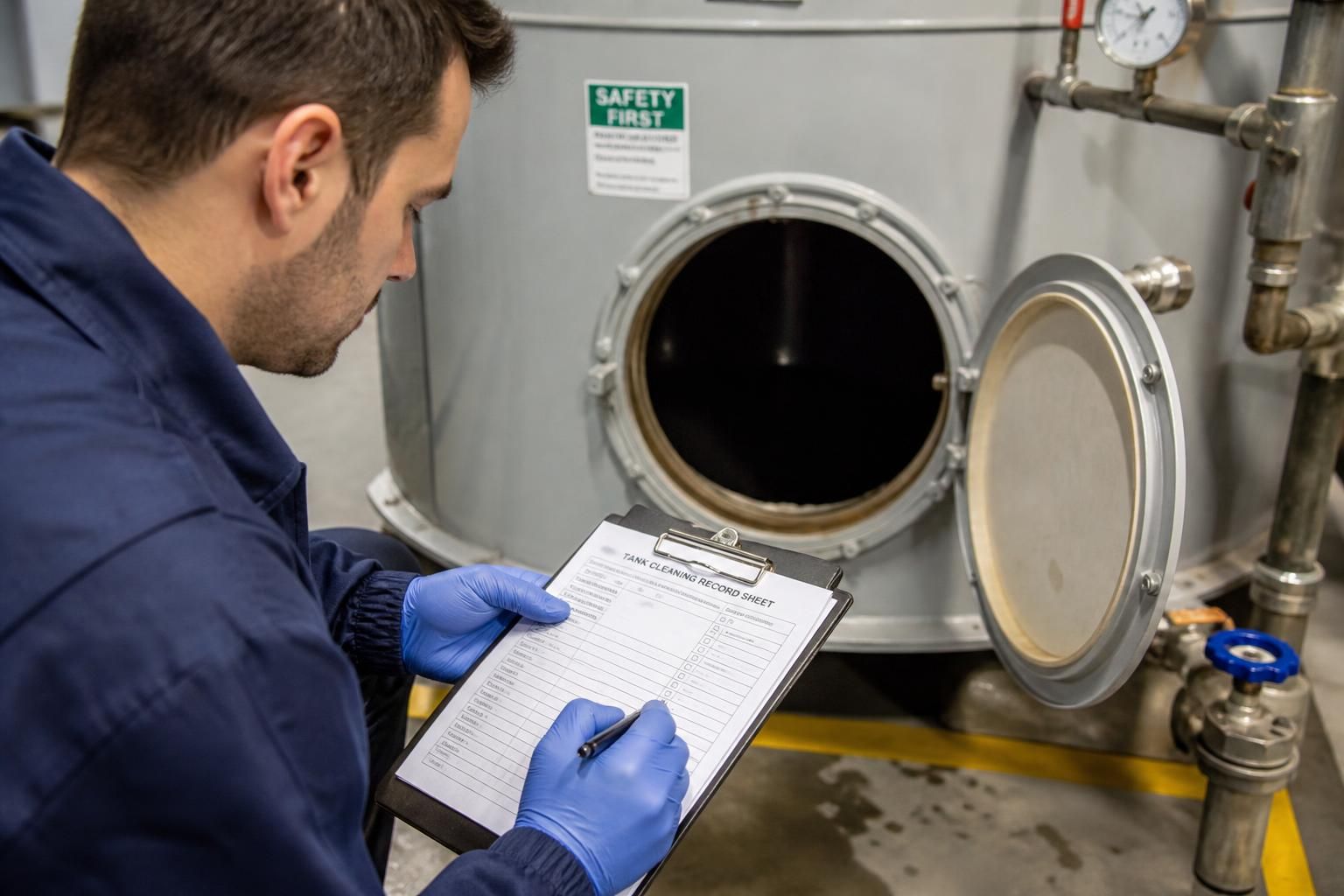
Evidence after hot water tank cleaning should form an auditable handover pack, not merely a statement that the work was completed. It should enable the responsible person to verify the cleaning method, assess the condition of the system, understand any water quality findings and demonstrate that outstanding actions have been controlled.
Cleaning method and completion criteria
The contractor should explain what was done in sufficient detail for another competent person to review it. This may include how the tank was isolated, drained, accessed, cleaned and returned to service; which internal surfaces and associated components were treated; and how debris or sludge was removed. If disinfection formed part of the work, the record should state the process used, the relevant control measurements and how the system was flushed or otherwise made suitable for use afterwards.
The handover should also state whether the work met the agreed specification. If a section of the tank, pipework or connected equipment could not be accessed or treated, that limitation should be recorded rather than concealed by a general completion statement.
Measurements and supporting data
Where measurements were needed to demonstrate safe reinstatement, the contractor should provide the actual readings, not only a pass or fail conclusion. Depending on the work scope, useful information may include temperature readings, disinfectant concentration, contact time, pH, turbidity or other system-specific checks. Each reading should be linked to the relevant part of the system and show when it was taken.
Instruments used for critical measurements should be identifiable, with calibration or verification information available where applicable. This helps the responsible person judge whether the results are reliable. A result without a method, unit, sampling point or collection date is difficult to interpret and has limited value in an audit.
Microbiological sampling information
If samples were taken, the supporting information should show who collected them, where they were collected, when they were collected and how they were handled before analysis. The laboratory report should identify the test undertaken, the result and any reporting limitations. Where an external laboratory is used, the client may also need confirmation that the relevant test falls within that laboratory's UKAS accreditation scope; accreditation of a laboratory does not automatically mean that every test it performs is covered.
The contractor should explain what the results mean in relation to the cleaning objective and the site's water safety controls. A laboratory result is evidence of the sample at a particular location and time, not proof that every part of a complex system has the same condition. Results that are unexpected, inconclusive or outside the agreed acceptance criteria should be accompanied by a clear escalation or follow-up recommendation.
Evidence of system reinstatement
The completion pack should confirm that valves, covers, insulation, access panels, temperature controls and other disturbed components were left in an appropriate condition. It should record any temporary isolation, bypass or restriction that remains in place. If the tank was returned to operation in stages, the sequence and any checks required before normal use should be clear.
This information is particularly important where cleaning affected hot water availability, storage arrangements or downstream outlets. The site team should be able to identify any operational precautions, restrictions or monitoring requirements that continue after the contractor has left.
Health, safety and environmental records
For work involving chemicals, confined spaces, contaminated water or restricted access, the contractor should make relevant close-out information available. This can include confirmation of the substances used, residual chemical controls, waste disposal arrangements and any incidents, near misses or access constraints encountered. The purpose is not to create paperwork for its own sake, but to show that hazards introduced or exposed during the work were addressed before handover.
Where the work revealed conditions that affect future maintenance, such as unsafe access, deteriorated tank components or inadequate isolation points, these should be recorded with their practical implications. The responsible person can then arrange corrective work through the appropriate process rather than treating the cleaning as a complete solution.
Traceability and sign-off
Every document should be traceable to the correct premises, system and asset. The pack should use consistent asset references and include the contractor's name, the operative or supervisor responsible, the work date and the date of handover. A client representative should be able to sign or acknowledge receipt, while the contractor's sign-off should identify who reviewed the work.
Records should be stored with the site's water safety documentation and cross-referenced to the relevant risk assessment, monitoring regime and remedial action log. If the cleaning changes the known condition of the system, the asset register, schematic or maintenance schedule may need updating. Keep the original contractor records and any later interpretation or action decision together so that the evidence remains understandable during an internal review, audit or investigation.
Questions to ask when reviewing the pack
- Does it demonstrate what was actually cleaned and what was outside the agreed scope?
- Can every measurement or sample be traced to a location, method and time?
- Are limitations, failed checks and unresolved defects stated plainly?
- Does it confirm how the system was safely returned to service?
- Does it identify actions, owners and review points rather than leaving recommendations open-ended?
- Can the records be understood by someone who was not present during the work?
If the evidence does not answer these points, the responsible person should ask for clarification before closing the maintenance task. A complete handover supports defensible water safety management because it connects the physical work carried out on the tank with the site's ongoing monitoring and control arrangements.

Photographic evidence can help verify hot water tank cleaning where the tank interior, access points or associated components are not readily visible after the work. Images should be labelled with the asset reference, location and date, and should show relevant areas before cleaning, during the work where practical, and after completion.
- Include tank surfaces, access covers, fittings, sludge or scale removed, and any defects identified.
- Make clear which areas were inaccessible or not included in the agreed scope.
- Ensure photographs are supplied with the service report rather than as unidentifiable files.
- Use the images to support, not replace, written findings, measurements and test results.
A photograph may demonstrate the condition of one visible area, but it cannot by itself prove that the entire tank or connected system was clean or suitable for return to service. The contractor’s report should explain what each image shows and how it relates to the completed work.
Discuss your hot water tank cleaning evidence requirements
If your current handover process leaves uncertainty about the evidence required, discuss your hot water tank cleaning requirements with Blue Fish Water Management Ltd. They can help clarify the documentation needed for your premises and water safety records.