
Should a hot water tank be replaced like for like?
Not necessarily. A like-for-like replacement may be suitable where the existing hot water tank remains correctly sized, compatible with the system and capable of meeting current safety and compliance requirements, but replacement is also an opportunity to review capacity, controls, temperature management, materials, access and Legionella risk before specifying the new tank.
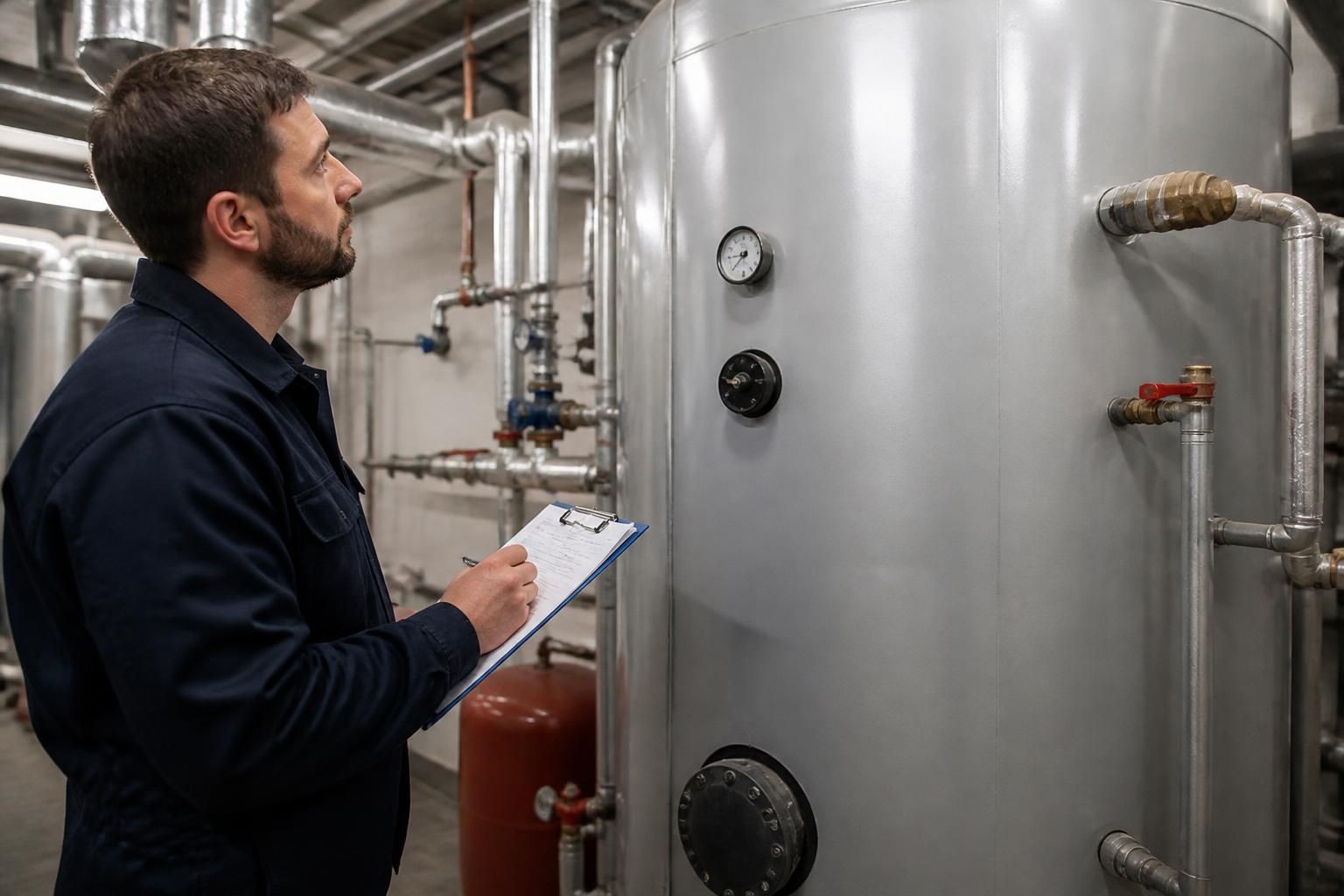
A hot water tank should be specified against the system’s assessed duty and current requirements, rather than replaced solely because the existing model has the same dimensions. A like-for-like choice can be appropriate where the tank’s capacity, materials, operating temperatures, controls, connections and installation arrangement remain suitable. However, a replacement should also correct any known deficiencies and reflect changes to the building, occupancy, water demand or water safety controls.
When like-for-like replacement may be suitable
Replacing the tank with an equivalent specification is more likely to be appropriate where:
- the stored hot water capacity still matches the building’s actual demand;
- the existing primary heating and secondary circulation arrangements are adequate;
- the vessel material and design are compatible with the incoming water and connected equipment;
- the temperature controls and safety devices can maintain the required operating conditions;
- the pipework, valves, supports, access and drainage arrangements remain suitable; and
- the existing arrangement has not created stagnant areas, persistent low temperatures or other water hygiene concerns.
In this situation, retaining the established layout may reduce design changes and avoid unnecessary alterations to associated pipework. It does not remove the need to check the complete installation, because a new vessel can still be unsuitable if it is connected to defective controls, poorly balanced circulation or inadequate safety equipment.
When a different specification should be considered
A like-for-like replacement may be inappropriate if the system has been altered since the original tank was installed. Changes such as increased occupancy, a new use for the premises, revised shower or process demand, reduced water consumption, extensions to the distribution network or changes to the primary heating system can affect the required capacity and recovery rate.
Replacement is also an opportunity to address problems identified during inspection or a legionella risk assessment. These may include excessive storage capacity, infrequently used outlets, dead legs, inadequate secondary circulation, poor insulation, inaccessible components or controls that do not provide reliable temperature management. Simply installing an identical vessel could preserve the underlying risk rather than resolve it.
Capacity and recovery must be assessed together
The correct size is not determined by storage volume alone. The specification should consider the pattern of demand, peak use, the time available for reheating, the output of the heat source and the performance of the associated primary circuit. A smaller tank with reliable recovery may perform differently from a larger tank with slow recovery, while oversizing can increase stored water volume and the time required to bring the system to its controlled temperature.
For a commercial or industrial installation, the assessment should use current demand information rather than relying only on the original design. The duty may need to account for staff, residents, visitors, production processes, welfare facilities and any outlets that are used intermittently. Where demand is uncertain, the assumptions should be recorded so that the selected vessel can be reviewed later if usage changes.
Water safety and legionella considerations
Stored hot water systems must be designed and operated to minimise conditions that allow Legionella to multiply. The replacement specification should therefore be checked against the site’s water safety arrangements, including storage temperature, distribution temperatures, circulation, outlet use, access for monitoring and the ability to carry out inspection and cleaning where required.
A new tank may change the volume, temperature profile or flow characteristics of the system. It can also alter the time needed for the vessel and connected pipework to reach their controlled temperatures. These changes should be considered before installation, not discovered during post-installation monitoring. If the replacement changes the system design or risk profile, the relevant legionella risk assessment and written control scheme may need to be reviewed.
Temperature control must be considered alongside scalding protection. Measures such as thermostatic mixing valves can reduce the temperature delivered at points of use, but they introduce additional components that need correct positioning, commissioning, cleaning and maintenance. They should not be used to conceal inadequate hot water generation or poor circulation.
Compatibility and technical checks
Before ordering a replacement, the responsible designer or competent contractor should verify the following:
- the tank’s working pressure, temperature rating and connection sizes;
- the compatibility of the vessel with the water quality and existing materials;
- the arrangement and output of the primary heating circuit;
- the location and operation of temperature, pressure and safety controls;
- the condition and sizing of primary and secondary circulation pipework;
- the position of drain points, inspection openings and sampling points;
- the available route for removal and installation, including access through doors, plant rooms and service areas;
- the strength and condition of the base, supports and surrounding structure; and
- insulation, condensation control and protection against accidental damage.
Physical dimensions alone are not enough. Two vessels may occupy a similar space but have different connection positions, usable capacities, heat transfer characteristics or maintenance requirements. The replacement should be checked against drawings, site measurements and the manufacturer’s technical information before procurement.
Compliance and project decisions
The decision should take account of the applicable building, health and safety, pressure-system and water hygiene requirements for the premises. The exact obligations depend on the type of installation and its use, so a competent assessment is preferable to assuming that the existing arrangement remains compliant simply because it has operated for many years.
Where the existing tank is being replaced because of corrosion, leakage or failure, the cause should be investigated. Corrosion may relate to water chemistry, incompatible materials, stray electrical currents, poor installation or lack of maintenance. Selecting an identical vessel without addressing the cause can lead to a repeat failure.
The project records should identify the basis for the chosen specification, including the demand assessment, design changes, control settings, safety devices and any water hygiene implications. Following installation, commissioning should confirm that the vessel heats correctly, circulation reaches the intended parts of the system, controls operate as designed and monitoring points are accessible. Relevant drawings, asset information and maintenance instructions should then be updated.
In practical terms, a like-for-like replacement is a valid outcome only when it is supported by a current assessment. If the system’s duty, condition, configuration or water safety controls have changed, the better approach is to specify the tank and associated equipment for the system as it needs to operate now, rather than reproduce an outdated arrangement.
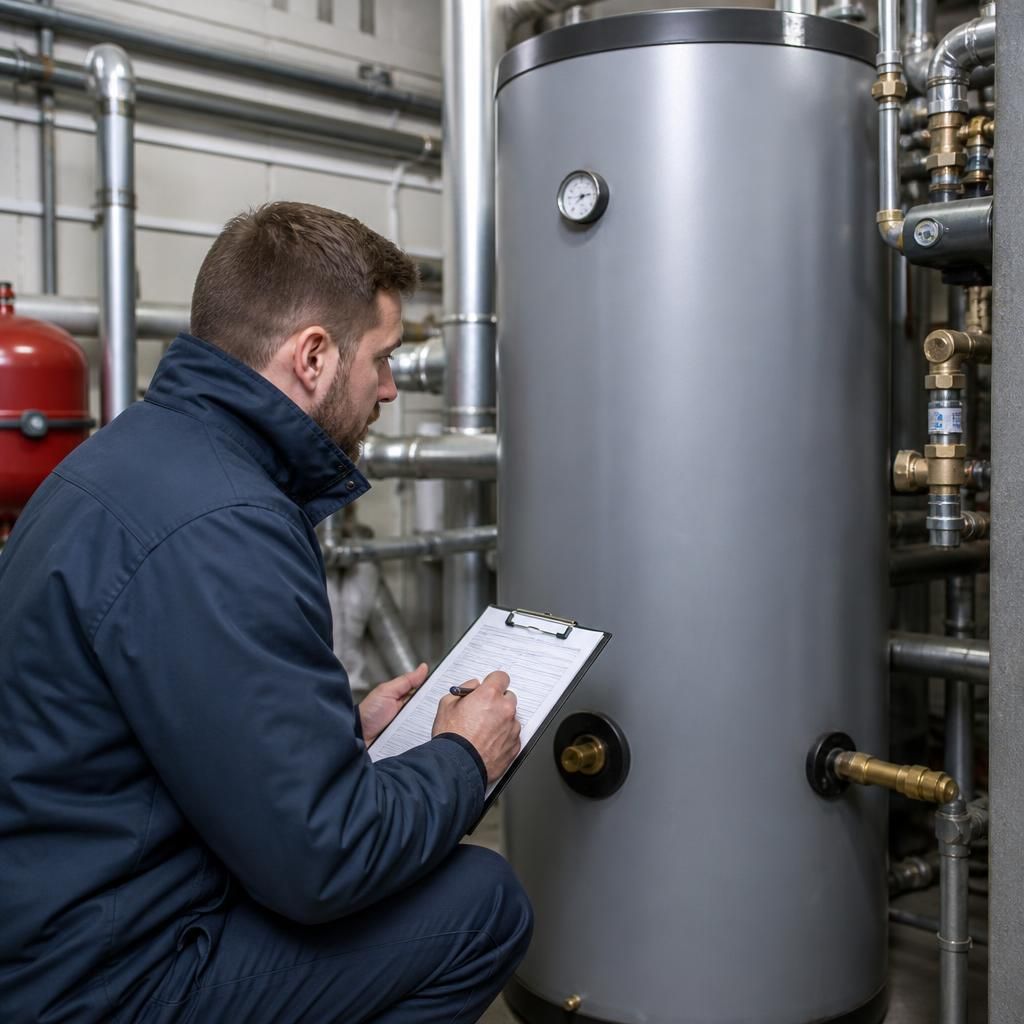
“Like for like” should normally mean equivalent performance and function, not an identical physical appearance. A replacement tank may have different dimensions, connection positions or construction while still being suitable if it provides the required hot water duty and integrates correctly with the existing system.
Conversely, a tank that looks identical may not be a true equivalent if its usable capacity, heat-transfer performance, pressure rating or control arrangements differ. The specification should therefore compare the relevant technical characteristics, not just the model label or external measurements. This distinction helps prevent an apparently simple replacement from introducing an unrecognised design or water safety issue.
Discuss your hot water tank replacement requirements
If you are planning a hot water tank replacement, discuss the proposed change with Blue Fish Water Management Ltd before the specification is finalised. Their team can help review the water safety implications and identify any further assessment or control measures required.