
How should businesses tailor hot water tank maintenance to their premises?
Businesses should tailor hot water tank maintenance to the tank design, water system, building use and risks identified at each premises. This means setting cleaning, inspection, monitoring and remedial work around factors such as occupancy, water demand, access, temperature control and the consequences of system failure.
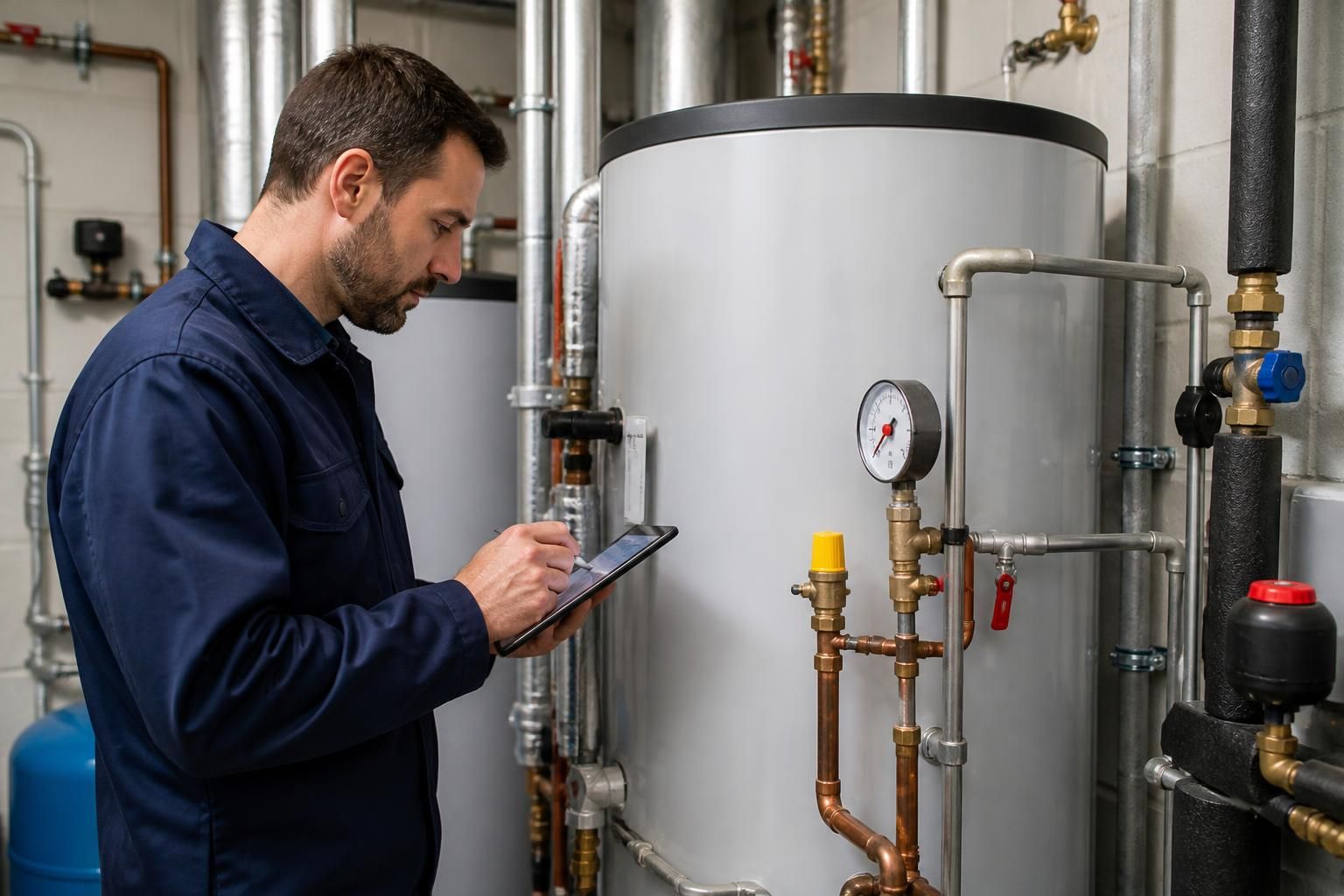
Hot water tank maintenance should be tailored through a documented, site-specific assessment rather than applied as a standard package. The maintenance plan should identify how the tank is constructed and connected, how water is stored and distributed, how the premises are used, and which control measures are needed to manage safety, hygiene and operational risk.
Start with the tank and system design. A pressurised unvented cylinder, a vented storage cylinder and a commercial calorifier may require different inspection and servicing arrangements. The assessment should record the tank’s materials, insulation, access points, protective devices, temperature controls, drain arrangements and connections to secondary return pipework. It should also identify dead legs, redundant branches, poorly circulating sections and any parts of the system that could allow water to stagnate.
Tank capacity should be considered alongside actual demand. A vessel that is too large for the building’s normal use may hold water for longer than necessary, while one that is undersized may be subject to rapid temperature changes and operational strain. The objective is not simply to clean the tank more often, but to ensure that storage volume, recovery, circulation and usage are understood when deciding what maintenance is appropriate.
Separate routine checks from specialist intervention. Routine monitoring may include checking stored and distributed water temperatures, observing warning signs, examining visible pipework and confirming that controls remain in service. Planned maintenance can involve internal inspection, removal of sediment or scale, disinfection, valve checks, vessel examination and testing of safety components. The plan should state which tasks can be completed by trained site personnel and which require a competent water hygiene or engineering contractor.
The condition of the stored water is particularly important. Sediment, corrosion products, scale and biofilm can collect in a tank or associated pipework and may reduce effective volume, affect heat transfer or provide conditions in which bacteria can persist. Inspection should therefore look beyond the external appearance of the vessel. Where safe access is available, the internal condition, drain contents and areas around inlets, outlets and baffles should be considered. Any cleaning or disinfection method must be suitable for the tank, its materials and the wider system.
Adjust the approach to the building’s use. A residential block, care setting, hotel, school, factory and office may have very different patterns of demand and exposure. A building with vulnerable occupants or accommodation that is used intermittently may require more detailed control arrangements than a low-occupancy office with predictable consumption. Areas such as showers, healthcare facilities, changing rooms and little-used outlets should be considered individually rather than hidden within a building-wide average.
Changes in occupancy also matter. Temporary closure, seasonal use, refurbishment, partial occupation or a change from office use to accommodation can alter circulation and draw-off patterns. Before a premises reopens or changes function, the responsible person should confirm that the tank and outlets have been assessed, stagnant sections have been addressed and the monitoring plan reflects the new operating conditions.
Consider access and the surrounding environment. A tank located in a plant room with clear working space can be inspected differently from one positioned above a ceiling, in a restricted service area or alongside other equipment. The maintenance plan should cover safe access, isolation points, drainage, ventilation, lighting, lifting requirements and protection of nearby equipment. If the tank cannot be safely opened, drained or examined, that limitation should be recorded and an alternative inspection or remedial approach agreed.
Environmental conditions can influence the plan as well. Heat loss, freezing risk, condensation, dust, flooding and limited ventilation may affect the vessel, insulation, controls or surrounding pipework. A tank installed in an area with a history of leaks may need closer attention to joints, fittings, bunding and drainage. Maintenance should also avoid introducing contamination into connected systems or damaging components that are not designed for a particular cleaning chemical or process.
Set control measures around risk, not just elapsed time. There is no reliable universal maintenance interval for every premises. The appropriate frequency and scope should follow the system risk assessment, previous inspection findings, manufacturer instructions where relevant, water quality results, temperature records, building use and any changes to the installation. A history of scale, corrosion, poor temperature control or recurring microbiological concerns may justify additional investigation or remedial work rather than simply repeating the same cleaning task.
Equally, a maintenance record should explain why a task is not required at a particular point. A clear rationale is more useful than a calendar entry with no supporting evidence. If monitoring shows that a control measure is not being achieved, the response should identify the cause, the immediate precautions, the corrective work and the follow-up check needed to confirm that the issue has been resolved.
Coordinate tank work with other water hygiene controls. Cleaning a tank in isolation may not address contamination or stagnation elsewhere. The assessment should consider cold water storage, hot water outlets, secondary circulation, thermostatic mixing valves, showers, hoses and infrequently used outlets where they form part of the same risk system. Sampling may be appropriate when the risk assessment indicates a need to investigate water quality or verify the effect of remedial work. Results should be interpreted alongside site conditions and operational records, not treated as a substitute for system control.
Where a system is disinfected, the method should be planned carefully. It should define the area included, isolation arrangements, contact conditions, flushing requirements, checks before return to use and any precautions for occupants or users. The contractor should provide evidence of what was done, including relevant readings, observations, deficiencies and follow-up recommendations. This enables the business to distinguish completed work from assumptions about the system’s condition.
Make the plan usable for the people who operate the premises. Responsibilities should identify who reviews monitoring records, who reports faults, who authorises isolation or shutdown, and who escalates a failed control measure. Instructions should be practical for the site team, including what to do when temperatures fall outside the required control range, an outlet is unused, a leak is found or a tank cannot be accessed. Training and handover are especially important where facilities teams, landlords, tenants and specialist contractors share responsibility.
A tailored maintenance plan should ultimately leave a traceable record for each premises. Useful records include the system description, risk assessment, tank and outlet locations, inspection findings, temperature and sampling results where applicable, cleaning or disinfection details, defects, photographs, completion dates, responsible persons and outstanding actions. Reviewing these records after alterations, incidents, changes in occupancy or repeated faults allows the plan to develop with the building instead of becoming a fixed routine that no longer reflects the installation.

A site-specific maintenance specification translates the premises assessment into clear instructions for the contractor. It should define the equipment included, the parts that must remain in service, the permitted isolation arrangements and the condition that must be achieved before the system is handed back.
For complex premises, the specification should also set out access restrictions, protection for adjacent equipment, requirements for clean working and arrangements for dealing with unexpected defects. This helps the business compare proposals on a like-for-like basis and prevents a basic tank clean being treated as sufficient where inspection, component testing or further investigation is also needed.
Before work starts, the responsible person should agree how completion will be judged. This may include confirmation that the specified areas were reached, defective items were reported, the system was safely reinstated and any limitations were clearly documented. The result is a maintenance task designed around the premises rather than a generic service description.
Discuss your premises-specific hot water tank maintenance needs
Discuss your premises-specific hot water tank maintenance needs with Blue Fish Water Management Ltd. Our team can help you identify the appropriate specialist input for your system, building use and operational requirements.