
How should businesses assess a contractor’s competence for hot water tank maintenance?
Businesses should assess a hot water tank maintenance contractor by checking relevant qualifications, practical experience, documented procedures and understanding of legionella control and health and safety duties. They should also verify suitable insurance, competent personnel, clear reporting arrangements and evidence that previous work was completed to an appropriate standard.
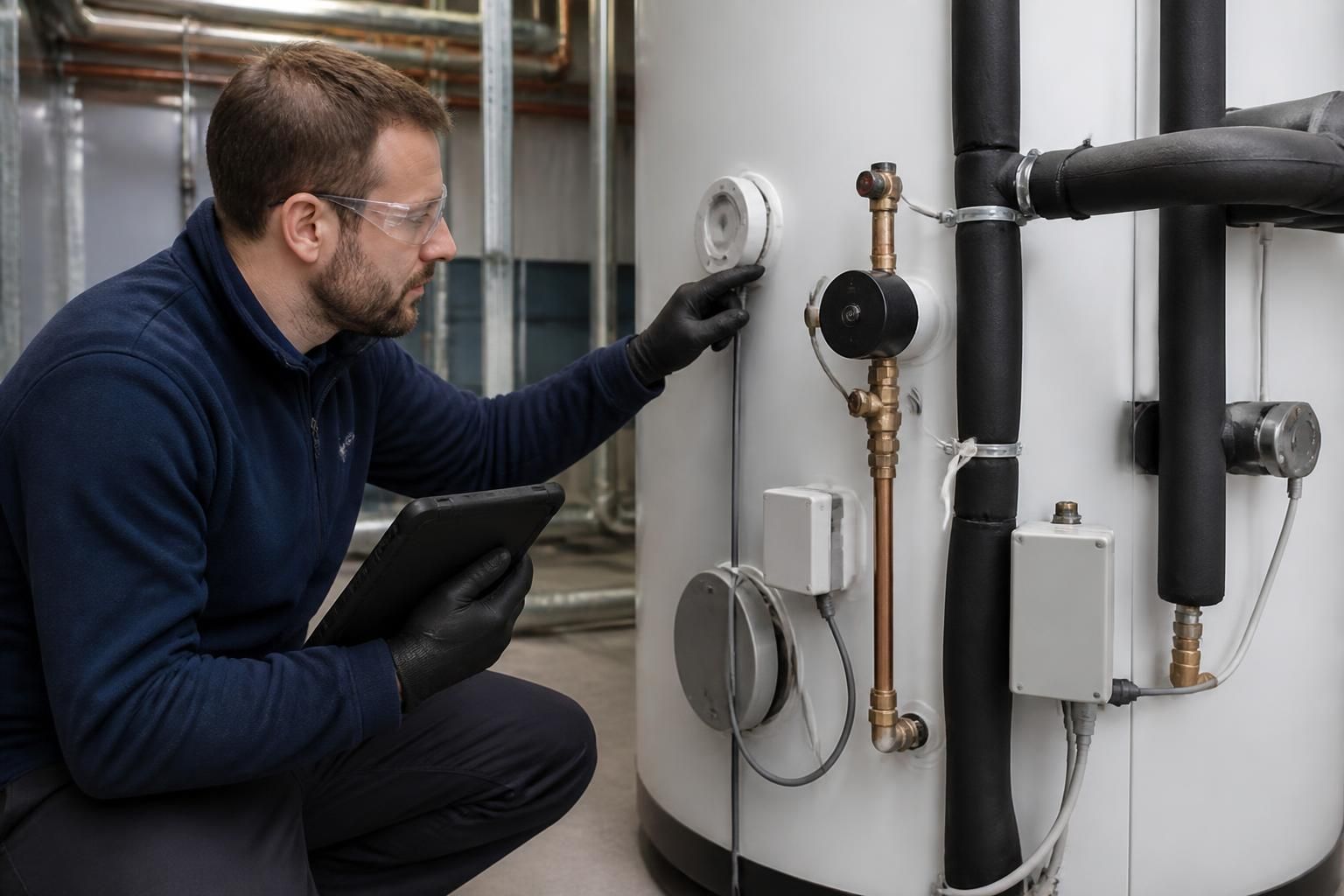
A competent hot water tank maintenance contractor is one that can assess the particular system, identify the condition and risks affecting stored hot water, carry out proportionate work, and leave the business with a clear basis for ongoing control. Businesses should therefore assess not only the contractor’s credentials, but also how they investigate the installation, define the work, justify recommendations and demonstrate that the completed task achieved its intended purpose.
Start with the contractor’s understanding of the system
Before comparing quotations, ask the contractor to explain what information they need about the installation. A meaningful assessment may include the tank or calorifier arrangement, storage capacity, materials, age, access, insulation, temperature controls, secondary return, associated pipework, outlets and any linked cold-water storage. The contractor should also recognise how the tank fits within the wider hot water system rather than treating it as an isolated vessel.
A site visit is often more informative than a price based only on a brief description. During the visit, the contractor should identify access limitations, drainage arrangements, isolation points, discharge routes, potential contamination sources and any defects that could affect safe maintenance. They should distinguish confirmed observations from assumptions and state where further investigation is required.
Check whether the proposed work is specific and proportionate
A reliable quotation should describe the actual maintenance activities rather than using broad wording such as “tank service”. Ask whether the scope includes inspection, removal of deposits, cleaning, disinfection, checks on associated components, replacement of minor parts, water sampling or follow-up recommendations. Each item should be clearly identified as included, excluded or subject to approval.
The contractor should be able to explain why the recommended work is appropriate for the tank’s condition and use. For example, visible scale, sludge, corrosion, damaged insulation or poor temperature control may require different actions. A competent contractor should not recommend chemical treatment, component replacement or system alterations without explaining the underlying finding and the effect of leaving it unresolved.
Ask how findings will be judged
Businesses should establish what constitutes a satisfactory outcome before work starts. This may involve confirming that deposits have been removed, surfaces and components have been inspected, access covers have been correctly reinstated, temperatures have been checked where relevant, and any agreed remedial action has been completed. Where sampling is included, ask what the results will be compared with, who will interpret them and what happens if they indicate a concern.
This avoids accepting a contractor’s statement that the work is complete without knowing what was actually checked. It also makes quotations easier to compare, because a low price may exclude inspection, testing, reinstatement or follow-up work that another contractor has included.
Test the contractor’s technical judgement
Useful questions are open-ended and relate to the business’s own installation. Ask:
- How would you decide whether the tank needs cleaning, disinfection, repair or replacement?
- Which conditions could cause stored hot water to become unsuitable for continued use?
- How would you deal with scale, sludge, corrosion, damaged anodes, faulty valves or inadequate insulation?
- What would you do if the tank cannot be fully drained, isolated or accessed safely?
- How would you identify a defect that is outside the agreed scope?
- How would your recommendations change if the building had periods of low occupancy or sections that were rarely used?
The value of these questions lies in the explanation. A capable contractor should link the answer to the system’s design, condition and use, explain any limitations, and separate urgent concerns from longer-term improvements. Overconfident answers that ignore site conditions are a warning sign.
Examine the proposed control of the work
Tank maintenance can affect water availability, outlet temperatures, connected equipment and building operations. Before appointment, ask how the contractor will coordinate isolation, drain-down, cleaning materials, reinstatement and return to service. The business should understand which actions require its approval and which defects will be reported for a separate decision.
Where the work involves more than one trade or a specialist subcontractor, establish who retains responsibility for the completed task. The main contractor should not leave the client to coordinate separate parties or resolve conflicting recommendations. Any change to the original scope should be recorded with its reason, cost basis and effect on the system.
Review the quality of the records
Ask to see an anonymised example of the type of maintenance record the contractor provides. It should be sufficiently detailed for another competent person to understand what was inspected, what was done, what was found and what remains outstanding. Useful records may include asset identification, date, areas accessed, condition observations, measurements where relevant, parts used, limitations, photographs and recommendations.
Records should refer to the specific tank or asset rather than relying on a generic tick-box sheet. They should also make clear whether a recommendation is essential, advisable or simply an improvement for consideration. A report that lists tasks without recording findings provides limited evidence that the contractor understood the installation.
Compare suppliers on value and accountability
Price should be considered alongside the clarity of the scope, the quality of technical reasoning, the detail of the records and the arrangements for dealing with defects. Ask for a complete cost breakdown and clarify charges for additional visits, laboratory work, replacement components, access equipment and remedial work. Extremely low quotations may indicate that important stages have been omitted, while an expensive quotation is not automatically evidence of greater competence.
For organisations with several premises, a provider serving sites nationally should be able to apply a consistent approach while recognising differences between individual systems. Ask how asset information, findings and recommendations will be kept consistent across locations, and how recurring issues will be identified rather than treated as unrelated one-off jobs.
Look for practical warning signs
- The contractor provides a price without inspecting the system or asking for relevant asset information.
- The scope uses generic terms and does not define what cleaning, inspection or completion means.
- Recommendations are presented without explaining the observed defect or risk.
- The contractor cannot distinguish maintenance from remedial work or replacement.
- There is no clear process for recording limitations, unexpected defects or incomplete work.
- The proposed report contains only a pass-or-fail statement with no supporting observations.
- The contractor pressures the business to approve additional work without a documented reason.
The strongest appointment decision comes from comparing task-specific evidence rather than selecting the first acceptable certificate or lowest quotation. A business should choose a contractor that understands the whole hot water installation, defines a proportionate scope, explains its decisions, records the condition accurately and provides recommendations that can be acted upon and reviewed within the organisation’s wider water safety arrangements.

A contractor’s competence should also be assessed through the risk assessment and method statement prepared for the specific tank maintenance task. These documents show whether the contractor has identified the hazards of working on the installation and planned suitable controls before attending site.
Check that the documentation addresses relevant issues such as:
- isolation of hot water, electrical and other connected services;
- draining, discharge and slip hazards;
- chemical handling and COSHH controls;
- access, manual handling and work at height;
- restricted access or confined-space considerations, where applicable; and
- what happens if the tank, valves or associated equipment cannot be safely returned to service.
The documents should identify who is responsible for each control and explain how site personnel will be informed. Generic paperwork copied from an unrelated job provides little evidence of competence. Task-specific, understandable documentation indicates that the contractor has considered the actual installation rather than applying a standard process without checking its suitability.
Get advice on choosing a competent hot water tank maintenance contractor
If you need an informed review of a proposed hot water tank maintenance arrangement, speak to Blue Fish Water Management Ltd about the system information and contractor documentation your business should consider.