
What should a hot water tank maintenance report contain?
A hot water tank maintenance report should record the asset inspected, inspection date, work completed, condition and operating findings, relevant temperature or monitoring results, defects identified, and any corrective actions required. It should also note who carried out the work, whether further investigation or remedial work is recommended, and provide a clear record for ongoing water safety management.
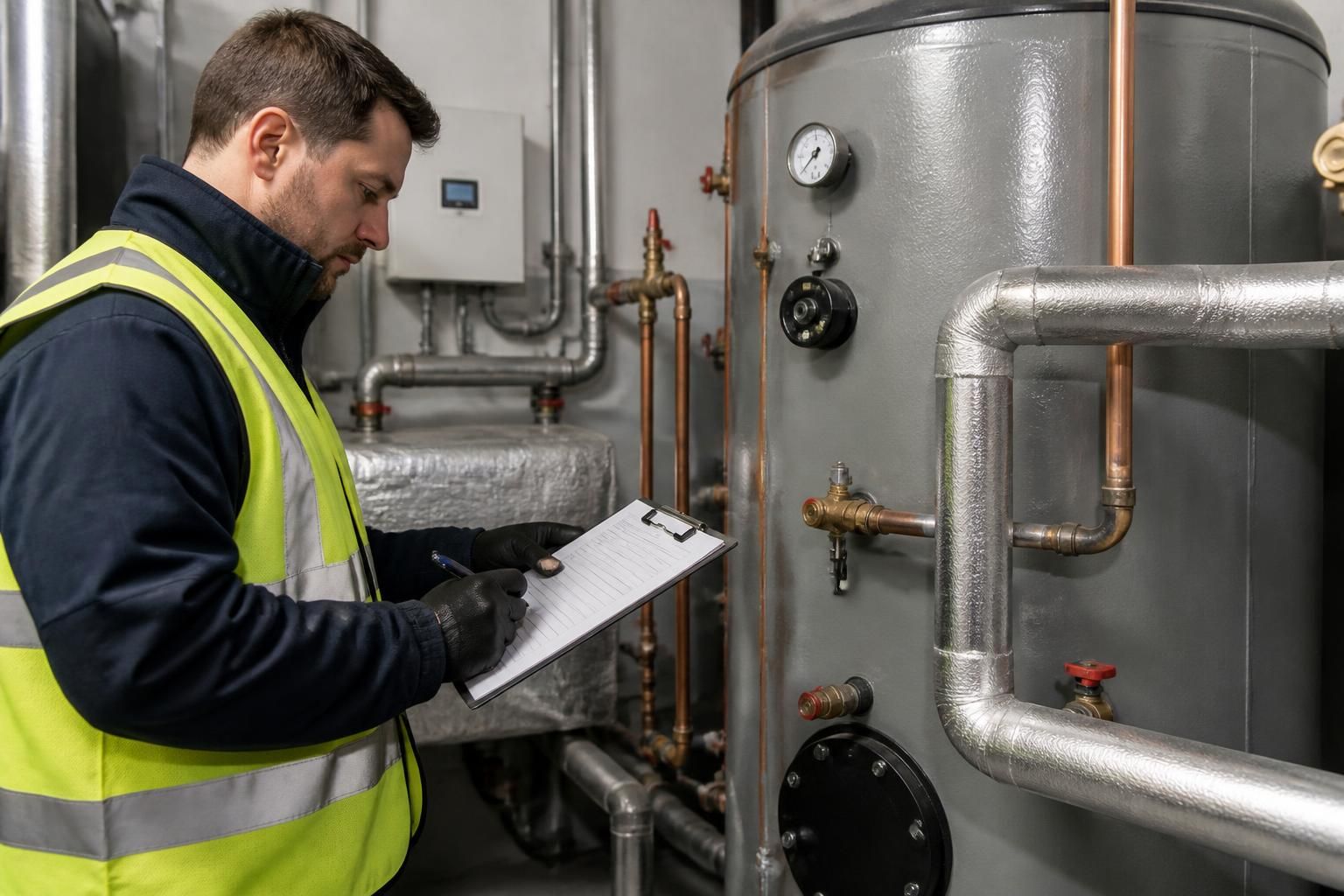
A useful hot water tank maintenance report is an auditable record that explains the scope of the review, the evidence collected, the significance of the findings and the decisions that follow. It should allow a responsible person, facilities team or auditor to understand what was assessed, identify any limitations in the evidence and track outstanding control measures without relying on informal notes.
Scope and reference information
- A client, site and internal reference should identify the report and link it to the relevant water system records.
- The report should state the reason for the visit, such as planned maintenance, investigation of a concern, verification of previous work or preparation for a compliance review.
- It should define the part of the hot water installation covered and distinguish any associated equipment that was outside the inspection scope.
- Where the system forms part of a wider domestic hot water or building water service, the report should explain how the tank relates to that arrangement.
Method and evidence
The report should explain how conclusions were reached. This may include visual examination, review of control settings, checks of accessible components, observation of system operation, review of monitoring records and comparison with the site's written control procedures. Readings should be presented with their location, the relevant outlet or component, the measuring point and any context needed to interpret them. If instruments were used, the record should identify them where this is relevant to the reliability of the result.
Photographs, marked-up system drawings, copies of relevant records or other supporting evidence can make the report more useful, particularly where a finding may need to be verified later. Images should be labelled clearly and linked to the relevant observation rather than included without explanation.
Limitations and exceptions
A professional report should be clear about anything that prevented a complete assessment. Examples include restricted access, insulation or guards that could not be removed, equipment that was isolated, missing records, inaccessible sampling points or parts of the installation that could not be observed safely. These limitations should explain the potential effect on the conclusions and identify whether a separate check is needed.
It is also useful to record information that could not be verified, rather than presenting assumptions as fact. This distinction helps the person responsible for the system decide whether additional evidence, access or specialist investigation is required.
Interpretation and priority
Findings should be explained in practical terms, not simply recorded as pass or fail. The report should indicate whether an observation is a routine maintenance matter, a developing issue, a water hygiene concern or a condition requiring prompt escalation. Where priorities are used, their meaning should be defined so that different people interpret them consistently.
Any recommendation should be specific enough to assign and monitor. It should identify the relevant component or control, explain why the measure is needed, state whether it is advisory or essential to the control arrangement and record any suggested review point. The report should avoid implying that a risk has been removed where a recommendation is still outstanding.
Connection with water safety records
For buildings managed under a legionella control scheme, the report should connect relevant observations with the site's risk assessment, written control scheme, monitoring log and previous maintenance history. This creates a continuous record rather than treating each visit as an isolated event. Changes to the tank, its controls or the way it is operated should be considered for inclusion in the wider system documentation.
The report should also make clear who is expected to review the findings and where the completed document is to be retained. A final sign-off or acknowledgement can confirm that the report has been received and considered, although it does not by itself demonstrate that recommended work has been completed. Subsequent evidence, such as a completion record or follow-up inspection, should be added when actions are closed.
In practice, the strongest report combines factual observations with a clear decision trail: what was examined, what could not be verified, how the evidence was interpreted and what must happen next. That format supports planned maintenance, defensible water safety management and more consistent follow-up across a portfolio of properties.

A hot water tank maintenance report should record the maintenance intervention in enough detail for another competent person to understand exactly what was done. Instead of stating only that the tank was serviced, it should identify the components inspected, cleaned, adjusted, repaired or replaced, together with any relevant setting changes and parts used.
Where work affected the system’s operation, the report should also note the resulting status, such as whether equipment was returned to service, left isolated or requires further attention. This creates a reliable maintenance history and helps prevent later uncertainty about which controls, components or defects have already been addressed.
Talk to us about your hot water tank maintenance report
If you need help reviewing or improving your hot water tank maintenance reporting, speak to Blue Fish Water Management Ltd about the evidence and follow-up records your organisation requires.