
What records should businesses retain after grease tank cleaning?

Businesses should retain grease tank cleaning records for the period required by applicable legislation, site procedures, insurance conditions and customer contracts. There is no single retention period that applies to every business or tank. Where a specific rule does not set a duration, the business should define a documented retention period based on the risks, the tank’s use, the site’s compliance obligations and the time needed to investigate disputes or recurring defects.
A complete maintenance file should contain more than evidence that a cleaning visit took place. It should also show how the business managed findings and any resulting work. Relevant supporting records may include:
- pre-service condition checks and notes about access, blockages, overflows or unusual deposits;
- defects, restrictions or recommendations identified during the work;
- internal instructions authorising follow-up work;
- quotations, work orders and completion evidence for remedial actions;
- records of repeat problems, complaints, spillages or operational incidents connected with the tank;
- changes to the site, drainage arrangements, production processes or tank usage that could affect cleaning requirements; and
- reviews confirming that outstanding actions have been closed or formally accepted by a responsible person.
Retention should be governed by a written document-control procedure. The procedure should identify who owns the records, where they are stored, how amendments are controlled and how long each category is kept. Digital copies should be readable, backed up and protected from unauthorised alteration. If paper documents are scanned, the business should check that the scan remains complete and legible before disposing of the original.
Records should be indexed so that a particular tank, location or service period can be traced without relying on an individual employee’s memory. This is especially important where a business has several premises, multiple tanks or a contractor that changes over time. A consistent naming convention and a register of completed and outstanding actions can make audits and incident investigations more efficient.
The retention period should also reflect the purpose of the record. Environmental compliance evidence may need to be available for inspection, while financial documents may follow separate accounting rules. Health and safety procedures, insurer requirements, lease terms and customer agreements can impose additional expectations. Businesses should therefore check the requirements that apply to their own operations rather than adopting an arbitrary period or deleting records as soon as an invoice has been paid.
When a record reaches the end of its approved retention period, its disposal should be authorised and logged. Records should not be destroyed if there is an unresolved complaint, enforcement enquiry, insurance matter, contractual dispute or suspected environmental incident. If a business is uncertain about the applicable period, it should seek advice from its environmental, legal or compliance adviser and record the decision it makes.
Good documentation links routine cleaning with ongoing site management. Reviewing previous findings before the next service can reveal recurring blockages, unsuitable operating practices or a need to change the cleaning schedule. The records should therefore be available to the person responsible for facilities, environmental compliance and contractor management, not kept solely within an accounts system.
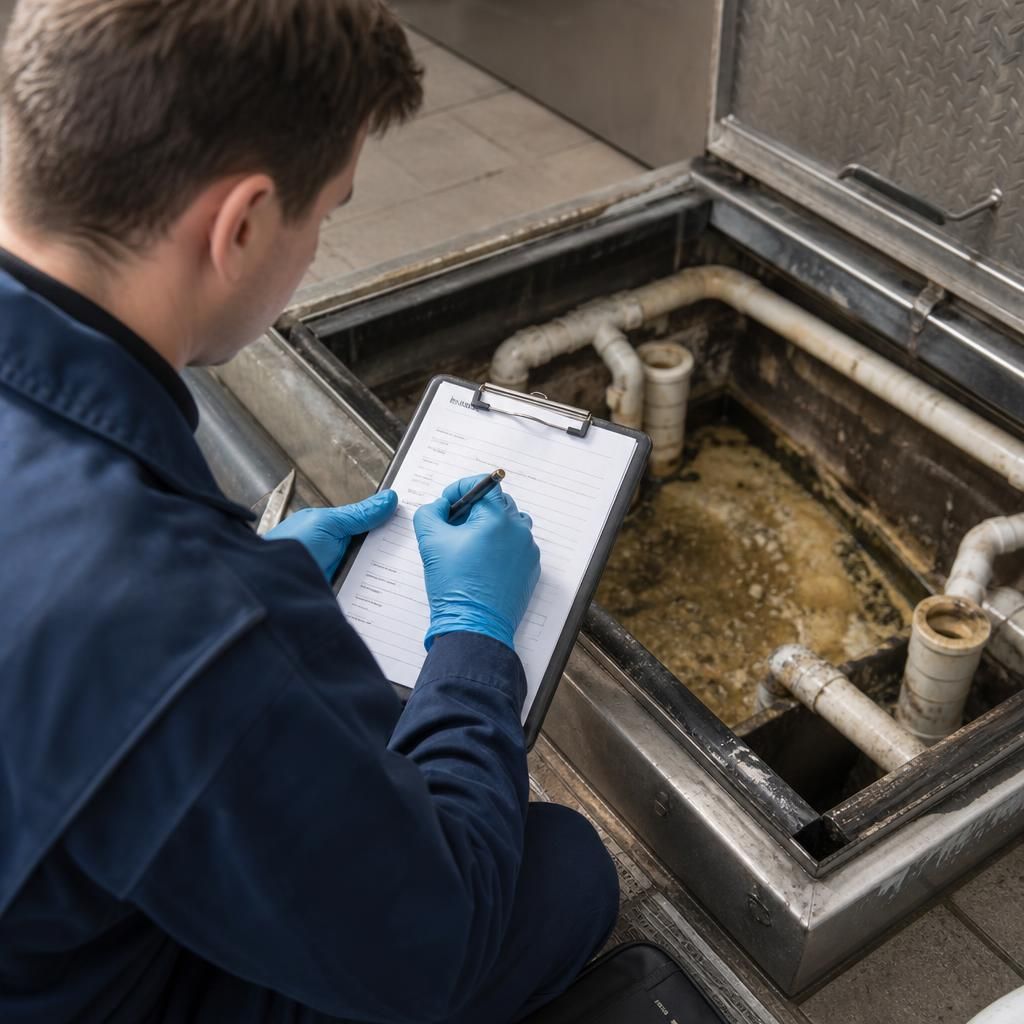
Waste documentation should be checked against the cleaning visit before it is filed. The waste transfer record should correspond with the correct site, tank, service date and contractor, with the waste description and collection details recorded clearly. Any consignment reference, receiving facility information or supporting paperwork supplied by the contractor should remain with the service report rather than being stored separately without a clear link.
This cross-check helps identify discrepancies, such as a waste record that relates to a different visit or does not account for the material removed. If information is missing or inconsistent, the responsible person should ask for clarification and retain the correspondence with the final record. Keeping the cleaning report and waste paperwork together provides a clearer account of what was removed and how the contractor documented its onward handling.
Discuss your grease tank cleaning record requirements
If you need to review how grease tank cleaning records are managed across your sites, discuss your documentation requirements with Blue Fish Water Management Ltd.