
What qualifications should a water tank disinfection contractor have?
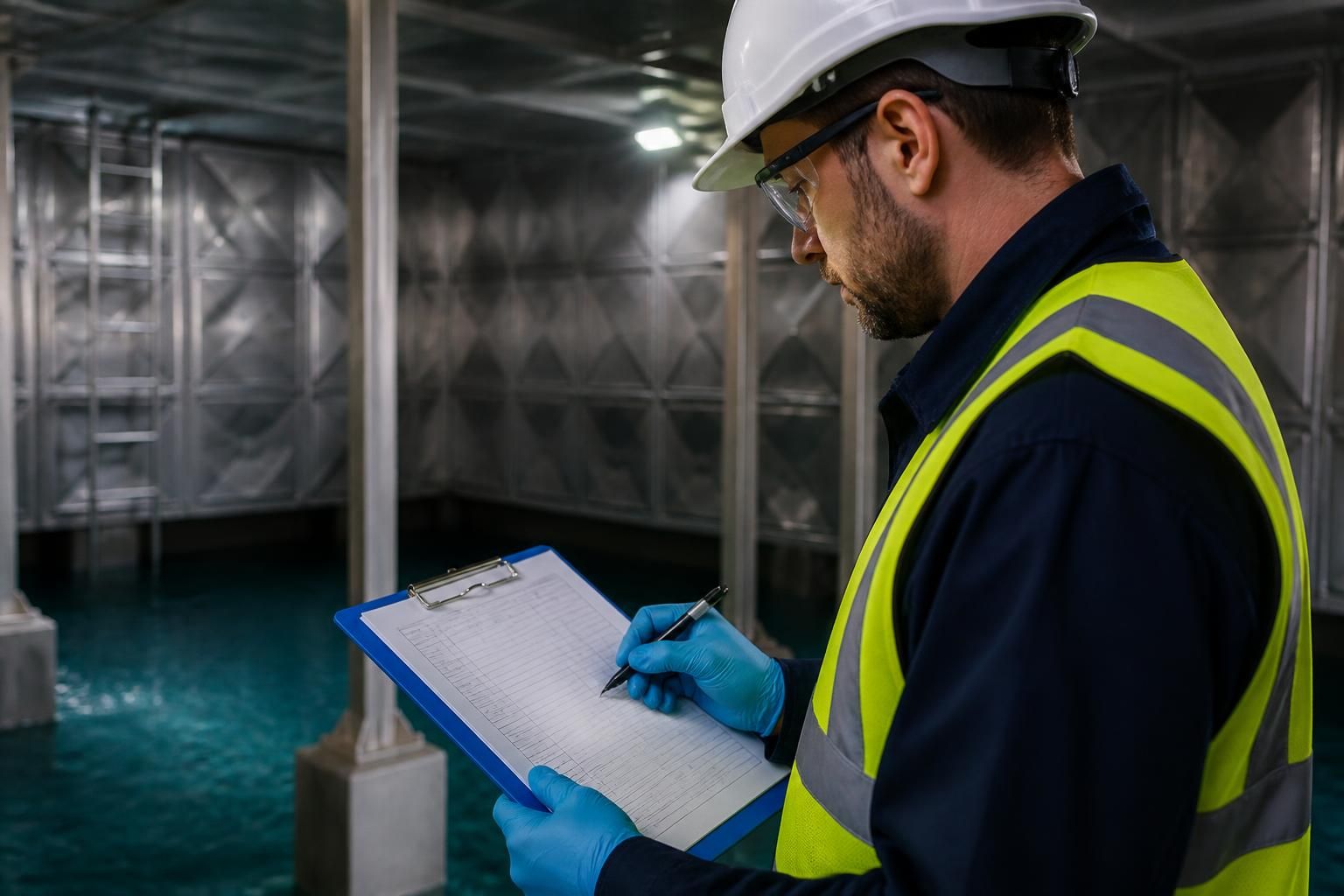
A competent water tank disinfection contractor should be able to evidence recognised water hygiene training, task-specific technical competence, effective supervision and a documented quality and safety system. There is no single universal licence that makes a contractor qualified for every type of tank or water system, so appointment decisions should be based on the contractor’s demonstrable ability to plan, carry out and verify the particular disinfection work required.
Ask for evidence that the people carrying out the work understand the relevant UK requirements and guidance, including the Health and Safety Executive’s Approved Code of Practice L8 and HSG274 where they apply. A suitable contractor should also understand the relationship between tank condition, stored-water temperature, stagnation, contamination risks, system design and the potential for Legionella growth. Their competence should extend beyond applying disinfectant: they need to know when a tank requires cleaning, repair, inspection or further investigation before it can be safely returned to service.
- Relevant training records: These should identify the individual, course subject, completion date and any refresher or continuing professional development undertaken.
- Task-specific competence: The contractor should be able to explain how their qualifications and experience relate to the tank type, access arrangements, connected pipework, pumps and intended water use.
- Supervision arrangements: Where less experienced operatives are involved, a suitably competent person should oversee planning, chemical preparation, monitoring, flushing and release of the system.
- Documented procedures: The business should have controlled procedures for isolation, dosing, contact time, neutralisation where required, flushing, sampling, reinstatement and dealing with an unsuccessful result.
- Safety competence: Evidence should cover risk assessment, personal protective equipment, emergency arrangements, storage and transport of chemicals, and the control of access to tanks and plant areas.
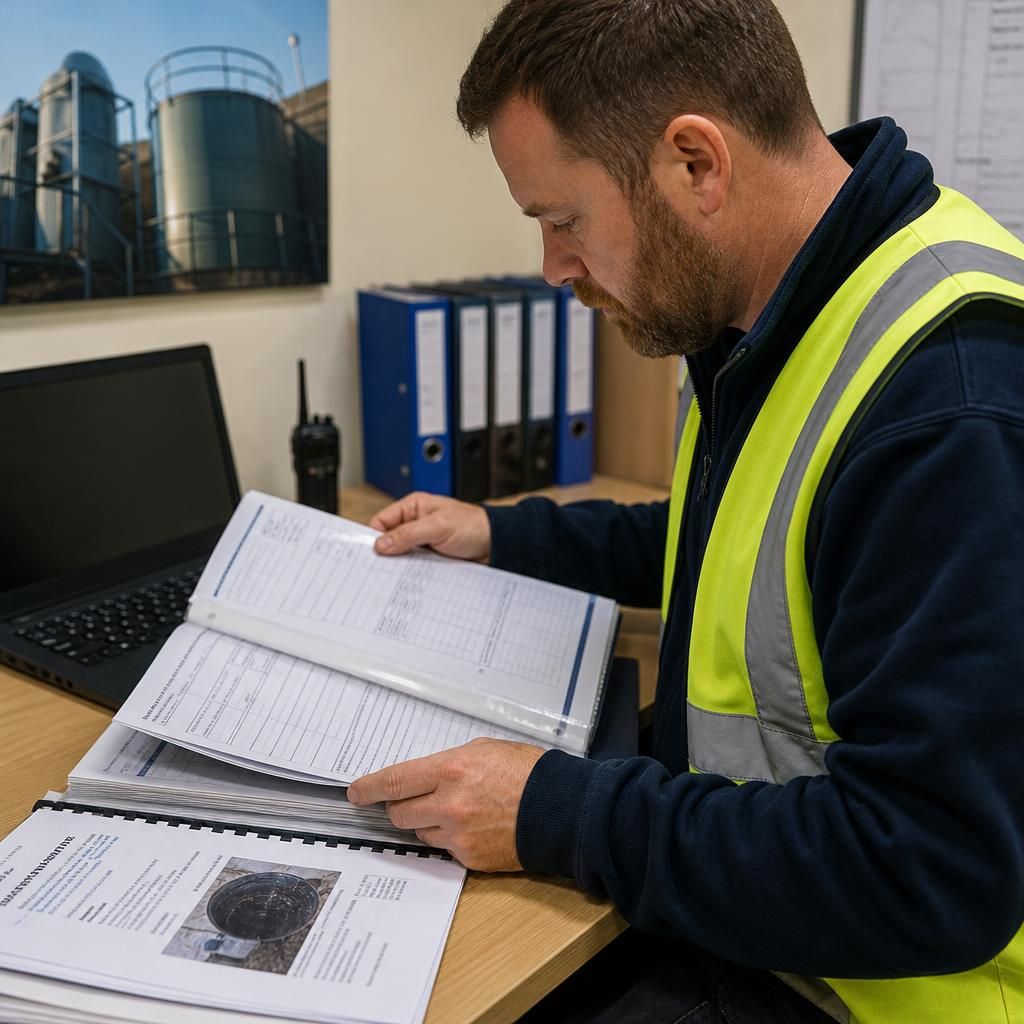
Qualifications should be supported by records rather than presented as unsupported claims. A responsible contractor can normally provide anonymised examples of completed disinfection documentation, operative training records, equipment checks and quality-control reviews. It is reasonable to ask whether the work is carried out by employees or subcontractors, and whether the same competence checks apply to everyone attending site.
Laboratory arrangements are another important distinction. The contractor may undertake field measurements and collect samples, but microbiological analysis should be performed by a suitably competent laboratory. Where UKAS-accredited testing is specified, confirm that the laboratory’s accreditation covers the relevant test methods and sample types. Accreditation of a laboratory does not, by itself, prove that the contractor is competent to disinfect a tank, while a contractor’s general industry membership does not replace evidence of laboratory competence.
The contractor should also understand the limits of disinfection. Chemical treatment is not a substitute for correcting defects such as damaged coatings, sediment accumulation, poor covers, inadequate turnover, dead legs or unsuitable materials. A qualified provider should record defects found during the work and explain which matters were resolved, which remain outstanding and what follow-up action is needed. This is particularly important where the tank forms part of a larger domestic, commercial, healthcare, industrial or high-risk water system.
Before appointment, request the following information in writing:
- The names or roles of the personnel responsible for the work and the evidence of their relevant training.
- The proposed method statement, including isolation, dosing controls, contact time, flushing and sampling arrangements.
- The risk assessment and control measures for occupants, workers, chemicals, discharge water and connected equipment.
- Details of the laboratory that will analyse samples and the applicable test methods.
- Examples of the completion records that will be supplied, such as dosing records, flushing results, photographs, test certificates and any defect report.
- Confirmation of appropriate public liability, employers’ liability and professional indemnity insurance where the scope of advice warrants it.
- The escalation process if post-disinfection results are unsatisfactory or the system cannot be safely returned to service.
Be cautious if a quotation relies only on a generic certificate, does not identify the people doing the work, omits post-treatment testing or treats every tank as though it has the same risks. A suitable qualification is relevant to the actual duties being performed, current enough to reflect accepted practice and supported by supervision and documented procedures. The strongest evidence is a coherent package of training, system-specific planning, safe execution, independent or appropriately controlled testing, and complete records that can be reviewed by the responsible person or duty holder.
For a business appointing a contractor, the final check is whether the proposed competence matches the consequences of failure. A small isolated tank and a storage tank supplying a complex occupied building may require different levels of planning, coordination and technical oversight. The responsible person should retain the qualification evidence, risk assessments, method statement, test results and completion records as part of the water safety file.
If access to the tank requires entry, the contractor must have suitable confined-space competence in addition to water hygiene training. This should cover entry assessment, permits, atmospheric monitoring, communication, personal protective equipment and a documented rescue plan. A tank should not be entered simply because disinfection is required; the contractor should first consider whether inspection, cleaning and dosing can be completed safely without entry.
Ask who is responsible for supervising any entry and how the arrangements apply to the particular tank, access point and surrounding plant. Evidence of confined-space training is relevant only when supported by suitable equipment, supervision and emergency procedures. If entry is unnecessary, the contractor should explain the safer alternative rather than treating tank access as a routine part of the work.
Need help assessing a water tank disinfection contractor?
Contact Blue Fish Water Management Ltd to discuss your tank disinfection requirements and the evidence you should request from a suitable contractor. Our team can help you identify an appropriate, documented approach for your water system.