
When should a window cleaning water tank be replaced rather than disinfected?
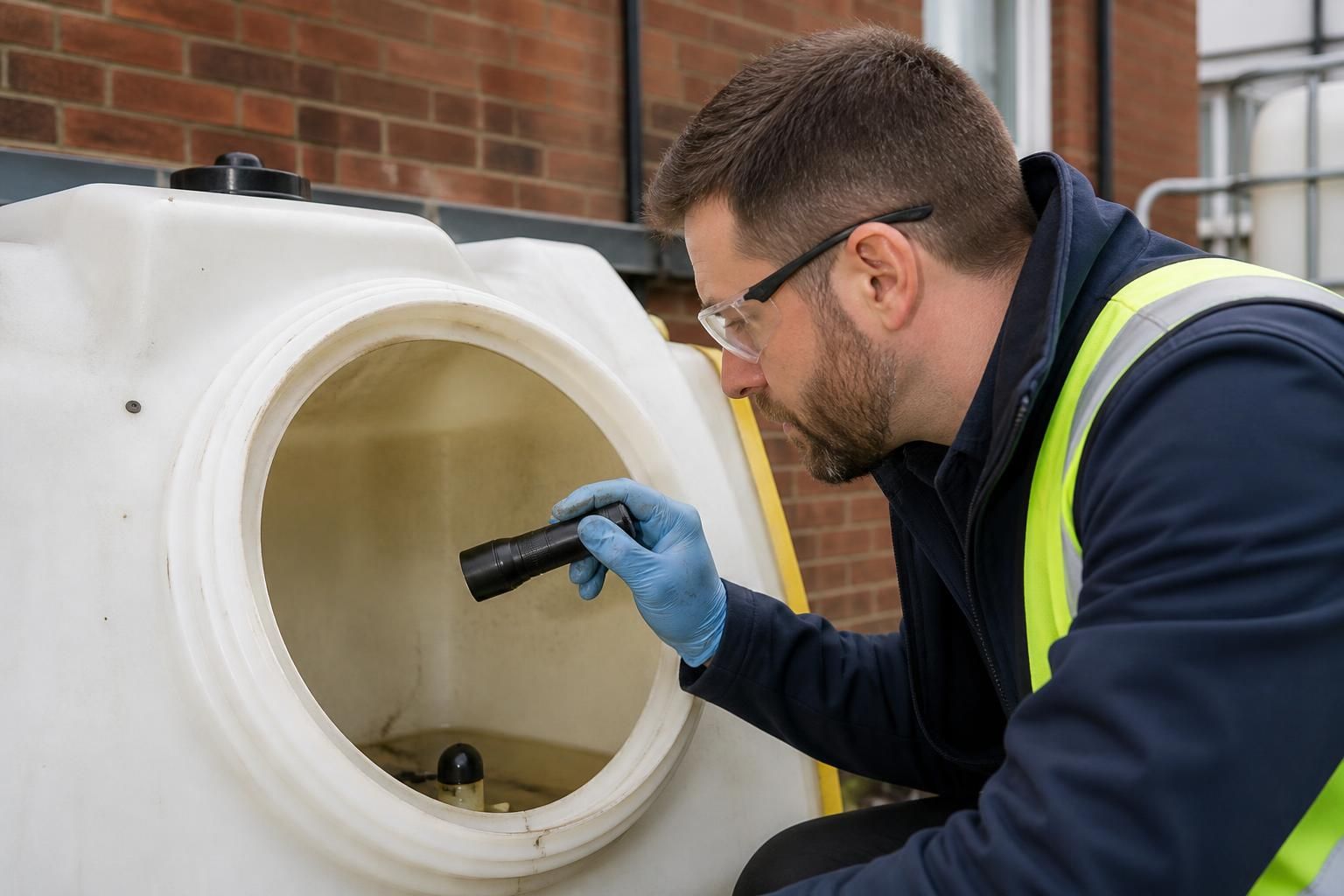
Replacement is appropriate when the tank’s condition, construction or configuration prevents dependable cleaning, disinfection and ongoing control. A positive test result or visible contamination does not, by itself, mean that a new tank is required; the decision should consider the tank’s physical integrity, cleanability, use, contamination history and the wider water system.
Disinfection treats contamination on accessible surfaces. It cannot reliably correct defects that allow contamination to remain protected or enter the stored water again. Replacement should therefore be considered where inspection identifies:
- Cracks, splits, leaks, distortion or failed joints that could compromise the tank or allow ingress.
- Internal pitting, crazing, flaking or degradation that leaves an uneven or porous surface.
- Severe staining, scale, sediment or established biofilm that cannot be removed by practical cleaning methods.
- A damaged or ill-fitting lid, defective inspection cover, faulty inlet protection or other route for dirt, insects or contaminated water to enter.
- Fittings, outlets or internal features that cannot be dismantled, reached or cleaned effectively.
- Material deterioration caused by age, ultraviolet exposure, chemicals, temperature or unsuitable cleaning practices.
The tank’s design may also justify replacement even where no obvious crack or leak is present. A configuration that leaves persistent sludge, inaccessible corners, poorly drained sections or areas of low flow can make effective hygiene control impractical. In a window cleaning system, the assessment should include the tank, pump, hoses, pipework and any treatment equipment, because contamination may be retained elsewhere and return to a replacement tank.
Repeated contamination is another important indicator. If a tank has been properly emptied, cleaned, disinfected and refilled, but contamination returns, the cause should be investigated before deciding on replacement. Possible causes include an unclean supply, dirty hoses or transfer equipment, inadequate protection from the environment, stagnant sections, unsuitable storage conditions or a tank surface that cannot be restored. Replacing the tank without correcting the underlying source will not provide reliable control.
Age alone is not a sufficient reason to replace a tank. A relatively old tank may remain suitable if it is sound, made from an appropriate material, protected from contamination and capable of being fully drained, inspected and cleaned. Conversely, a newer tank may need replacement if it has suffered chemical or physical damage, has an unsuitable design or cannot be maintained hygienically. The manufacturer’s care instructions and the tank’s maintenance history should form part of the decision.
A practical assessment should record the tank’s condition and construction, access arrangements, inlet and outlet configuration, drainage, evidence of sediment or biofilm, previous cleaning and disinfection, and any water quality results. It should also consider how the stored water is used and whether the system creates an exposure risk through spray, mist or contact with contaminated equipment. Testing can support the assessment, but a satisfactory sample is only evidence about the water at the time and place sampled; it does not prove that concealed surfaces or inaccessible parts of the tank are hygienically sound.
Where replacement is selected, the old tank should be isolated, drained and removed safely, with contaminated water and residues managed appropriately. The replacement should be suitable for its intended use, installed to prevent contamination, arranged for complete drainage and provided with secure access for future inspection. The tank and connected equipment should then be cleaned and disinfected before being returned to service, followed by any verification required by the site’s water hygiene arrangements.
Where disinfection remains technically suitable, it should be supported by a written record of the findings, cleaning method, disinfectant, contact conditions, flushing and any follow-up checks. If the tank cannot be restored to a condition that permits effective control, replacement is the more defensible option for maintaining water hygiene and demonstrating compliance. A competent water hygiene professional can document that decision through a risk assessment, inspection and, where appropriate, UKAS-accredited testing.
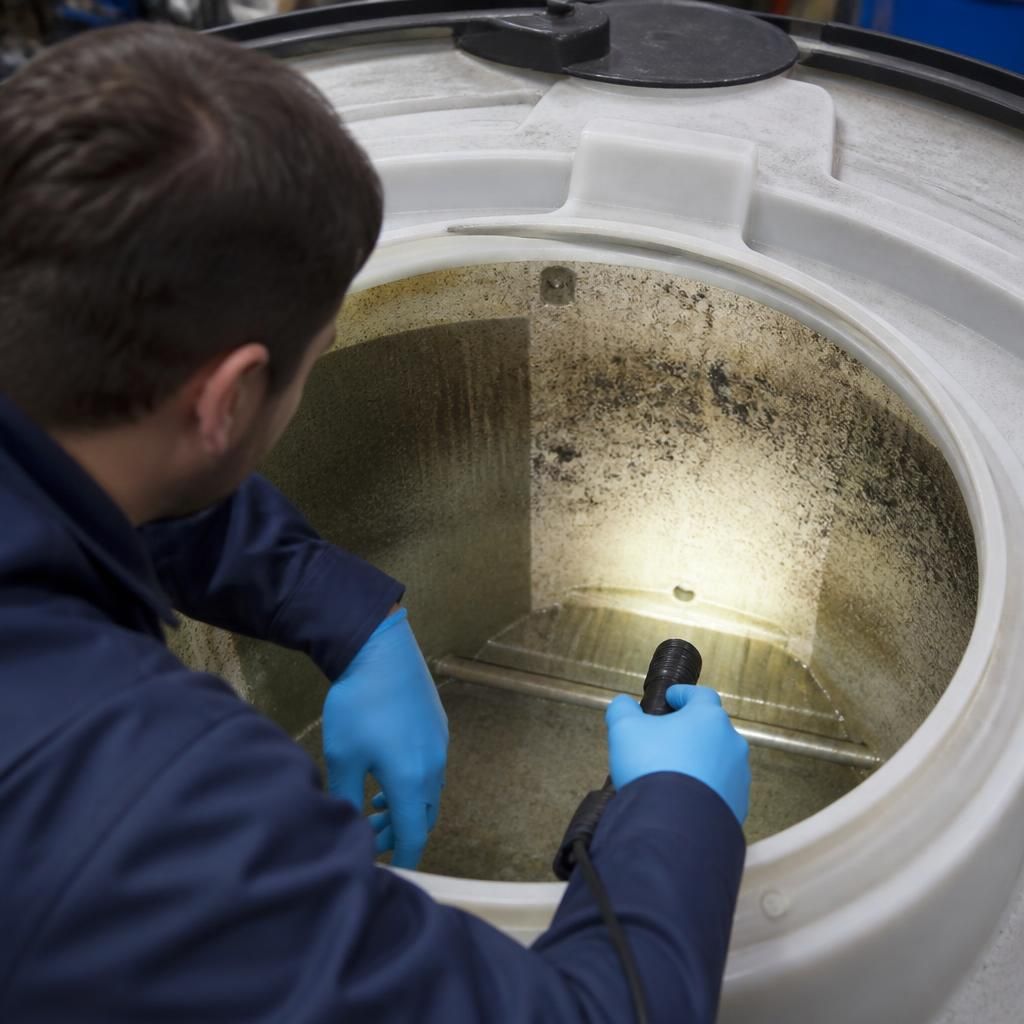
A tank should also be considered for replacement where the disinfection method needed to control contamination is not compatible with its material or condition. The tank manufacturer’s care instructions should be checked before treatment, including any restrictions on disinfectant strength, contact time and flushing requirements.
If the tank is already degraded, chemically sensitive or likely to release damaged material during treatment, disinfection may worsen its condition or leave the system difficult to control. In that situation, replacing it with a suitable, maintainable tank can provide a more reliable basis for ongoing water hygiene.
Request a Window Cleaning Water Tank Assessment
If you are unsure whether your window cleaning water tank can be restored safely, request a professional tank assessment to support a documented replacement or disinfection decision.