
What should a GRP water storage tank disinfection record include?
A GRP water storage tank disinfection record should identify the tank and system, record the date and reason for the work, and describe the cleaning and disinfection method used. It should also include personnel and equipment details, inspection findings, water sampling and test results, any corrective actions, and confirmation that the system was safe to recommission.
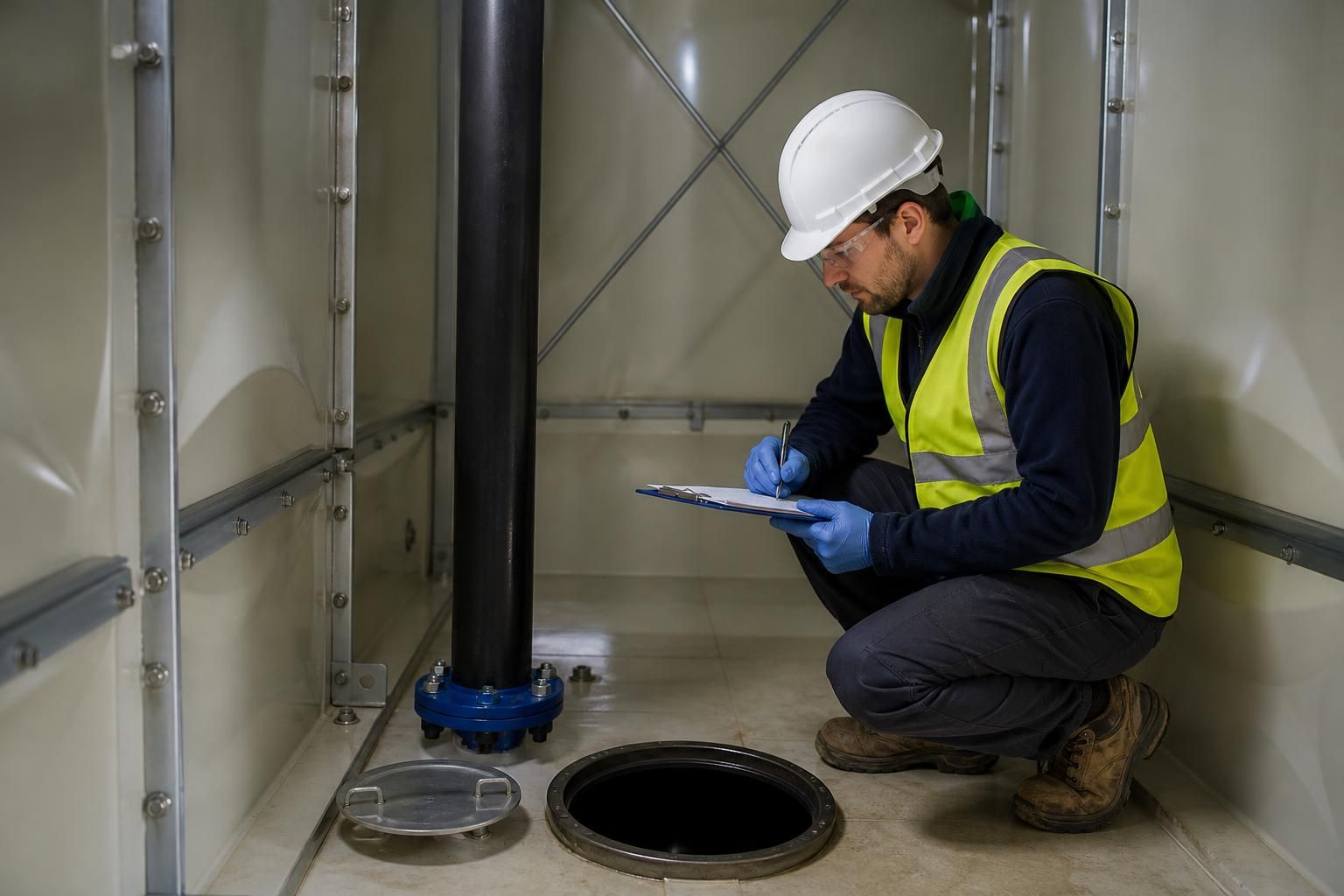
A complete GRP water storage tank disinfection record is an auditable account of the work, the conditions under which it was carried out, and the evidence used to decide whether the tank could return to service. It should allow a competent person, auditor or responsible person to understand exactly what was done, compare the outcome with the applicable control requirements, and identify any limitations or follow-up actions.
In addition to the core operational details, the record should cover the following areas:
- Scope and system boundaries: state whether the work covered the tank alone or included associated pipework, outlets, valves, pumps, fittings and distribution sections. If any part of the system was excluded, record the reason and explain how that exclusion affects the assessment.
- Tank condition and construction: note relevant features of the GRP tank, including panel condition, internal surfaces, joints, seals, access arrangements, overflow and warning-pipe arrangements, inlet and outlet connections, and any visible defects that could affect hygiene or cleaning.
- Isolation and safety controls: document how the tank was taken out of service, how water supplies were protected, and what precautions controlled exposure to disinfectant, contaminated water and confined or restricted access areas. Where applicable, the record should show that discharge arrangements prevented harm to people, equipment and the environment.
- Disinfectant control: record the product or chemical used, its concentration or target residual, the means of application, and how the required contact conditions were maintained. The relevant measurements should be linked to times and locations rather than presented as an unexplained single figure.
- Flushing and neutralisation: explain how disinfectant was removed or reduced after treatment, where discharge took place, and how the system was protected from recontamination during filling and return to use.
- Sampling traceability: each sample should have a clear reference, collection point, collection date and time, and the name or role of the sampler. The record should also state whether samples were taken before or after flushing, and whether they represent the tank, the incoming supply or downstream outlets.
- Laboratory information: where samples are sent for analysis, retain the laboratory report and record the laboratory identity, report reference, analytical scope and any qualifications attached to the result. The record should distinguish between field measurements and laboratory findings.
- Acceptance decision: explain how the evidence was assessed against the applicable procedure, risk assessment, specification or technical guidance. A result should not simply be labelled satisfactory without stating what decision it supports and whether any restrictions remain.
- Defects and outstanding work: record leaks, damaged coatings, deteriorated seals, inaccessible areas, persistent debris, poor drainage or other issues found during the work. Each item should have an owner, recommended action and review status where further work is needed.
- Reinstatement controls: document the checks made before the tank was put back into operation, including the condition of covers and access points, correct reconnection, protection against unauthorised entry, and any operational restrictions or monitoring requirements.
- Authorisation and accountability: include the names and roles of the person who carried out the work, the person who reviewed the record, and the person who authorised the return to service. Signatures or secure electronic approvals should be dated and linked to the final version of the record.
The record should also preserve supporting evidence rather than relying on a brief completion certificate. Useful attachments may include the method statement, risk assessment, chemical safety information, photographs, instrument checks, laboratory reports, sample plans, flushing logs and marked-up system drawings. Photographs are particularly useful for recording the condition of GRP panels, seals, internal fittings and access covers, provided that each image can be linked to a location and date.
Any instrument used to measure disinfectant concentration or related parameters should be traceable to its calibration or verification status. The record does not need to reproduce every technical certificate, but it should identify the instrument and retain the relevant supporting evidence. This helps distinguish a documented measurement from an unsupported assertion.
Records should be controlled as part of the site's water hygiene documentation. Use a unique document reference, revision status and issue date, and retain the final signed record with the tank's asset history and water safety risk assessment. If the work changes the system, reveals a new risk or leaves remedial work outstanding, the associated management documents should be updated rather than allowing the disinfection record to stand alone.
A useful final review asks whether another competent person could reconstruct the work without relying on verbal explanations. If the record shows the scope, controls, measurements, evidence, deviations, decision and authorisation in a traceable sequence, it provides meaningful compliance evidence. If it only states that the tank was cleaned and disinfected, it is unlikely to demonstrate adequately how water safety was controlled.
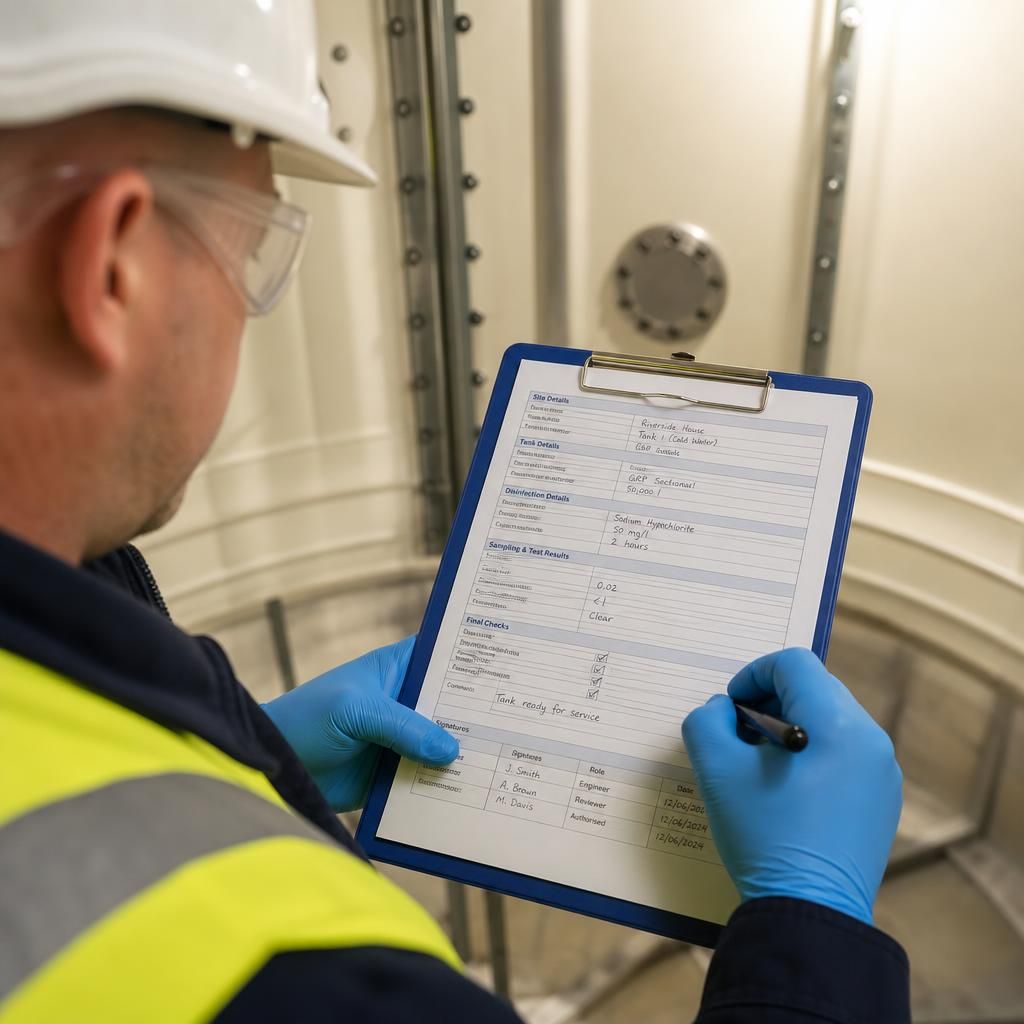
A disinfection record should preserve the integrity of the information it contains. If a reading, date or observation is corrected, the original entry should remain identifiable, with the amendment dated, attributable to a named person and accompanied by a brief reason. Entries should not be deleted or overwritten in a way that obscures what was first recorded.
This is particularly important where results or site conditions lead to a change in the planned work. A clear amendment trail shows whether the final decision was based on information available at the time and helps prevent later uncertainty about who approved a change.
Need help reviewing your GRP water storage tank disinfection record?
If your GRP water storage tank disinfection record needs checking against the wider water safety requirements, speak to Blue Fish Water Management about a water hygiene compliance audit. Their team can help identify missing evidence, unresolved actions and documentation that may need updating.