
What does GRP water storage tank disinfection involve?
GRP water storage tank disinfection involves isolating the tank, draining and cleaning it, applying an appropriate disinfectant, then flushing and testing the system before recommissioning. The method should follow the risk assessment, tank condition and water system requirements, with records retained to demonstrate that the work was completed correctly.
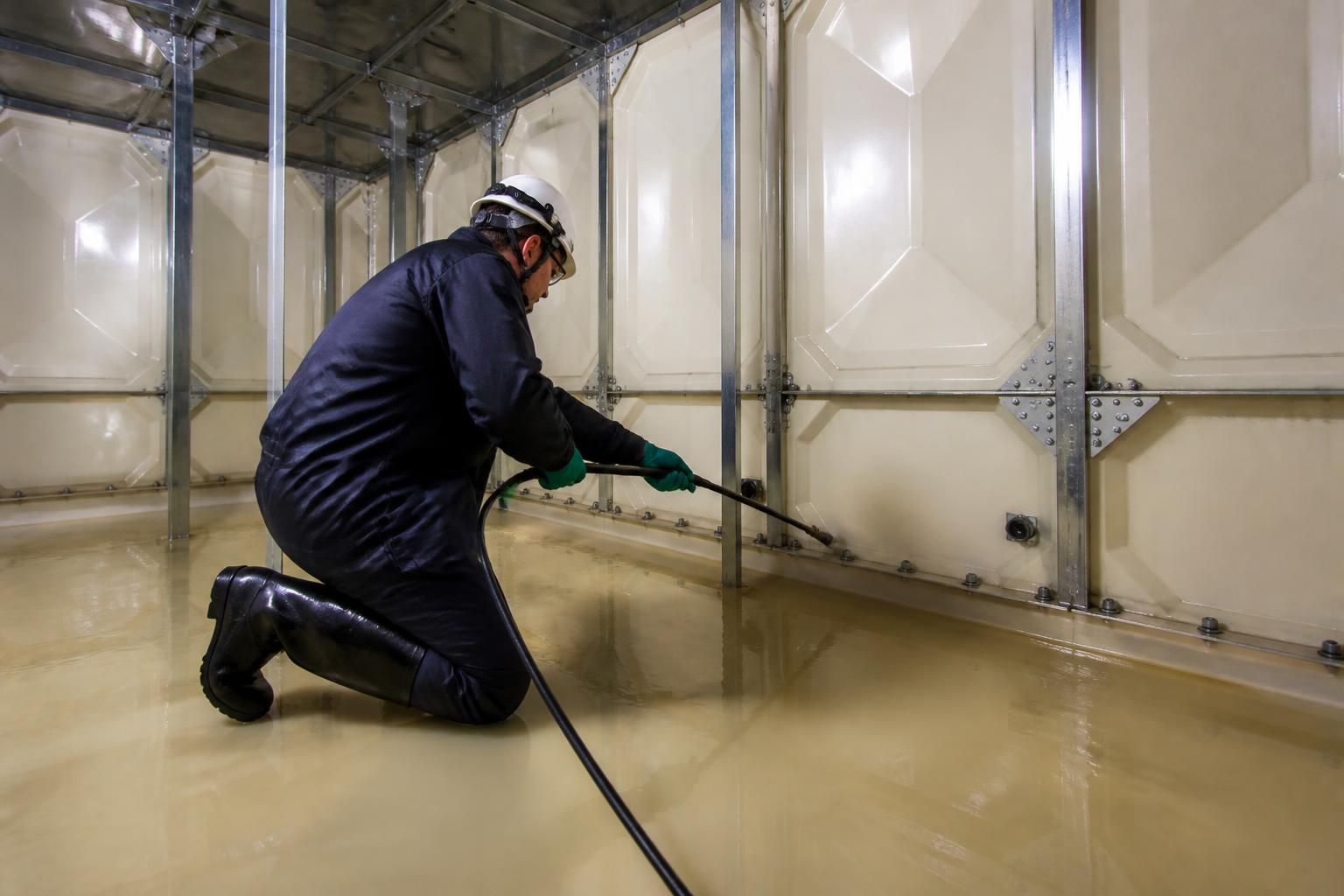
GRP water storage tank disinfection is a controlled process that combines isolation, physical cleaning, chemical treatment, flushing and verification. The precise method depends on the tank’s condition, the connected water system, the source of contamination and the findings of the site-specific risk assessment.
1. Planning and preparation
Before work starts, the responsible person should establish which tank, pipework and outlets are affected and how the water supply will be maintained safely during the intervention. The tank should be isolated from the system so that disinfectant cannot enter occupied areas or contaminate an untreated supply. Any alternative supply arrangements, access requirements and operational restrictions should be agreed in advance.
The disinfection plan should identify the treatment method, the disinfectant to be used, the required contact conditions, flushing arrangements, sampling points and the criteria for returning the system to service. The chemical’s safety data and control measures should also be reviewed under the Control of Substances Hazardous to Health Regulations (COSHH).
2. Emptying and internal inspection
The tank is drained in a controlled manner, taking account of the disposal route and any site-specific environmental requirements. Once accessible, the internal surfaces, cover, fittings, inlet and outlet arrangements are inspected. Particular attention is given to sediment, scale, slime, corrosion, damaged coatings, ineffective lids, gaps around access points and evidence of animal or environmental ingress.
This inspection is important because disinfection alone may not remove deposits or resolve defects that allow contamination to recur. If the tank, insulation, fittings or associated pipework are damaged, remedial work may be needed before treatment can be considered effective.
3. Physical cleaning
Accumulated sediment and loose debris are removed before chemical treatment. Surfaces are cleaned using methods and equipment that are suitable for GRP and do not damage the laminate, sealants, internal coating or associated components. Cleaning may include controlled brushing, vacuuming or low-pressure washing, depending on the tank design and condition.
Removed material should not be allowed to enter connected pipework. Cleaning residues are collected and disposed of appropriately, and the tank is rinsed where necessary. The objective is to expose the surfaces to be disinfected rather than simply dilute contamination within the tank.
4. Applying the disinfectant
An appropriate disinfectant is introduced in accordance with the written method statement, product instructions and risk assessment. Treatment must reach every relevant wetted surface, including the tank floor, walls, underside of the cover, internal fittings, outlet arrangement and connected sections of pipework where these form part of the disinfection exercise.
The disinfectant must remain in contact with the target surfaces for the specified period and under the required conditions. Concentration and other relevant parameters are checked using suitable test equipment rather than assumed from the amount added. The operative should record the readings, time of application and any adjustments made during the treatment.
Care is needed around valves, flexible connections, level controls and materials that may be affected by the chosen chemical. Disinfectants must never be mixed with incompatible substances, and the tank should remain isolated while treatment is taking place. Appropriate personal protective equipment, ventilation and emergency arrangements are part of the control measures.
5. Treating associated pipework and outlets
A tank cannot be assessed in isolation where contaminated water has entered the distribution system. Depending on the risk assessment, outlets and connected pipework may need to be included so that treated water reaches the relevant parts of the system. Dead legs, low-use branches, hoses, strainers and point-of-use components may require particular attention because they can retain stagnant water or disinfectant residues.
Where components cannot safely tolerate the treatment method, they may need to be removed, replaced, bypassed or treated separately. This decision should be documented, as incomplete coverage can undermine the disinfection of the wider system.
6. Draining, flushing and restoring the system
After the required contact period, the disinfectant is drained and the tank and pipework are thoroughly flushed with wholesome water. Flushing continues until residual disinfectant is reduced to an acceptable level and the water is suitable for its intended use. The discharge route must be managed so that treated water does not create a hazard to people, equipment, drainage systems or the environment.
Flushing should include the relevant outlets and branches, not just the tank itself. Valves and outlets are operated in a planned sequence to clear retained solution from the system. Filters, strainers and other components may need inspection or replacement if they have collected loosened debris.
7. Testing and verification
Recommissioning should follow evidence that the treatment and flushing stages have been completed satisfactorily. Depending on the circumstances, this can include checks of disinfectant residual, visual condition, operational performance and microbiological samples taken from appropriate locations. Samples should be collected using a defined plan and submitted to a competent laboratory where laboratory analysis is required.
Water should not be returned to normal use solely because the tank looks clean. The results must be considered alongside the treatment records, the original reason for disinfection and any relevant remedial work. If results or observations indicate continuing contamination, the system should remain under control while the cause is investigated and further action is agreed.
8. Documentation and follow-up
A complete record normally identifies the tank and system, the reason for the work, inspection findings, cleaning method, disinfectant and application details, contact period, test readings, flushing arrangements, sample information, remedial actions and the person responsible for approving recommissioning. Supporting photographs, laboratory reports and waste records may also be retained where relevant.
Disinfection is one part of ongoing water hygiene management. Following treatment, the tank should be returned to the monitoring schedule set by the risk assessment. That may include routine inspections, checking covers and fittings, reviewing water turnover and investigating any recurring sediment, stagnation or contamination. Persistent problems can indicate that the tank design, operation or maintenance regime needs wider review.
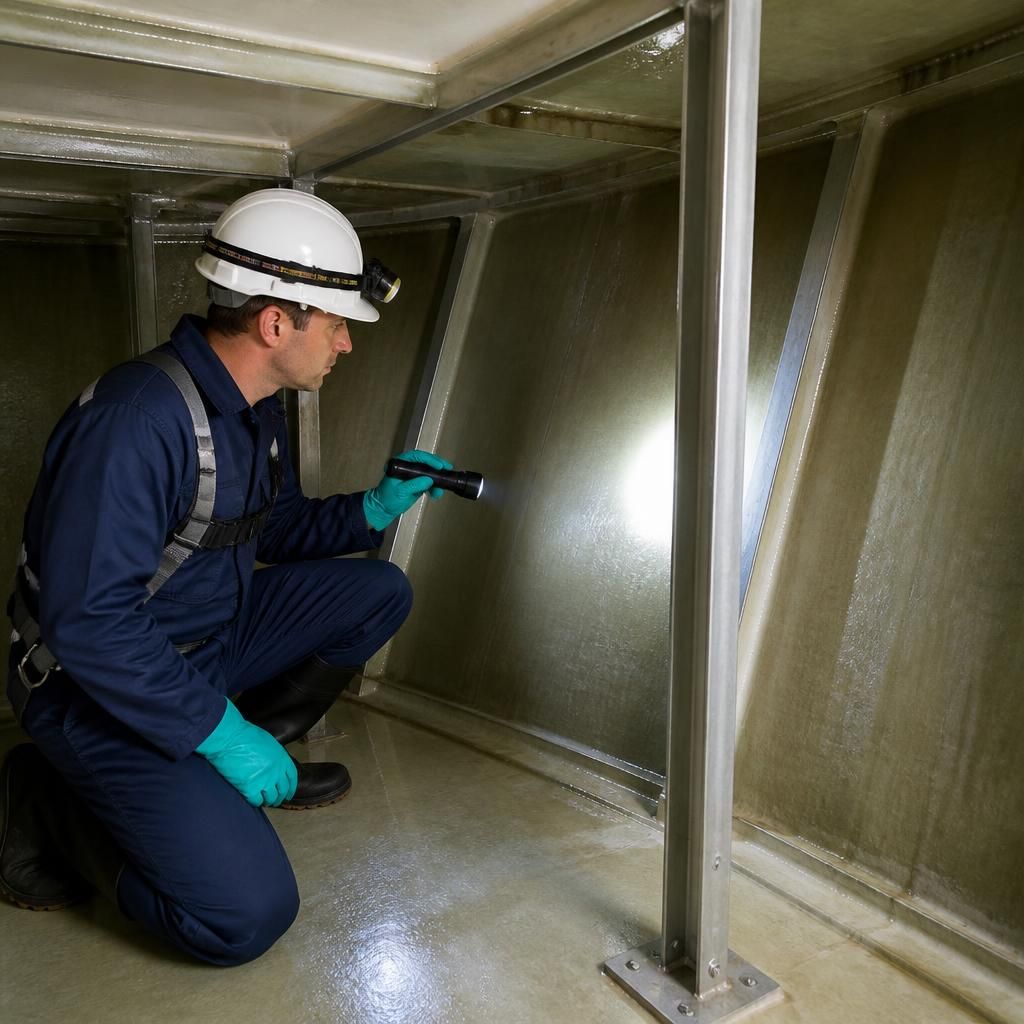
GRP water storage tank disinfection must account for the tank’s laminate, resin and any internal lining. The fact that a chemical is effective against microorganisms does not automatically mean it is suitable for every GRP construction. The proposed disinfectant, concentration, temperature and contact period should therefore be checked against the tank specification and the condition of its surfaces before treatment begins.
Where the laminate or lining shows blistering, exposed fibres, cracking or other deterioration, chemical treatment may worsen the defect or fail to provide reliable coverage. In such cases, the condition should be assessed and any necessary repair or replacement agreed before the tank is disinfected and returned to service.
Need Advice on GRP Water Storage Tank Disinfection?
If you need to confirm the appropriate disinfection approach for a GRP water storage tank, contact Blue Fish Water Management Ltd to discuss the tank specification, system arrangement and evidence required before recommissioning.